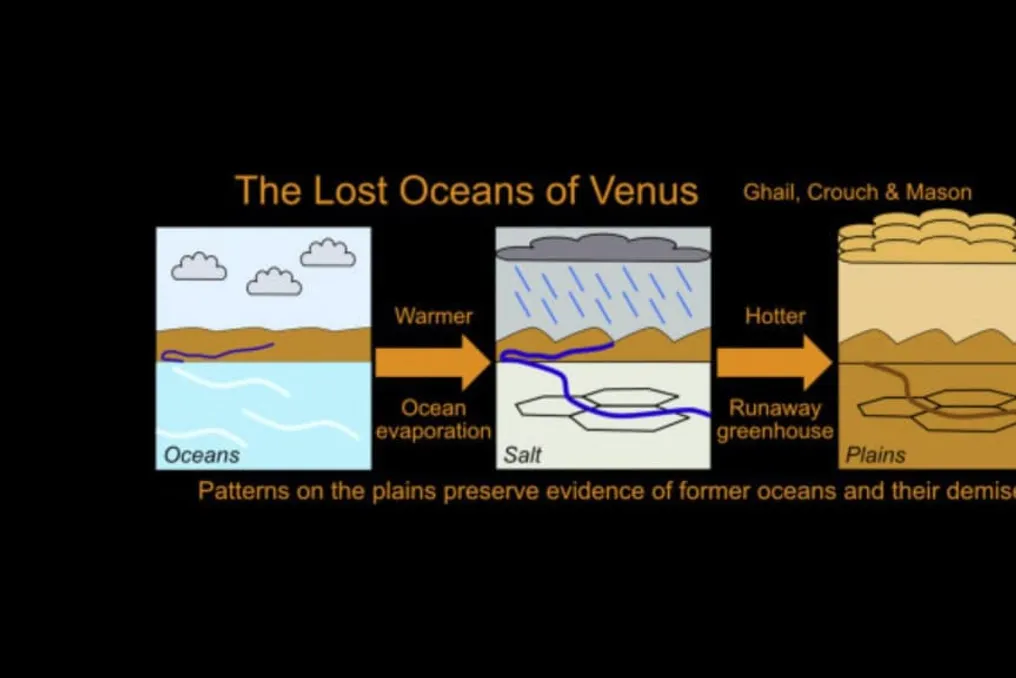
A study published in the scientific journal Earth and Planetary Science Letters, conducted by researchers from the University of London, suggests that Venus might have harbored vast oceans during a recent geological period.
Analysis of data obtained by radar revealed on the Venusian surface structures resembling marine formations found on Earth. Scientists calculate that, before completely evaporating, liquid water covered approximately 90% of the planet's surface.
The total amount of water estimated on Venus would be equivalent to about 40% of the volume of Earth's oceans, presenting an average depth of 1.4 kilometers. According to the research, these seas could have existed less than a billion years ago, at a time when an uncontrolled greenhouse effect modified the planet's climate, contradicting the traditional view of Venus as an exclusively dry and volcanic world.
To support this conclusion, the team investigated three distinct categories of geological formations on Venus. The first category comprises extensive networks of polygonal terrains located in the flat and low areas of the planet. While previous theories attributed these fissures to the cooling of volcanic rocks, current models point to similarities with cracks generated by the dehydration of marine clays on the Earth's ocean floor.
The second evidence lies in channels called 'canali,' which extend for thousands of kilometers across the Venusian surface. Conventional theory suggested that these grooves were created by low-viscosity lava. However, the physical characteristics of these paths indicate that they developed as underwater channels, shaped by strong water currents beneath the oceanic layers.
The third indicator is the presence of undulating ridges scattered in the planet's lowest regions. Researchers determined that these ground folds are the result of crust deformation over a salt layer with a minimum thickness of 64 meters. This phenomenon is comparable to the Messinian Salinity Crisis, a historical event where the Mediterranean Sea dried up on Earth, leaving large salt deposits.
Despite the accumulated evidence, the study's authors emphasize that the findings do not yet constitute conclusive proof. Alternative tectonic and volcanic processes have not been entirely ruled out as possible explanations for each formation individually. The hypothesis of a marine origin gains greater support only when all geological traces are examined together.
Confirmation of Venus's watery past will depend on future space exploration. The EnVision mission, belonging to the European Space Agency (ESA), and Veritas, from NASA, are scheduled for launch in the next decade. Both probes will employ high-resolution radars designed to map the Venusian subsurface and surface with an unprecedented level of detail.