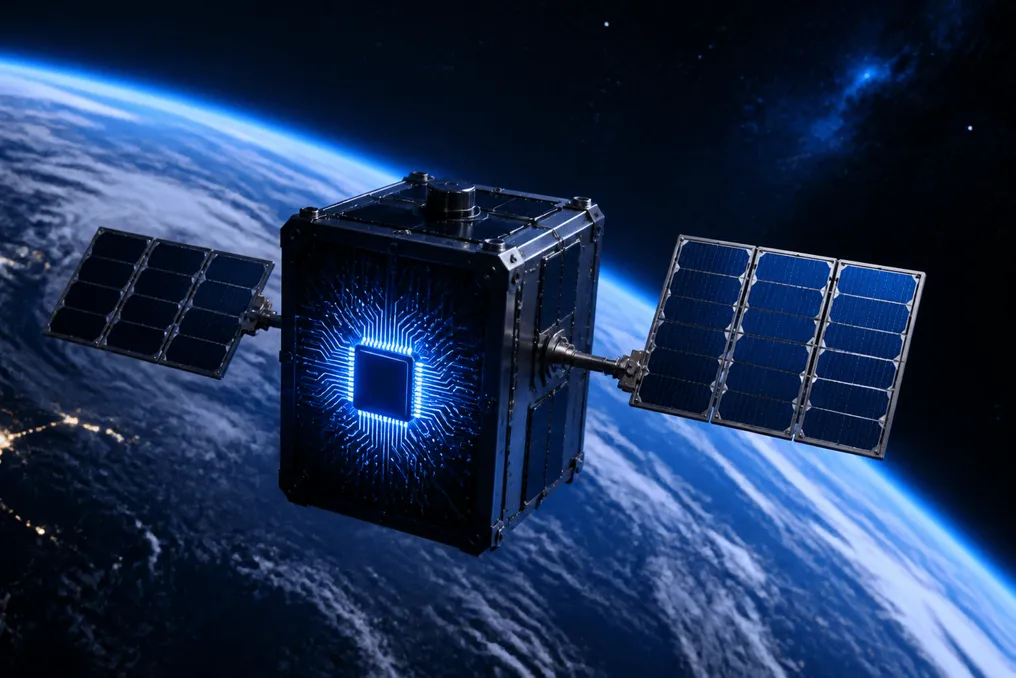
China added a new category of satellites to its orbital fleet at the end of July. Using the Dongfeng rocket, Chenguang-1 was launched from a commercial zone for innovative space tests, carrying an eight-card computing server designed to perform AI inference in orbit. This mission is the country's latest demonstration in space computing, as it transforms satellites from simple cameras into autonomous agents capable of filtering, recognizing, and making decisions before data is transmitted to Earth.
Luo Yaoci, Chairman and CEO of Zhongke Tiansuan, explained this transformation in simple terms. Traditional satellites capture raw images and transmit them to ground stations for processing. Less than five percent of the collected data reaches the ground, and processing useful information can take days. Satellites equipped with their own computing power can extract valuable insights from the images they capture and send only those insights, significantly reducing bandwidth costs.
The economic significance of this trend extends beyond remote sensing. If a global layer of orbital computing becomes a full infrastructure, it will also provide access to computing resources for regions lacking fiber-optic lines and data centers. Zhongke Tiansuan is preparing a fully domestic POPS-class onboard computer, scheduled for delivery by the end of 2026, and has completed the development of an eight-card space server prototype for training based on domestic CPU and GPU architectures. The company's long-term goal is to create a 10,000-card space supercomputer, which they have named the Tiansuan Plan.
China's system involves many participants besides one company. The National Supercomputing Center in Tianjin presented the Tianhe Joint Space Superintelligence Integration Center to the public at the World Intelligence Industry Exhibition in May 2026. GoSharpened Aerospace, specializing in AI satellite internet, supplies its orbital computing group, StarCompute Plan, consisting of 2800 satellites. The Institute of Computing Technology of the Chinese Academy of Sciences has developed a high-performance heat-dissipating computing module sourced domestically, as well as a radiation-hardened RISC-V multi-core processor. Universities in Shenzhen and Shanghai have already incorporated courses on space computing, and the Hangzhou Institute of Advanced Studies at UCAS has opened a specialized research center for space computing.
China is not alone in these developments. SpaceX has launched test Starlink satellites equipped with AI chips, Google has outlined plans for creating space data centers, and other American players are working on their own orbital computing modules. However, a distinguishing feature of China's position is the breadth of the parallel infrastructure assembled and the speed at which engineering experiments are transformed into the named orbital infrastructure.