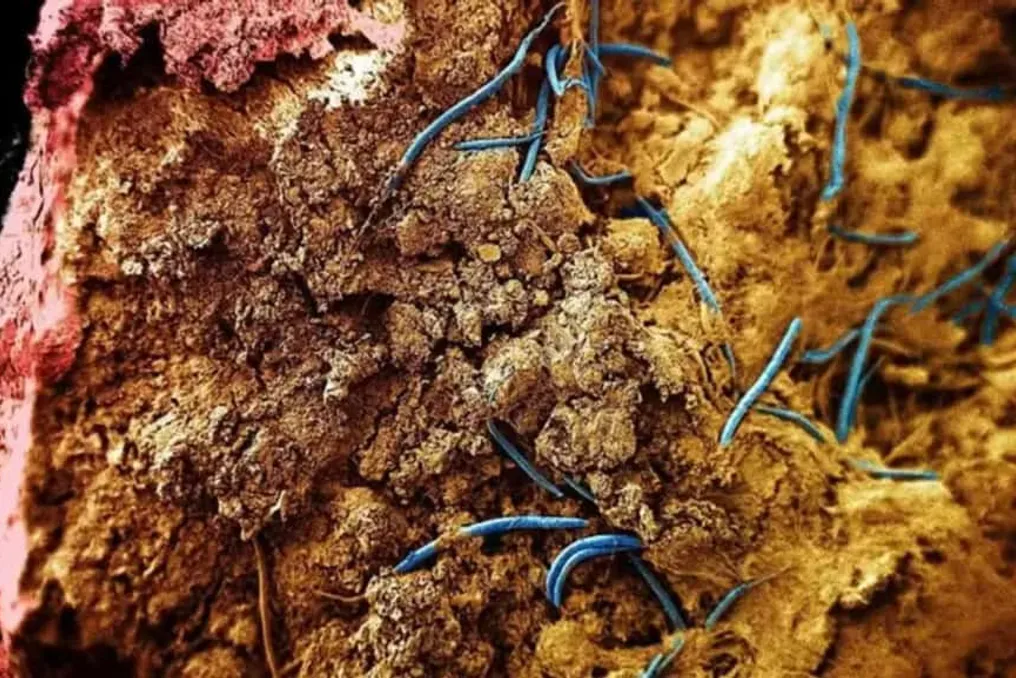
A small worm, identified as Halicephalobus mephisto, found in a gold mine in South Africa, has changed the scientific perception of the limits of life on the planet. This animal was cataloged in 2011 as the first known nematode to reside in such deep regions of the Earth's crust.
The discovery began in 2008 when researchers analyzed thousands of liters of groundwater extracted from rocks located approximately 1.3 km below the surface. This investigation demonstrated that complex ecosystems can thrive in environments characterized by being dark, hot, and with little interaction with the surface.
The analysis of this 'devil worm' indicated that certain forms of life are capable of surviving without directly depending on sunlight or an oxygen-rich atmosphere. These results brought new perspectives on the adaptability of living beings and on the environmental conditions that support the existence of life.
For many decades, the predominant belief among biologists was that animal life would have difficulty at great depths; until the 1980s, the majority hypothesis suggested that just a few centimeters below the ground constituted a limit for more complex organisms.
This panorama began to change in the 1990s with the emergence of evidence of microorganisms living kilometers below the surface. From the 2000s onward, biologist Gaetan Borgonie, a specialist in nematodes, began studies to verify if worms could also occupy these extreme niches.
This search led Borgonie and other specialists to the Beatrix mine in South Africa. There, water flowing through fissures in the underground rocks was examined. The team used filters to capture microscopic organisms and, after analyzing over 6,000 liters of water, located a novel worm for science.
The research was expanded to other mines in the country. In one of these explorations, scientists filtered over 12 million liters of water, finding various species of nematodes, as well as fungi, invertebrates, and other microorganisms.
The specimen named Halicephalobus mephisto possessed a crucial characteristic for its scientific study: it was a female capable of producing offspring without resorting to sexual reproduction. Before dying, the animal produced eight viable eggs, which allowed researchers to continue experiments in the laboratory.
The descendants were sent for analysis conducted by geneticist John Bracht of the American University in Washington, United States. Under controlled conditions, it was observed that the worm exhibited preferences distinct from those of other known nematodes. While species like Caenorhabditis elegans depend on decaying organic matter and can be studied at lower temperatures, the devil worm shows better performance near 37°C, a temperature similar to its subterranean habitat.
The species also has a unique mode of locomotion. Instead of swimming, it uses body structures to attach itself to surfaces, a characteristic that may aid its persistence in restricted spaces between rocks.
DNA analysis of Halicephalobus mephisto provided clues about its survival mechanisms. In 2019, the team led by John Bracht identified a high concentration of genes linked to the production of heat shock proteins. These molecules act by protecting other proteins in the organism against damage caused by high temperatures, signaling a specific adaptation to life in hot, subterranean environments.
Subsequent research, conducted in 2024, focused on cytochrome c oxidase, a molecule involved in using oxygen for energy production. Tests showed that this structure operates more efficiently at elevated temperatures and decreases its activity in colder climates.
According to John Bracht, a genomic researcher at the American University, this characteristic can be seen as an evolutionary strategy of the animal. He explained the metabolic behavior of the devil worm, stating that 'They are ensuring they will reproduce more in the better, warmer environment.'
The ability to reproduce without a partner is also being studied as a potential advantage in an environment where encounters between individuals of the same species may be uncommon. Bracht assesses that this tactic would ensure the continuity of the species even in isolated locations. However, he also considers the possibility that males of the species have not yet been discovered, which would allow for sexual reproduction in certain circumstances. The lack of genetic diversity resulting from asexual reproduction is often pointed out as a possible evolutionary disadvantage.
The origin of the organisms inhabiting the depths remains a mystery. Studies conducted by Gaetan Borgonie and geobiologist Cara Magnabosco suggest that some nematodes may have reached these areas through the movement of groundwater, possibly influenced by seismic events.
Studies on the so-called deep biosphere indicate that microorganisms below the surface represent a considerable part of the planet's microscopic life. Estimates cited by researchers suggest they may account for a fraction between 12% and 20% of the total terrestrial microbial biomass.
Another example investigated is the bacterium Desulforudis audaxviator, found in the depths of three continents. Researchers noted that this species shares great genetic similarity between distant populations and may have been present in these environments since the separation of the supercontinent Pangaea, which occurred about 165 million years ago.
The study of these subterranean beings also aids in understanding the origins of life on the planet. Scientists assess that deep environments may provide clues about the conditions necessary to sustain organisms before the emergence of current ecosystems.
The research on the devil worm reinforces a broader conclusion: life has the capacity to occupy seemingly improbable spaces and remain active even under conditions very different from those found on the surface.
Van Heerden, an environmental scientist from the South African bioremediation company iWater, stated in an interview with the team responsible for the discovery: 'As human beings, we think we rule the world, but that is not true.' She added that the study provided a perspective of humility before organisms that have existed for millions, and perhaps billions, of years.