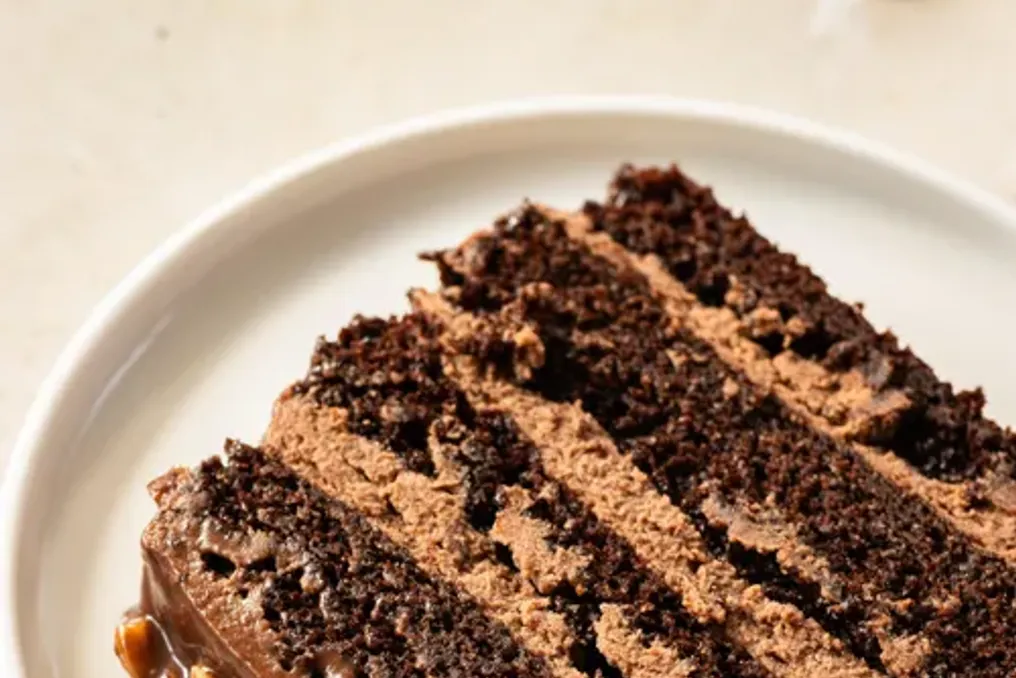
This recipe offers the creation of an exquisite layered chocolate bread, which can be made using several components: a soft chocolate sponge cake, whipped chocolate ganache, and ganache with crunchy hazelnuts.
This recipe offers the creation of an exquisite layered chocolate bread, which can be made using several components: a soft chocolate sponge cake, whipped chocolate ganache, and ganache with crunchy hazelnuts.
To make the soft chocolate sponge cake (in a 20x20 cm square mold), the following ingredients are required: 200 g of baking flour, 60 g of cocoa powder, 7 g of baking powder, 5 g of baking soda, 250 g of powdered sugar, 100 g of eggs, 120 g of butter, 180 g of buttermilk or maas, 180 g of hot coffee or hot water, 5 g of vanilla extract, and 3 g of salt.
The process of making the sponge cake begins with preheating the oven to 170°C. A 20 cm square mold must be greased and lined with parchment paper. The dry components should be mixed, then the eggs, butter, buttermilk, and vanilla are added, mixing until a smooth consistency is achieved. Next, the hot coffee or water is slowly incorporated. Bake for 28–35 minutes, after which the sponge cake cools completely.
For this layer, you will need 400 g of milk or dark chocolate and 300 g of fresh cream. The cream is heated until steamy, then poured over the chopped chocolate. The mixture is left for 2 minutes and then stirred until uniform. After that, the ganache is chilled until thickened, and then lightly whipped until airy and spreadable.
This component uses 200 g of milk chocolate, 120 g of cream, and 80–100 g of crushed roasted hazelnuts. The cream is heated until hot and poured over the chocolate, stirring until it achieves a glossy appearance. Then, the crushed hazelnuts are folded into the mixture. Before application, the ganache should be slightly cooled so that it holds better on the sponge cake rather than running off.
To achieve the effect of layered bread, the sponge cake is cut into strips suitable for a loaf pan. The loaf pan is lined with parchment paper. The layers are assembled in the following order: sponge cake, whipped ganache, sponge cake, and again ganache. The structure is chilled until firm, then removed onto a serving plate and covered with the hazelnut ganache.
There is a special nostalgia associated with stopping by the roadside. Long before convenience stores became the standard, South African farm stalls, diners, and roadside motels gave travelers a reason to slow down. These places served as points where coffee was served in huge mugs, pies disappeared before they could cool, and conversations with locals became part of the journey itself. Today, many of these stops have become attractive destinations in themselves.
Whether you are driving on the N2 highway, exploring Route 62, or heading deep into the Karoo, these legendary roadside eateries prove that sometimes the best part of a road trip is the places where you stop.
Several roadside establishments embody nostalgia as vividly as Diesel & Crème. Located on the iconic Route 62 near Barrydale, this diner blends classic American road trip culture with vintage gas stations, chrome accents, and decor inspired by jackboxes and tall milkshakes. The restaurant was created to pay homage to the golden age of road travel and provide visitors with another reason to stay in Barrydale, one of the most beloved towns on Route 62. Their burgers, thick chips, and luxurious cocktails have become almost as famous as the route itself.
For generations of travelers passing between Gqeberha and the Addo region, Nanaga Farmstall is a must-stop. Established in the early 1960s, this family farm shop earned its reputation through freshly baked roosterkoek, hearty pies, and traditional South African hospitality. What started as a small roadside business has grown into one of the most recognizable landmarks for traveling through the Eastern Cape, while retaining its rustic roots.
The best time to visit Nanaga Farmstall is year-round, especially if you combine the trip with a safari in Addo National Park. Tip: come hungry. The famous roosterkoek sandwiches are perfect for the road, and the shelves are stocked with local preserves, biltong, and pâté.
Few names are as closely associated with road trips in South Africa as Peregrine Farm Stall. The business began as a modest fruit stall in 1964, selling produce from the fertile Elgin Valley. Over the decades, it has evolved into one of the country's most renowned roadside stops, famous for its bakery, apple pies, and local products showcasing the region's agricultural heritage.
The optimal time to visit Peregrine Farm Stall is autumn, when the apple season transforms the Elgin Valley into one of the most picturesque landscapes in the Western Cape. Tip: stock up on baked goods before heading over the Sir Lowry's Pass or driving towards Hermanus and Garden Route.
Located near the historic Houw Hoek Pass, this roadside attraction has welcomed travelers for decades. While the neighboring Houw Hoek hotel dates back to the 1800s, the farm stall gained fame for its freshly baked pies, bread, and local produce that fueled countless family holidays on the Garden Route. Many South Africans define their road trip by whether they stopped for a pie at Houw Hoek.
The most scenic time to visit is winter and spring, when the green landscapes of Overberg and fewer people outside school holidays make the trip particularly pleasant. Tip: buy local cheeses, preserves, and fresh bread before continuing through the Overberg wine region.
Tankwa Padstal stands out for its remoteness, uniqueness, and authenticity, resembling an oasis in one of South Africa's most isolated landscapes. Situated along the gravel road R355, it has become an unofficial gathering point for adventurers crossing the Tankwa Karoo. Visitors stop here to enjoy strong coffee, taste homemade treats, biltong, and share stories with cyclists, overlanders, and motorists traversing one of the country's greatest routes.
The best time to visit is spring and autumn, when the temperature is more comfortable; summer can be extremely hot. Tip: fill up your tank before entering the region and bring plenty of water. The surrounding scenery is magnificent for photos, especially at sunrise and sunset.
Serving as a bakery, farm stall, and local attraction, Ou Meul has become one of the favorite roadside spots in the Western Cape. This establishment celebrates traditional rural baking, with freshly made roosterkoek, artisanal bread, and local delicacies at the center of attention. Its rustic atmosphere reflects the agricultural heritage of the Overberg while offering warm hospitality to travelers on the N2 highway.
Ou Meul is suitable for visiting year-round, although weekday mornings are usually quieter. Tip: grab some fresh roosterkoek and take a few minutes to look at local crafts before hitting the road again.
Although technically more than just a roadside restaurant, Piggly Wiggly has become an iconic spot for anyone exploring the Midlands Meander. Originally established as a shopping destination, it has transformed into a collection of artisan shops, cafes, and diners that celebrate local craftsmanship and cuisine. Fresh coffee, homemade baked goods, and a relaxing rural setting have made it a beloved detour for decades.
The optimal time to visit is autumn and winter, when a brisk morning makes a coffee stop particularly appealing. Tip: allow yourself extra time. It is easy to spend several hours among the cafes, craft workshops, and local shops.
Road trips are often measured in kilometers, but the most memorable moments happen when we stop. Whether it's sharing a legendary pie, ordering an incredibly large milkshake, or chatting with people who have welcomed travelers for decades, these roadside eateries remind us that slowing down is part of the adventure. Next time you plan a route through South Africa, leave room not only for scenic views. Some of the brightest travel experiences in the country begin with a handwritten menu, a cup of fresh coffee, and a roadside sign inviting you to stop.
For those who wish to replace wired headphones with wireless options, this is a good time to do some research. Three suggestions for Bluetooth headphones on sale on Amazon have been gathered, suitable for various user profiles, from those who value long battery life to those who need water resistance for physical activities.
The Philips TAT1109 model is presented as a robust alternative for prolonged daily use. Utilizing TWS (True Wireless Stereo) technology, Bluetooth connectivity, and a built-in microphone, it offers up to 24 hours of total autonomy, eliminating the need for constant recharging. Its black finish gives it a discreet look, suitable for any occasion.
A second model, classified as Sports Bluetooth Headphone, was developed with physical exercises in mind. It features Bluetooth 5.3, IPX5 certification against sweat and splashes, and offers up to 42 hours of playback. This headphone has powerful bass, ideal for genres like electronic and rap, and works without problems with both iOS and Android systems.
The Philips TAT1209 balances protection and functionality. With IPX4 certification, it resists everyday splashes, and the integrated microphone allows for calls. Offering 18 hours of playback and TWS design, it proves to be a versatile choice for work or leisure time.
It is important to note that promotions like these tend to be short-lived on Amazon. If any of these models have sparked interest, it is recommended to access the link immediately to confirm availability and secure the purchase before stock runs out or prices return to normal.
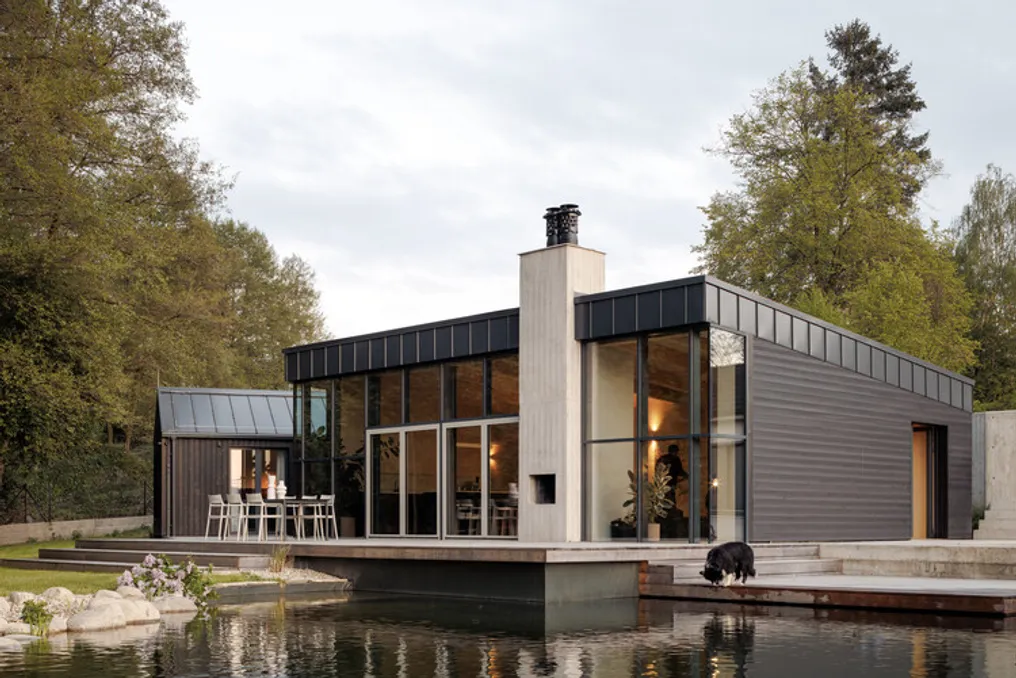
Located in the Czech village of Krámy, near the Brdy Plateau, the weekend house was developed by the firm Anna Koukolová architekti. It was built on a sloping plot, bordered by a wooded area and a stream. The residence, constructed with a wooden structure, features charred spruce wood cladding and rests on a simple construction system, utilizing authentic materials and careful planning that gives unexpected spaciousness to its modest usable area.
The clients sought this tranquil retreat outside the capital at the beginning of the pandemic, ideal for spending weekends with their dog. They located two adjacent plots, situated just 40 kilometers from Prague, which descended towards a small forest. After contacting the team at Anna Koukolová architekti, the project evolved, driven by mutual trust between the architect and the owners, resulting in this unique wooden house covered with charred Scandinavian spruce.
The architectural language of the project is freely inspired by contemporary Australian residences, characterized by the fluidity of interiors towards the landscape, achieved through simple forms and the use of natural materials. Even with a usable area of only 123 m², the pitched roof in the main room, combined with large glass panels, generates a strong sense of openness and spatial generosity.
The project is based on two central concepts. The first is ensuring a permanent visual connection with the natural environment. Architect Anna Koukolová explained that the initial concept aimed to maximize the direct relationship of the plot with the forest while ensuring privacy from the neighboring development and the public road, thus establishing an intimate and reserved setting.
Although the facade facing the neighbors is closed, the glazed face oriented to the north allows the main social area to open up to views of the forest, the stream, and distant fields. The bedroom located in the private wing shares this same perspective. Strategically positioned windows frame new internal gardens, transforming the journey through the house into a succession of constantly changing spatial experiences.
The second principle adopted is the clear distinction between social zones and private areas. These are organized into two separate wings, connected by a glazed gallery, which has become a distinctive element of the project. Koukolová added that the simple functional program and the clients' trust allowed for the development of a surprisingly elaborate set, given that each section of the house has distinct spatial needs, which is reflected in its morphology. The main volume features a single-pitch roof, high ceilings, and an entirely glazed facade, while the bedroom wing is smaller, with a double-pitched roof, providing a cozier atmosphere.
Structurally, the residence sits on reinforced concrete foundations with a floor slab. Its support is composed of a 2x4 wood frame system, complemented by a longitudinal structural wall supported by a pair of metal pillars. The main room opens to the northwest through a light glass framing, and the interior walls are clad with birch plywood that includes acoustic insulation. Underfloor heating is assisted by built-in fan coils. A double-sided fireplace, constructed from locally molded concrete using wooden plank forms, serves as a cozy internal focal point and as a barbecue area on the terrace.
The charred wood cladding has a dark color and requires little maintenance, aging naturally over time. The material palette is completed by a graphite standing-seam metal roofing. The extensive outdoor terrace is made of untreated larch wood, which will gradually develop a silvery patina. The plot enclosure combines a reinforced concrete base with the texture of the wooden forms and vertical wooden slats.
Inside the social area, light birch plywood defines the character of the space, covering walls, doors, and custom furniture. The plywood-clad corridor discreetly hides the entrances to the washroom, service area, and large built-in wardrobes. Deep windows punctuate these continuous surfaces, framing carefully selected views of the vegetation. The private wing also features a bathroom equipped with a soaking tub and integrated shower. A burnt cement finish unifies the surfaces in a serene and monolithic environment, while the epoxy resin floor ensures durability and resistance to daily use and pet coexistence.
The architecture demonstrates a response to the sloping topography of the land, reinforcing the house's connection to the surrounding landscape. The original master plan also includes the future installation of a garage and an independent guest pavilion in the wooded area, without compromising the overall spatial configuration of the plot.