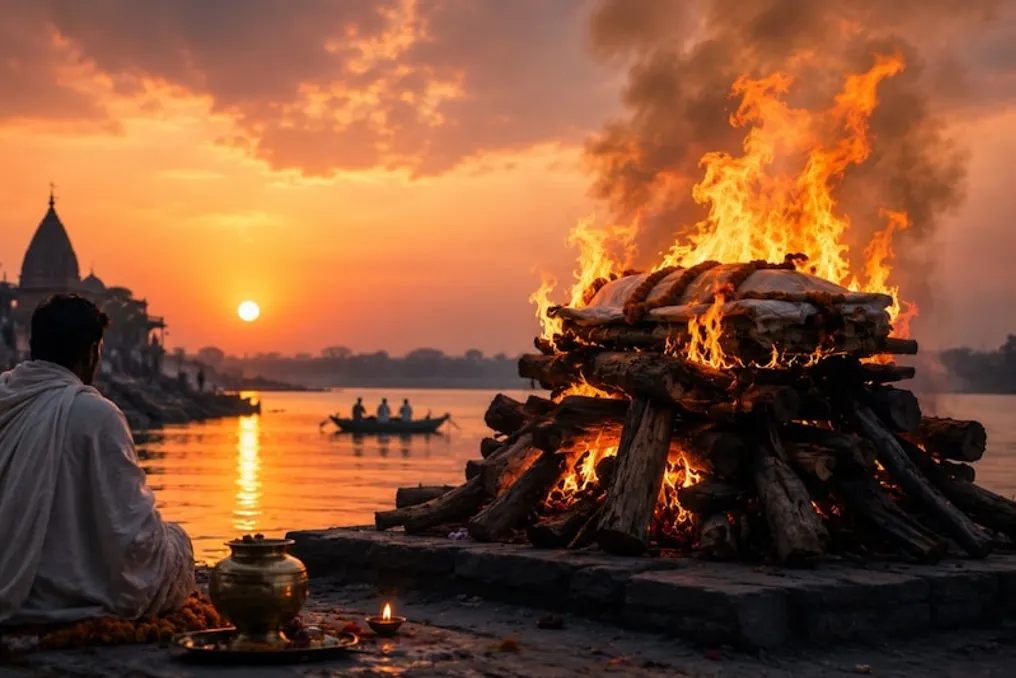
The death of any person is a very sad moment. When a loved one passes away, in addition to deep sorrow, preparations for their burial begin. The Garuda Purana describes death and the numerous rules and beliefs associated with it in detail. One of the important beliefs there is the prohibition of performing cremation after sunset.
Why is cremation not performed at night? According to the Garuda Purana, if death occurs after sunset, one should wait until sunrise to perform the final rites. This is based on both religious and spiritual reasons. The text states that performing cremation at night is forbidden because it may cause suffering to the deceased soul in the afterlife.
There is also a belief that if cremation is performed at night, this person may suffer some physical limitation or defect in the next life. Therefore, it is considered auspicious to hold the funeral during the day when the sun's influence is active. In Hinduism, the Sun is regarded as a factor of the soul; it symbolizes life, energy, and consciousness. It is believed that the soul is born from the Sun and ultimately dissolves into it. Consequently, performing cremation during the day, in the presence of the Sun, is considered more suitable for the peace of the soul and achieving liberation.
Furthermore, it is asserted that the gates to heaven close after sunset, and negative forces become more active. Under such conditions, performing cremation could create obstacles on the soul's path to liberation.
What to do in case of death at night?
If death occurs at night, the Garuda Purana prescribes certain precautions. For example, the body should not be left inside the house; instead, a lamp should be lit near a Tulsi plant. It is also believed that the body should never be left alone, as the influence of negative forces increases at this time. A family member should sit near the deceased and pray to God for the peace of their soul. This helps the soul find peace and prepare for its further journey.
What is cremation?
Hinduism describes only 16 rituals, and cremation is considered one of the most significant. It is not just a religious act, but a process of liberating the soul from the body and dissolving it into the five elements. The body consists of five elements: earth, water, fire, air, and ether, and through cremation, all these elements return to nature.
There are also exceptions in certain special circumstances. For instance, Sadhus and saints receive Samadhi instead of cremation, as their bodies are considered filled with special energy due to asceticism and penance. Therefore, it is extremely important to perform the cremation of the deceased according to established rites and at the proper time. This not only brings peace to the soul but also increases the chances of it achieving moksha.