Residents of the "Lolazor" mahalla have faced the problem of losing public spaces, which has led to a series of conflicts with developers. The story concerning the halt of the business center construction in the courtyard of the "Lolazor" mahalla following public outcry and government intervention has become one of the most discussed issues in Tashkent. However, there are other courtyards nearby where similar confrontations are unfolding.
In the "Lolazor" mahalla of Mirabad district, attention was drawn to the construction of a five-story business center on the site of former children's and sports grounds and mahalla buildings. After a series of media publications and public resonance, the head of President Saied Mirziyoyev's Administration arrived at the site and instructed the Prosecutor General's Office to conduct an inspection of the legality of all courtyard development projects in Tashkent. As a result, the construction was suspended.
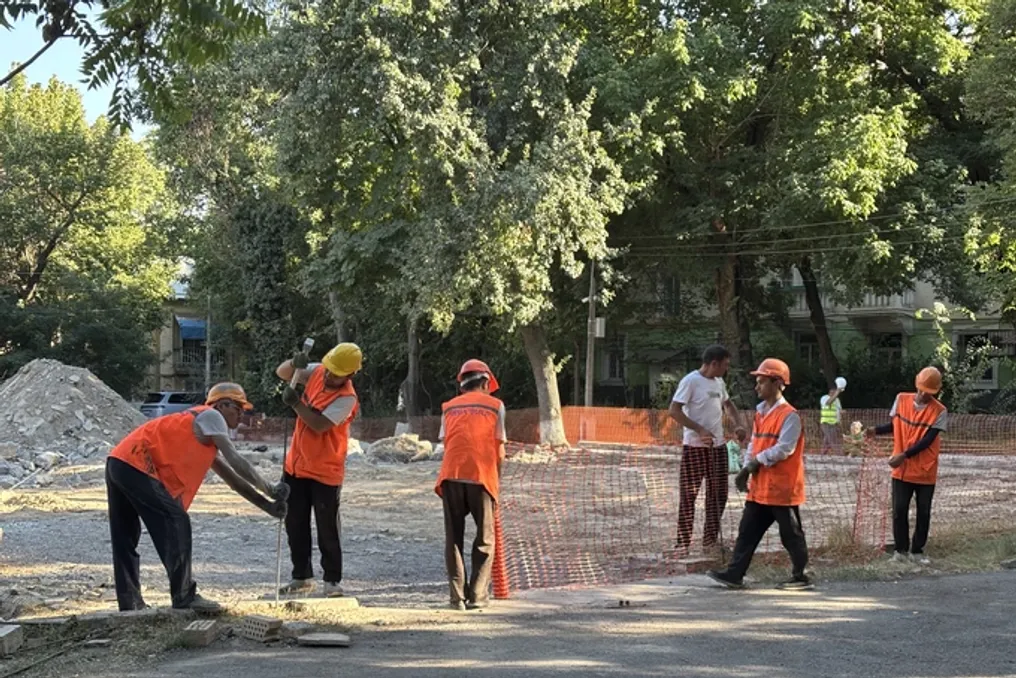
When a correspondent from "Gazeta" visited the courtyard surrounded by houses No. 27/5, 27/6, 27/7, and 27/8, active work by an excavator was observed to dismantle the remains of the old building and clear the territory. Although the metal fence that previously enclosed the area had been dismantled, residents gathered nearby expressed relief at the halt of work but were uncertain about the end of the conflict.
Resident Fatima Temirkhodzayeva emphasized that they would not calm down until the children's and sports grounds were restored, trees were planted, and they were sure that no new construction fence would appear soon. According to her, the public area, which housed the mahalla committee, playgrounds, and trees, could disappear, which was unthinkable for the residents.
Alla Avanesova recalled that this space was the center of life in the yard, a place for meetings, celebrations, and sports for young people. In May 2026, a four-meter fence was erected around the site. Residents initially believed it was a reconstruction, but when they tried to get information from the mahalla chairman and the developer, they did not receive clear answers.
Alla Avanesova said that she required building permits and cadastral documents, but they were denied. Subsequently, the mahalla building was demolished, the children's playground was removed, and trees, including oaks, pavonias, and fruit trees planted by the residents themselves, were cut down, and the site was prepared for development.
Only after the object's passport appeared did the residents learn that a five-story business center with an underground parking lot was planned. Fatima Temirkhodzayeva noted that this massive building does not match the architecture of the surrounding houses, built in 1956 in the Stalinist Empire style, and wonders how such a decision could have been made without resident participation.
Alla Avanesova added that the building belonged to the mahalla and questioned why the repair was not carried out by the mahalla itself or the management company, but the duties were shifted to a stranger, while no one protected the rights of the residents.
By mid-summer, residents almost lost hope because numerous appeals to the hokimiyat, prosecutor's office, and cadastral bodies only received formal responses, and applications were passed between departments. The last attempt was a collective appeal to the Presidential Administration asking to check the legality of the construction.
The residents were surprised by the wide response to their appeal, calling it a "real miracle," as they saw that even a small person fighting for their yard could be heard. After the visit of the delegation led by Saied Mirziyoyev, residents began receiving messages of support from different districts of the capital, giving them hope for the resolution of the case.
This wariness among the residents is due to the fact that over the past years, the quarter has already lost several public areas: a hotel with parking appeared on the site of the children's playground at house No. 27/5, and a business center was built next to house No. 27/8. Therefore, the playground in the "Lolazor" mahalla remained the last gathering place for residents of several houses.
In another courtyard, at house No. 27/3, there used to be a children's playground where several generations of children grew up and trees planted by residents grew. In April 2025, the site was fenced off, but the developer provided no explanation. Soon, the entire playground—swings, slides, climbing frames, and gazebo—was removed overnight, after which construction was intermittently stopped and resumed.
After complaints from residents, a new playground was installed, but Elena Politayeva believes it has not replaced the original one because it is designed for toddlers, and the elements are located unsafely. Furthermore, the site intended for a football field also ended up behind a construction fence. According to the object's passport, the customer was the MChZh "ARX STROY PROJECT"; a five-story building was planned on an area of 1979 sq. m, with 30% of the territory (593 sq. m) allocated for mahalla requests, and 70% (1385 sq. m) for the investor's residential complex.
Elena Politayeva notes that previously the site had grass, trees, and shade, but now it has concrete, asphalt, and iron, which leads to severe heating of the yard in the summer.
In the third case, residents of house No. 27/10 have been fighting for their space since 2018. Previously, there were utility closets, a children's playground, and a green area. Now it is an empty, sun-scorched area with a single bench. Vladimir Davydov recalls that life was bustling here, but now "there is no room for anyone".
According to the residents, in February 2018, utility closets covering an area of about 440 sq. m, which had been used for decades, were transferred to the furniture enterprise "Viva Victoria" as compensation for real estate seized during the construction of Tashkent City, marking the beginning of development plans.