Around the world, there are many famous closed doors and sealed vaults. Legends associated with these objects, tales of untold treasures, or historical secrets have always aroused strong interest in people. The question remains open: what exactly is hidden behind these closed doors, as it is unlikely that anyone has entered them in modern times.
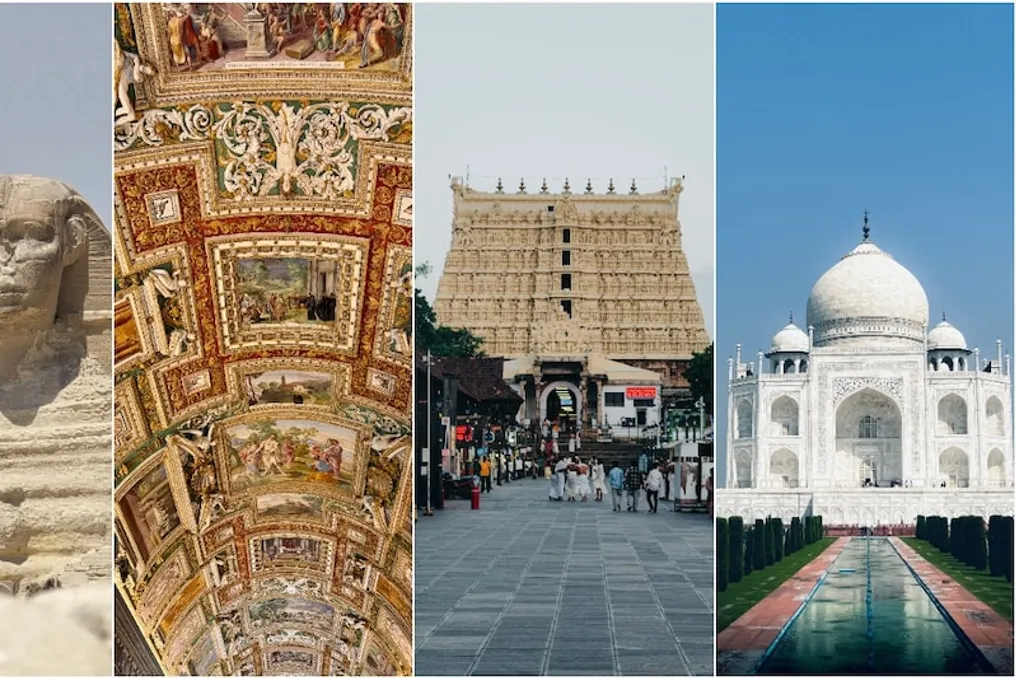
Among the five most mysterious doors are the closed Door B in the Padmanabhaswamy Temple in India, the sealed basement doors of the Taj Mahal, the door to a secret Vatican archive room, the hidden door near the Great Sphinx, and the mysterious gates of the gods in Armu-Muru in Peru.
The Padmanabhaswamy Temple is located in the picturesque state of Kerala, India, and is known not only for its stunning beauty but also for many other reasons. There are six basements beneath the temple, which have been given unique names: A, B, C, D, E, and F. The massive iron doors of these basements add even more depth to the mysteries hidden behind them. Several years ago, authorities decided to open these basements to the world, but this proved to be a difficult task. Ultimately, in 2011, five out of the six basements were opened, and gold bars and gemstones worth billions were discovered inside. Nevertheless, Basement 'B' remains completely closed. Despite all attempts, it could not be opened. According to legends, it is sealed by the curse of a divine serpent, and opening it without precise sacred mantras could lead to catastrophe.
Many secrets are hidden within the Taj Mahal. The palace itself contains numerous rooms that have been sealed and into which no one is allowed to enter. Beneath the main marble platform of the Taj Mahal are dozens of rooms and chambers sealed with bricks, which have remained untouched since the monument's construction in the 17th century. If one examines photographs of the building taken from the riverbank, two basements can be seen, but they are also sealed. No one knows what is inside, or why they were closed during Shah Jahan's time. Many theories have been put forward regarding these issues, but the truth remains unknown.
In the city of Vatican, there is a secret archive room known as the Vatican Apostolic Archive. No one knows what is hidden behind its closed doors, as no one enters it. It is said that it houses documents and manuscripts covering over 1200 years of history, placed on shelves in an area spanning 85 kilometers. These closed doors protect ancient records related to sensitive papal affairs, documents from trials of the Knights Templar, and letters dating back over a thousand years.
The Great Sphinx of Giza is surrounded by mysteries. It is not only the largest monolithic statue in the world but also a hybrid creature with a woman's head and a lion's body. Its origin is linked to Egyptian and Greek mythology. It is very ancient, with an estimated age of approximately 4500 years. Archaeologists have discovered huge stone blocks and sets of abandoned tools near the site. However, the true mystery of the Sphinx lies beneath its claws, underground. A group of scientists, using seismographs, discovered two secret rooms under the Sphinx's paws. Some believe these rooms might be a 'Hall of Records,' containing ancient texts that reveal the secrets of the universe.
Armu-Muru, also known as Hugh Mark or the Gates of the Gods, is a structure carved into solid rock on a high plateau in the Puno region of southern Peru. This site is considered one of the most mysterious places in the country from an archaeological perspective; it is not a functioning door, meaning there is nothing inside; it is simply a structure carved in stone. However, according to local Andean culture, it is a sacred place for ancient rituals. According to local legends, it is a door leading to another world, an entrance to another people. Ancient people used it along with a magical golden disc.