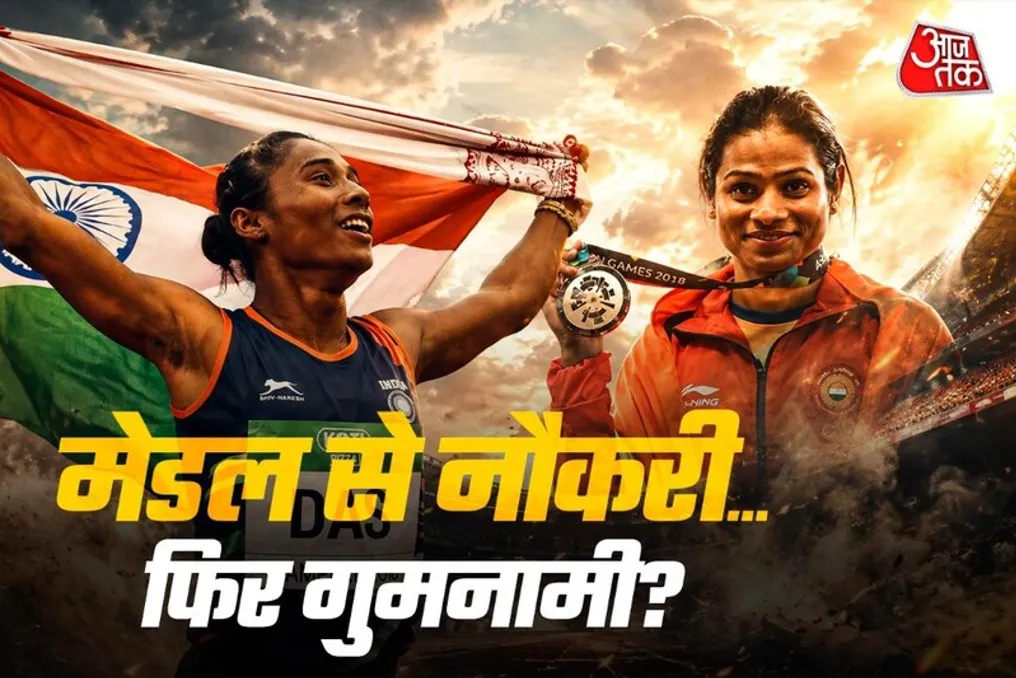
The story of Hima Das and Dutee Chand reflects not only the fates of two athletes but also the unfulfilled dreams of the Indian sports system. The Glasgow Commonwealth Games 2026 were memorable for India, marked by an influx of medals, the emergence of new stars, and a demonstration of India's growing strength in athletics on the world stage. Observing the new faces on the track, it became evident that India is not just producing talent, but is reaching a level that allows it to challenge global leaders.
Questions arise regarding the current status of Hima Das and Dutee Chand. This issue goes beyond the lives of these two athletes and poses a serious problem for the Indian sports system.
On July 12, 2018, in Tampere, Finland, at the World Junior Athletics Championships, one Indian girl achieved a historic feat on the 400-meter track. Hima Das became the first Indian female athlete to win a gold medal at the world level in running. After this, her name, known as 'Dhing Express,' was everywhere—from newspapers to television screens and digital news platforms.
In the same year, at the Asian Games in Jakarta, Hima Das set a national record in the 400-meter distance, running in 50.79 seconds. Winning two gold and one silver medal, she became the main hope of Indian athletics. In the following year, 2019, Hima won five consecutive gold medals in Europe in just 20 days, creating the impression that India had found a consistent contender on the world stage in the 400-meter distance. Her journey from a small village in Assam to the world stage led India to consider her the biggest track star of the next decade. However, as practice in sports shows, maintaining such a high level of success becomes extremely difficult over time.
On the other hand was Dutee Chand, one of the fastest Indian runners in the 100 and 200 meters. She was an athlete who fought for gender rights and challenged social norms, winning two silver medals at the 2018 Asian Games. In 2019, at the Summer Universiade in Naples, Italy, Dutee Chand won the gold medal in the 100-meter event, finishing in 11.32 seconds. This made her the first Indian female sprinter to win gold at the Universiade, confirming that she is among India's top sprinting hopes not only regionally but globally.
Currently, Hima Das holds the position of DSP in the Assam Police, and Dutee Chand received an early promotion in the Odisha Mining Corporation (OMC) in 2020. Hima Das is currently 26 years old, and Dutee Chand is 30. This age does not mean the end of a sprinter's career, as many runners win medals at major tournaments at this age.
Although Hima Das recently returned to the track after an almost two-year break, Dutee Chand has long been sidelined from the main picture of national and international athletics. The reason is that in August 2023, the NADA Anti-Doping Disciplinary Panel (ADDP) imposed a four-year ban on Dutee Chand after the detection of prohibited substances (SARMs) in two doping samples taken in December 2022. Despite appealing this decision, she has not publicly received any relief yet.
The main debate is this: is government service becoming the ultimate goal for an athlete in India? Although this question may seem harsh, studying it is necessary. Most athletes in India come from modest families, and government work guarantees them a stable life with respect amidst economic instability, limited resources, and an uncertain future. Therefore, getting a job itself is not an error. The problem arises when the athlete's international career gradually fades after securing employment.
Hima's career includes winning the 2018 World Junior Championships, setting a national record at the Asian Games, and five international gold medals in 2019. However, injuries halted her ascent after 2019. She then had to face actions from NADA regarding 'Whatabouts' rule issues, which were unrelated to doping. After returning to the track, she has significantly moved away from the center of attention of Indian athletics.
The question is not about who is to blame. The question is how an athlete whom India considered a superstar for the next ten years could disappear from the public eye in just eight years? Perhaps this is not just Hima's and Dutee's story. There are many examples in Indian sports where athletes failed to maintain momentum after initial success. The reasons for this lie not only with the athletes themselves but with the entire ecosystem.
How is the world doing? Countries like the USA, UK, Australia, and Jamaica provide athletes with a highly effective ecosystem that helps them stay at the top for a long time. These countries have created a system that promotes the extension and improvement of athletes' careers.