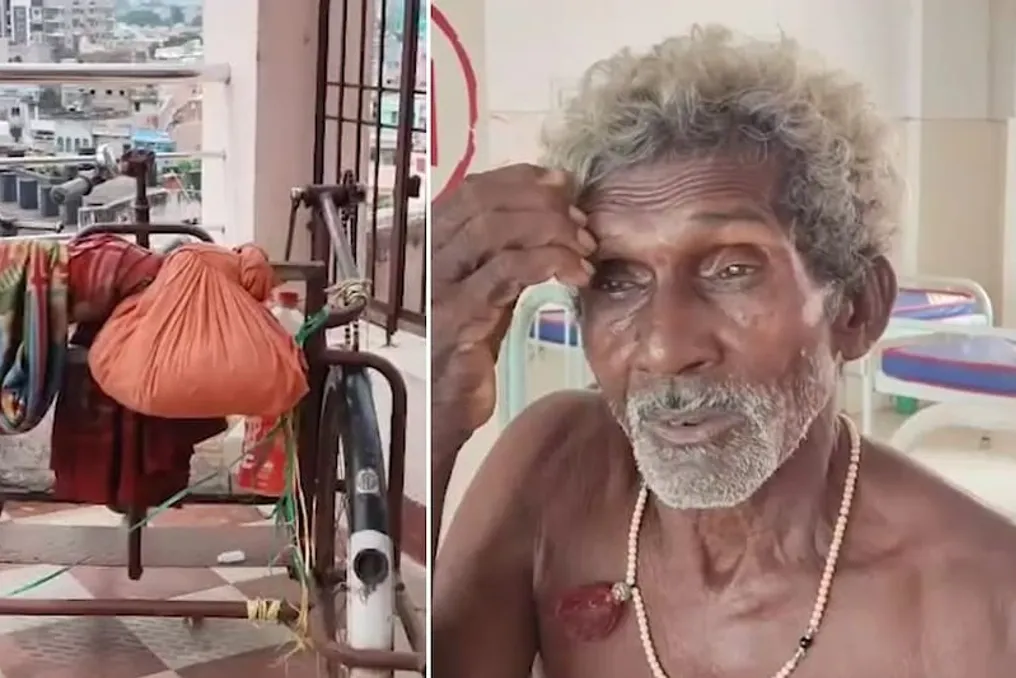
Some journeys become stories of human courage rather than just about reaching a destination. When an elderly man arrived at the gates of the hospital in Ganjam, Odisha, on a tricycle, the people there watched him with astonishment. He was 73 years old, had a fractured left leg, almost no money in his pocket, and no one nearby, but his eyes held the hope that if he reached the hospital, he could walk again.
This story belongs to Sukdev Nahaku, a resident of Brasahi village in the Nyagara district of Odisha. It is a narrative of poverty, loneliness, and pain, but most of all, it is about the will to live. Previously, Sukdev worked as a watchman in the village. It was a small job, but it allowed him to barely make ends meet. His wife was with him, and he had a son; life was going along normally. However, time changed.
In 2011, his wife passed away, leaving the family without its main support. His son became mentally ill and unable to work. The responsibility for the household fell entirely on Sukdev's shoulders. At this time, an accident further complicated his life.
As a result of the accident, his left leg was broken. The pain was so severe that walking became difficult, but the pain from lacking funds for treatment was even stronger. He spent several days in the village, coping with the situation as best he could. But when the pain became unbearable, he decided that he needed medical treatment.
Without money and without support, he set off anyway. For an ordinary person, a journey of 150 kilometers is not an easy feat. But imagine a 73-year-old man with a broken leg, without money, setting out on such a long journey on a tricycle. Sukdev expected no one. He took his old tricycle and set off from Brasahi village in Odisha to the MKCG Medical College and Hospital in Barhamupe.
This journey did not take just one or two hours. He continued moving along the road for about two consecutive days. There were sunny days, and there were dark nights. Sometimes the road was flat, and sometimes it was uneven. With every pedal stroke, his broken leg ached in pain, but his determination did not weaken. Along the way, he met strangers who supported his hope. Sukdev did not have enough money to buy food on the road. People who saw his condition fed him, gave him water, and gave him strength to move forward. Perhaps it was the kindness of these strangers that sustained Sukdev's strength, and his tricycle kept moving.
After two days, he finally reached the gates of the hospital in Barhamupe, having covered a distance of about 150 kilometers. When the hospital staff heard his story, everyone was moved to tears. Doctors immediately examined him. The hospital administration assured him that a full examination would be conducted and the necessary treatment would be provided. Under the supervision of the medical superintendent, officials stated that all medical tests would be done first, and after receiving the results, doctors would begin treatment.
Telling his story, Sukdev said that he is a resident of Brasahi village in the Nyagara district. He came to Barhamupe on a tricycle for treatment. It took about two days. The road was very difficult, but he needed treatment. People fed him on the way, which allowed him to get here. My left leg is broken. My son is mentally ill and cannot work. My wife died in 2011. The doctors examined me. I hope I will recover and be able to walk again.
In his words, there was less complaint and more hope. This is not just a journey; it is also a mirror for society. Sukdev's story is not just the story of one old man's struggle. It raises many questions. Should an elderly man with a broken leg travel 150 kilometers on a tricycle for treatment? Is poverty still the biggest threat to a person's treatment today? Can medical services not reach our villages so easily that an injured old man has to spend two days on the road?
But the biggest message of this story is different. In every person's life, there are moments when circumstances call for giving up. Sukdev had many reasons to give up: no wife, his son could not be a support, there was no money, his leg was broken, and he was 73 years old. But he did not give up. He left the pain behind and directed hope forward, riding his tricycle.
Perhaps that is why Sukdev Nahaku's journey is not just a story of overcoming a distance of 150 kilometers. It is a story of overcoming the distance that a person often creates in their own mind. And perhaps that is why this elderly man from Odisha is today not just a patient, but a symbol of courage, confidence, and an indomitable will to live.