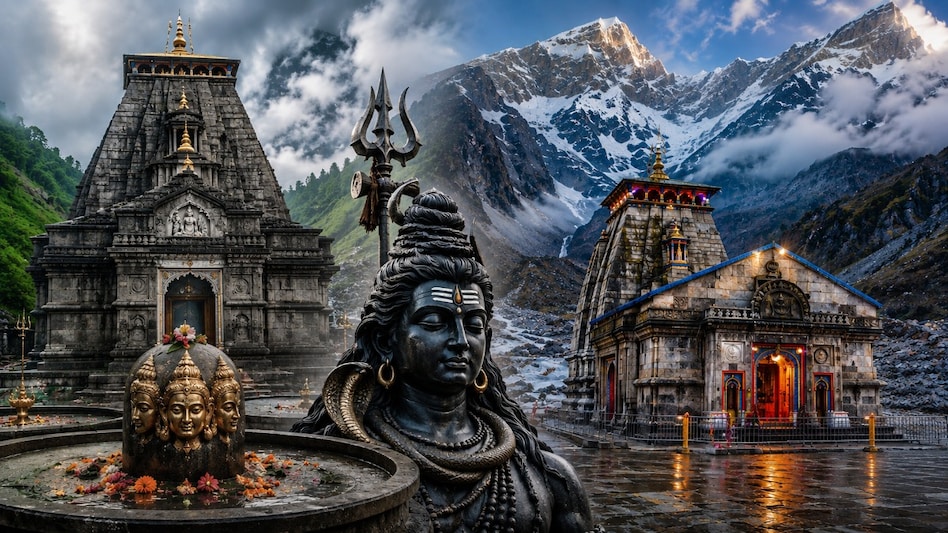
During the sacred month of Sawan, millions of pilgrims travel to Shiva's shrines to receive the blessings of Mahadeva. India is an ancient land of temples, where every holy site holds unique secrets, miracles, and mythological stories. Particularly significant are major holy places such as Triambakeshwar Jyotirlinga in Maharashtra, as well as Kedarnath and Badrinath Dham in Uttarakhand, whose visits during the month of Sawan are considered especially auspicious.
In this sacred month, we will explore the unique legends, miraculous events, and deep mysteries associated with these three historical and mythological temples.
Triambakeshwar Temple, Maharashtra
Triambakeshwar is one of the twelve Jyotirlingas of Lord Shiva. Its distinct feature is that the Shivling here has three faces, symbolizing Brahma, Vishnu, and Mahesh. This Jyotirlinga is located inside a kund and is gradually eroding due to constant bathing. There is a belief that this signifies the decline of religion in Kali Yuga.
According to mythological history, after Gaththam Rishi performed severe asceticism for people suffering from drought, Lord Shiva was moved and commanded Ganga to appear at this place. This river later became the Godavari River, known as 'Ganga Yuga Dakshina'. Another belief associated with the temple relates to the Pandavas: it is believed that the precious crown here belongs to the era of the Pandavas and is displayed for a period every Saturday. The Kushavarta Kund, located near the temple, is considered the source of the Godavari, which never dries up, which is also considered a mystery. Triambakeshwar is also known for its special rituals, such as Narayan Nagbali, Kalsarpa Shanti, and Mahamurtunjay Jap. Pilgrims believe that these rites help alleviate serious problems and illnesses.
Kedarnath Temple, Uttarakhand
Kedarnath Dham, nestled in the Himalayas, is an extremely sacred Jyotirlinga of Lord Shiva. It is situated at an altitude of about 3583 meters above sea level and is a key part of the Char Dham pilgrimage. The most famous story associated with Kedarnath comes from the Mahabharata era. The Pandavas went in search of Lord Shiva to be freed from the sins of war. Lord Shiva was displeased with them and hid in the form of Nandi. Bhima recognized him and tried to capture him, resulting in Lord Shiva's body splitting into five parts, appearing in different locations, known as Panch Kedar.
The construction of this temple is full of mysteries. This structure, built from heavy stones without mortar, withstood centuries of snow, storms, and natural disasters. Even scientists are amazed by its durability. The disaster in Kedarnath in 2013 was the biggest event in the history of this temple. During a severe flood, the entire area was destroyed, yet the temple remained unharmed. A massive boulder stopped behind the temple, changing the direction of the water. Pilgrims call it Bhimshila and consider it a miracle of Lord Shiva.
The Fusion of Faith and Science
The main characteristic of these two temples lies in the amazing combination of faith and science. While pilgrims view these events as miracles, scientists attempt to find scientific explanations for these phenomena. Triambakeshwar and Kedarnath are not just religious sites but symbols of India's cultural, spiritual, and mysterious heritage. This is why their grandeur and mysteries continue to attract people centuries later.