Sam Altman, founder and CEO of OpenAI, faced criticism after suggesting that the ChatGPT chatbot could be used to assist in raising children.
In recent years, AI-based childcare applications have become more prominent in the technology sector.
Sam Altman, founder and CEO of OpenAI, faced criticism after suggesting that the ChatGPT chatbot could be used to assist in raising children.
In recent years, AI-based childcare applications have become more prominent in the technology sector.
Jay Panchal, co-founder and CEO of the Bengaluru-based startup Aule Space, explains that many private geostationary satellites valued at over $100 billion are in orbit but are being decommissioned due to fuel depletion, despite generating significant revenue.
Panchal notes that extending the lifespan of these satellites allows operators to avoid launching an entirely new craft, which could cost hundreds of millions of dollars.
Aule Space is addressing this issue by creating what is called a 'satellite-jetpack.' This spacecraft docks with the fuel-depleted satellite, remains attached, and provides it with thrust using its own fuel, allowing it to continue operating for several more years.
Earlier this year, the company raised $2 million in a seed funding round led by pi Ventures. Aule Space also participated in the Entrepreneurs First Accelerator Programme and has support from Transpose Platform.
According to Panchal, in just eighteen months, Aule tested its technology on ISRO assets and achieved Technology Readiness Level (TRL) 6, using a scale originally developed by NASA. Achieving TRL 9 signifies technology readiness for commercial deployment.
He stated that after a successful orbital docking demonstration next year, the company will reach TRL 9 and begin signing commercial contracts. Manish Singhal, founding partner at pi Ventures, believes Aule will be one of the few global companies to achieve this after a successful launch, and it can do so at a significantly lower cost. Singhal predicts the company could start signing commercial agreements within the next two to three years.
The only other company that has previously successfully performed a docking is the American aerospace and defense technology firm Northrop Grumman, which demonstrated a similar satellite life extension mission in 2020.
Panchal emphasized that Aule's mission will be much cheaper, estimated at around $20–30 million. He compared this to missions where astronauts physically captured a satellite, returned it to Earth, and relaunched it, which cost about a billion dollars and never became commercially viable. Attempts by NASA to conduct autonomous robotic servicing missions are also mentioned, costing hundreds of millions of dollars. Aule's goal is to achieve similar capabilities at roughly twenty times the lower cost.
The only other Indian company working in this area is OrbitAID Aerospace, but it focuses on in-orbit refueling rather than docking.
Aule's technology is targeted at high-value communication satellites. Panchal clarified that they are specifically targeting private geostationary communication satellites. There are currently about 320 such satellites in orbit, and approximately 20–25 fail each year.
The in-orbit satellite servicing market is expected to reach approximately $5.5 billion by 2030, demonstrating a Compound Annual Growth Rate (CAGR) of about 10–11%, according to a report by The Business Research Company. This market includes services for life extension, refueling, repair, repositioning, and inspection.
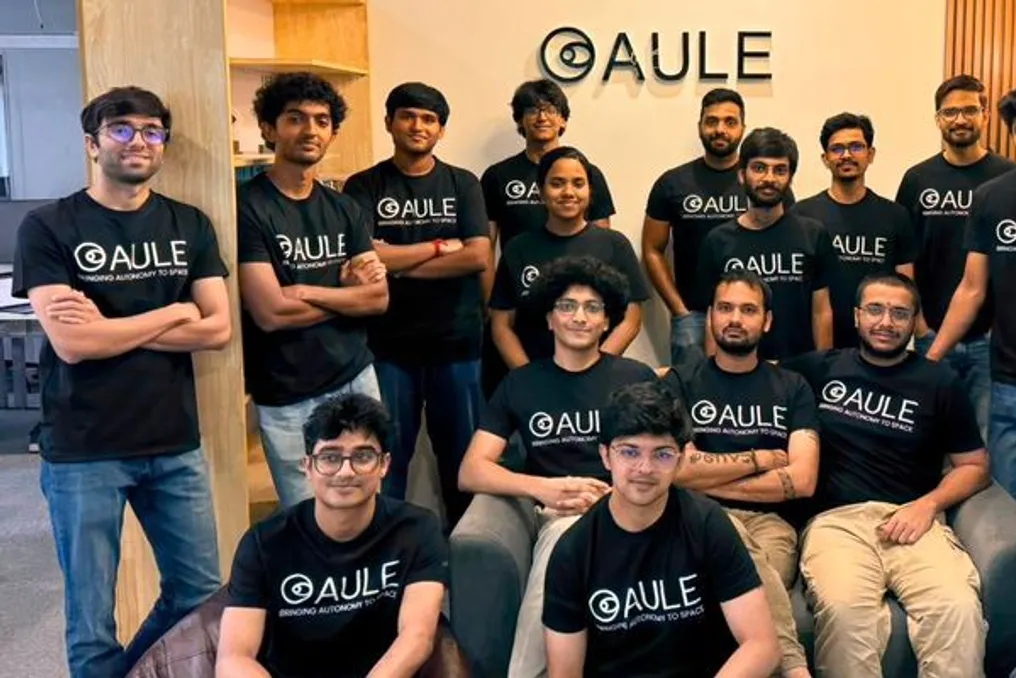
Aule's ultimate goal is to increase the satellite's lifespan by about five years. Panchal leads the company alongside Nithyaa Giri, Chief Technology Officer (CTO), and Hrishit Tambi, Chief Operating Officer (COO), along with a team of about 23 people.
The team includes specialists from Pixxel, Skyroot, ISRO, and other organizations. Additionally, the company has consultants from ISRO who participated in India's docking missions, work with communication satellites, and other major programs.
Panchal noted that India achieved docking as part of the ISRO SpaDex mission in 2024, but he stressed that Aule's mission is different. He explained that previous missions involved cooperative satellites specifically designed for docking, whereas Aule aims to dock with satellites that lack docking interfaces.
Explaining their approach, Panchal said their task is to create the lightest and most efficient satellite in the world for performing these operations. Instead of using expensive LiDAR or radar, they are developing computer vision-based systems that use cameras to determine the satellite's position and orientation.
The company has created several test environments. One is a darkened room equipped with a solar simulator, which recreates the view of a satellite in space to train computer vision models on images captured by cameras. There is also a test platform with air bearings, which creates a frictionless environment to model movement without forces and test docking systems.
Although one service satellite can only dock with one satellite at a time, it is not limited to one client for its entire lifespan. For example, it can dock with one satellite, extend its life by two years, detach, and move on to another. Thus, the operational lifespan of the service spacecraft can be distributed among several client satellites. After completing the mission, the satellites will be moved to a graveyard orbit above the operational geostationary orbit.
Panchal explained why Aule Space does not focus on refueling but prefers docking. He stated that even if refueling technology becomes available, existing satellites were not designed for refueling. Instead of transferring fuel, their craft attaches to the satellite and functions as a tow vehicle, providing thrust for up to six years.
Panchal's career began at Pixxel, where he worked on mechanical systems for six hyperspectral satellites launched last year. His interest in space arose back in college as part of a student satellite team. When he founded the company, the initial goal was to remove space debris. However, after discussions with clients and space agencies, it became clear that servicing valuable satellites presented a more immediate commercial opportunity. Ultimately, the same technology can also support debris removal.
Looking ahead, the company plans to engage in extraterrestrial robotics and then asteroid mining by 2050. 'Our goal is to create a robotic workforce for space. Satellite servicing is the first application. As launch costs decrease, space manufacturing, in-space assembly, asteroid mining, and lunar infrastructure will become increasingly feasible,' Panchal concluded.