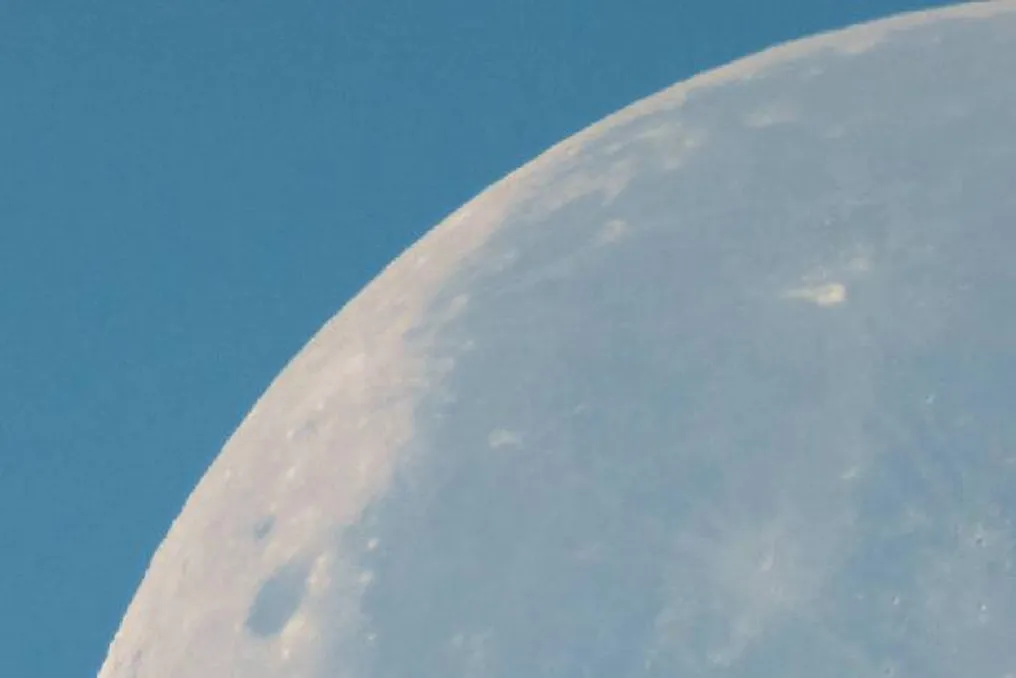
Astronomers have confirmed that a SpaceX rocket stage, which has been in space since last year, collided at high speed with the Moon early Wednesday morning. This incident joins a series of meteoroids, lost spacecraft, and other space debris that have long bombarded the lunar surface.
The object, the size of a school bus, is the second stage of SpaceX's Falcon 9 rocket. This rocket launched the Firefly Aerospace lunar lander toward the Moon in January 2025. Although the rocket booster returned to Earth, the upper stage remained in space after completing its primary mission.
The unintentional collision occurred around 2:35 AM Eastern Time (06:35 GMT), when the 4000-kilogram rocket impacted the Moon at a speed of approximately 8690 kilometers per hour. Astronomers tracking the object's trajectory had predicted this impact several months in advance.
The collision posed no threat to Earth, and no spacecraft orbiting the Moon was positioned for a close-up view of the impact. Nevertheless, the Very Large Telescope of the European Southern Observatory (ESO) in Chile recorded flashes of light associated with the event. An ESO representative told Reuters: 'We can confirm that the telescope detected spectral lines of gaseous sodium and lithium in the impact trail, which lasted 5-10 minutes after the collision.'
It was also expected that NASA's Lunar Reconnaissance Orbiter and South Korea's Pathfinder lunar orbiter would photograph the impact site, although obtaining this information might take several days.
This event occurs against the backdrop of expanding space operations and commercial activities by SpaceX. In its first quarterly report after going public in June, the company reported significant revenue growth, reaching $7.8 billion, more than 90% higher than the previous year. Revenue from Starlink, which accounted for over half of total income, increased by 66%, and revenue from SpaceX's artificial intelligence business, which Musk promotes as a future driver of company growth, grew by approximately 250%. However, after the report's release, shares fell by 8% in after-hours trading as investors reacted to the sharp increase in capital expenditures, largely driven by investments in AI infrastructure.
Space debris raises concerns
Space debris is becoming an increasingly serious problem as more satellites and spacecraft are launched into orbit. Experts warn that the accumulation of too much space debris around Earth could trigger a dangerous chain reaction of collisions, known as the 'Kessler syndrome.'
Julianna Shaiman, Director of NASA's scientific programs and SpaceX's Dragon programs, stated at a press conference on Monday that during such missions, SpaceX performs maneuvers to ensure the second stage is 'safe according to relevant rules and regulations.' She continued that 'we did that, but what happened is essentially a combination of solar activity and gravitational forces that directed it to the Moon.'
This rocket stage was just one of tens of thousands of pieces of man-made debris currently orbiting Earth. While the Moon is constantly bombarded by natural objects such as meteoroids, collisions with artificial spacecraft remain relatively rare.
Shaiman noted that NASA and SpaceX are discussing ways to prevent future lunar collisions. As part of NASA's multi-billion dollar Artemis program, the space agency plans to build a lunar base and send regular astronaut missions to the lunar surface later this decade. Protecting future spacecraft, equipment, and lunar bases from errant fragments of space debris will become an increasing priority.
'One thing we are working on in partnership with NASA and other relevant agencies is defining the best future path for disposing of high-energy missions in the Sun-Earth-Moon system,' said Shaiman.
Despite concerns about space debris, scientists also see research value in this collision. NASA intentionally crashed stages of its Saturn V lunar rocket into the Moon in the 1970s to study the seismic effects of impacts. In 2009, the agency intentionally crashed a rocket stage into the Moon as part of the LCROSS mission to study the plume of lunar material lifted by the impact, leading to a key discovery about traces of water ice in lunar dust. This time, the American agency stated, 'NASA scientists plan to collect lunar data from this event and improve methods for tracking objects in space.'