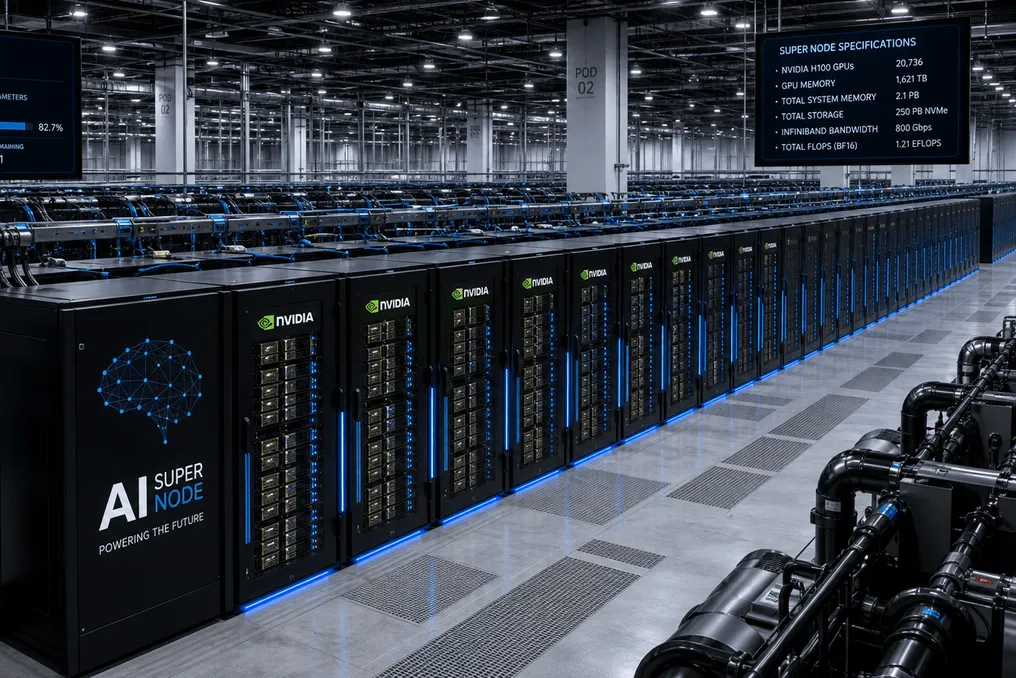
Computational power is becoming a critical resource as tech giants actively strive to create and deploy artificial intelligence supernodes. This frenzy is driven by competitions to increase model parameters, which creates unprecedented demand for infrastructure.
Competition in Computing Power
Companies, including Huawei, ZTE, H3C, and Sugon, are competing to build and deploy AI supernodes scalable from 1024 to 100 thousand GPUs. The increasing demands, driven by models like Kimi K3 and GLM-5, push computational capacity to its limits. Supernodes have replaced models as the central focus of the WAIC 2026 exhibition, as computational capability has become the main limiting factor in AI development. The shift from clusters with 8 cards to clusters of 100 thousand cards makes supernode capacity a direct competitive advantage; consequently, H3C demonstrated a 58% growth, and Inspur showed 41% growth over three weeks.
Demand Pressure at the Frontier of Models
The most evident demand pressure is observed at the forefront of model development. GLM-5 models from Zhipu AI and Kimi K3 from Moonshot AI, boasting 2.8 trillion parameters, have been forced to raise prices and restrict subscriptions due to the enormous inference demand. Deploying the K3 model requires a supernode configuration with more than 64 GPUs, setting a minimum computational threshold for advanced models. In response, Zhipu acquired Zhongke Jiahe and built a domestic AI data center with a capacity of 1 GW, leading to a 37% rise in the company's stock in one day. The math of the situation is telling: industry participants report computation costs of approximately $0.80 per dollar of revenue from the model, yet every dollar of revenue corresponds to a multiple increase in valuation multipliers, making the scale of computation the primary lever for growth.
Technology Development and Strategies
Existing achievements include the use of Huawei Ascend 950 with 1024 NPUs and deployed over 750 A384 sets, as well as ZTE OEX with 128 GPUs per rack and a cluster of 10 thousand. Sugon introduced Dawn 8000—the first domestic system with 100 thousand cards. H3C is building an AI factory capable of delivering 240–300 kW to a test point. Technological directions diverge: Huawei utilizes a proprietary full-stack model—from chip to interconnect and cooling—allowing for deep optimization across layers but requiring colossal R&D investment. ZTE and its partners prefer an open approach using multiple chips to avoid dependence on a single vendor and ensure flexibility for clients. Other players, such as Moore Threads, Pingtouge, and Baidu Kunlun, focus on specific cloud or vertical scenarios, paying close attention to inference efficiency and economic performance. The overarching challenge lies in maintaining system integrity across the architecture of chips, interconnect, software stack, and operational tools, as advantages gained in one area cannot compensate for systemic gaps.
The Future of AI and Supernodes
Model parameters have not yet reached the 2.8 trillion mark; forecasts indicate reaching 10 trillion within two years. The consensus was clear: supernodes define the future. Companies that cannot secure computational power at the supernode scale will be structurally excluded from the AI frontier competition.