The manufacturers Hyundai and Kia have begun producing components that conventional production methods cannot fabricate. Both South Korean companies presented details about the operation of the Additive Manufacturing Solutions Center (AMSC), located at the Namyang R&D Center in South Korea. This center represents the first installation of the Hyundai Motor Group dedicated exclusively to 3D printing research and production.
This center was established about thirty years after the group introduced its first industrial 3D printer in 1996. The methodology employed reverses the usual process: instead of relying on molds, dies, or machining, which removes material and restricts the shape of the parts, additive manufacturing gradually adds material, layer by layer, until the exact configuration defined in the digital file is achieved.
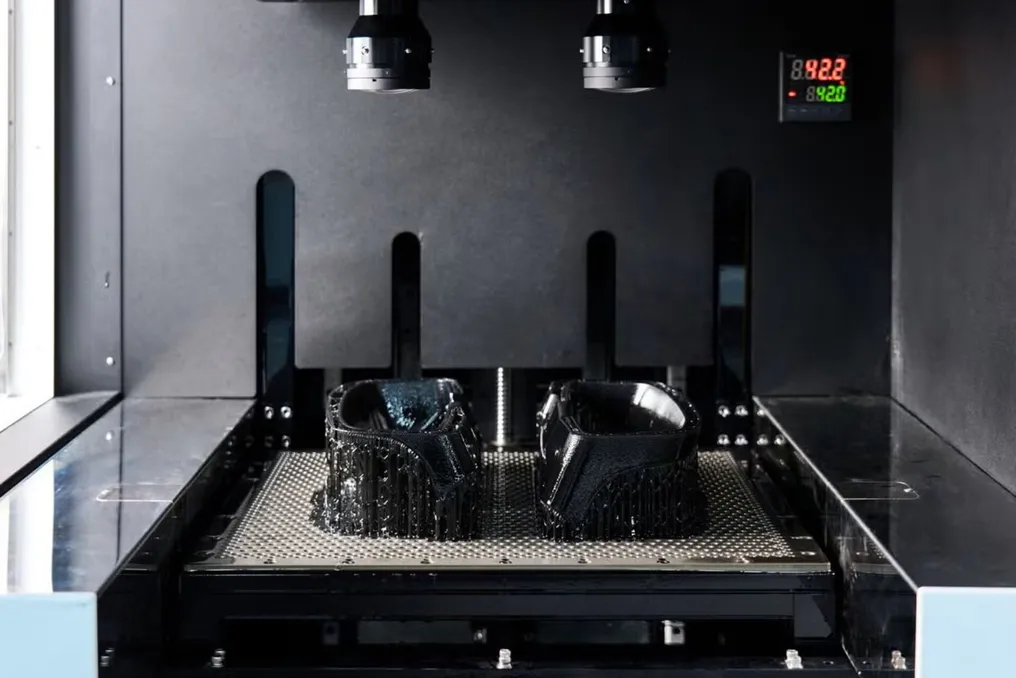
In practice, this technology enables the creation of lighter parts with geometries that would be impossible to obtain through casting or stamping. For polymeric materials, the AMSC uses techniques such as vat photopolymerization, covering Digital Light Processing (DLP) and stereolithography (SLA), in addition to powder bed fusion, which minimizes waste and eliminates the need for support structures.
Regarding metals, the center operates advanced systems of powder bed laser melting and directed energy deposition. Among these is DED-WAAM, which uses a welding arc to stack materials such as steel, stainless steel, aluminum, and titanium into large structural components.
Every produced part must pass through the Quality Inspection Cell, where its dimensions are verified and it undergoes rigorous tests for tensile strength, flexural rigidity, and impact resistance. Furthermore, the manufacturers themselves conduct internal metallurgical and material analyses to ensure the final product meets the same standards required for mass production.
The applications of the AMSC have far exceeded the prototyping phase. Currently, it manufactures jigs and fixtures used directly on assembly lines, as well as spare parts for discontinued models whose original tooling would be unfeasible to reactivate. In the restoration sector, engineers managed to recreate a side sill component of the Hyundai Pony using 3D scanning and reverse engineering, achieving an finish identical to the original.
In motorsports, 3D printing is already applied in the manufacturing of brake ducts, shock absorber mounts, and stabilizer bar blades, where the combination of lightness and rigidity is crucial. The group also develops the concept of Design for Additive Manufacturing, designing the part from the beginning to be printed. This allows consolidating several components that previously needed to be assembled separately and incorporating truss structures to reduce weight without compromising strength.
Hanwoo On, senior manager of the Additive Manufacturing Solutions team, commented on the advancement, stating that the company is 'rapidly internalizing additive manufacturing technologies.' He added that the use of these technologies now extends to high-value items outside the vehicle, such as manufacturing tools and equipment consumables.