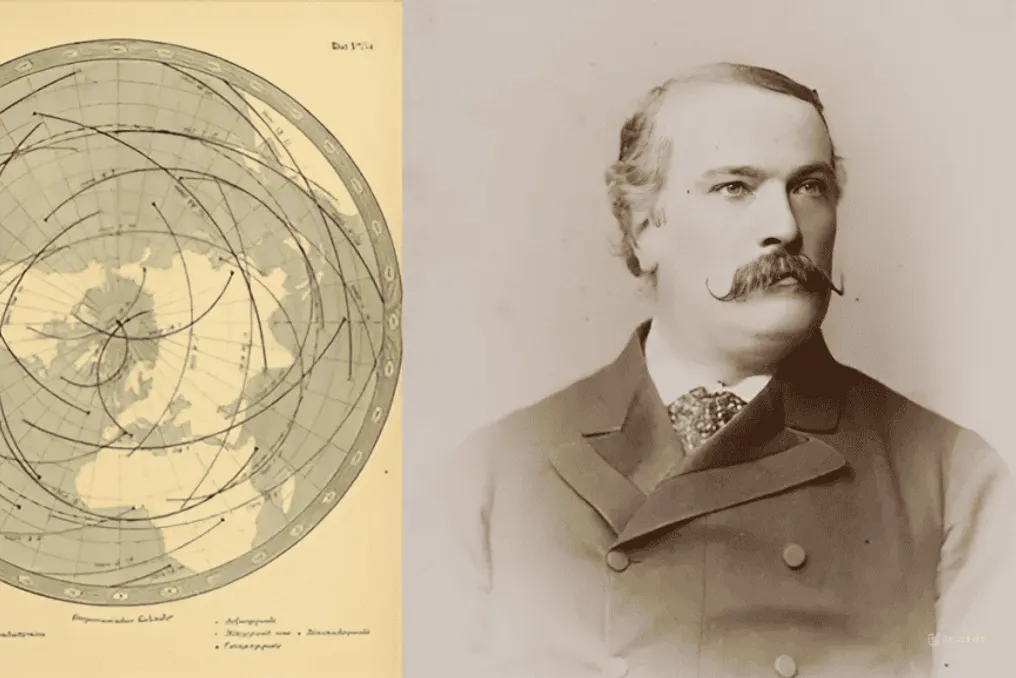
Eclipse observation enthusiasts have likely heard of Fred Espenak. This astrophysicist, born in the USA, worked for many years at NASA's Goddard Space Flight Center and became one of the world's leading figures in this field due to his detailed calculations and predictions of phenomena. He earned the nickname 'Mr. Eclipse.'
Espenak's passion began in March 1970 when he was 16 years old and witnessed his first total solar eclipse. This experience sparked an interest that defined his entire career. Eight years later, he began compiling eclipse bulletins for NASA and has since published numerous works considered seminal in the field.
Today, astronomers, photographers, and enthusiasts often refer to EclipseWise.com, created by Espenak, which combines maps, forecasts, and information on solar and lunar eclipses. The portal has become a primary source of information for those who wish to track these events anywhere on the planet.
Although Espenak is the most well-known today, he was not the first to dedicate himself to studying eclipses. Nearly a century ago, another researcher achieved a remarkable feat that continues to impress historians of science and astronomers.
The Predecessor: Theodor Ritter von Oppolzer
This scientist, whom many consider the true 'Mr. Eclipse' of the 19th century, managed to determine the dates and characteristics of over 13 thousand eclipses using only paper, pencil, and thousands of mathematical abacuses, without electronic calculators or computers.
Oppolzer was born on October 26, 1841, in Prague, which is now part of the Czech Republic. As a child, he moved with his family to Vienna, Austria, where he quickly attracted attention for his facility with numbers and talent for solving mathematical problems. His father, a renowned surgeon, wanted his son to pursue medical studies. Oppolzer received his doctorate in the field at the age of 23 but never abandoned his true calling—the study of astronomy.
Even at a young age, he devoted a significant amount of time to astronomical research. At the age of 21, he published his first scientific paper on the orbit of Comet Thatcher, discovered in 1861. Modern astronomers know that this comet is responsible for the annual Lyrid meteor shower observed in April.
In 1866, Oppolzer began teaching theoretical astronomy and geodesy at the University of Vienna. Simultaneously, he built a private observatory equipped with state-of-the-art instruments for the time, including a seven-inch refractor telescope, a comet finder, and a meridian circle.
In addition to observing the sky, the researcher gained fame for his exceptional ability to perform complex calculations. According to contemporary accounts, he memorized about 14 thousand logarithm values, which facilitated the solution of extremely lengthy mathematical operations.
His specific interest in eclipses arose in 1868 during a scientific expedition to the city of Aden, modern Yemen, to observe a solar eclipse. This experience sparked curiosity about similar events recorded in history, but there was a problem: organized records of ancient eclipses were virtually non-existent.
At that time, Oppolzer decided to create the most comprehensive catalog available at the time. His vision was far grander than just collecting dates; he aimed to accurately calculate when and where every eclipse could be visible, covering both past and future events.
To achieve this, he utilized the work of astronomer Peter Andreas Hansen, who had developed highly accurate tables of lunar motion. These calculations formed the basis for the massive undertaking that Oppolzer began in the following years.
The task was so vast that the first five volunteers refused to complete it. In 1882, the researcher hired five assistants and began paying them one florin for each calculated solar eclipse. This sum roughly equated to the cost of a meal and was sufficient to support the team until the project's end.
After many years of work, the manuscript was completed in October 1885. The work was titled Canon der Finsternisse and compiled about 8 thousand solar and 5,2 thousand lunar eclipses, covering a period of more than 33 centuries, from 1208 BCE to 2161 CE. The entire catalog was created manually. The calculations spanned 242 large volumes and comprised over 10 million handwritten digits. Decades later, specialists recognized this work as one of the greatest computational achievements of the pre-electronic era.
Conclusion
However, this enormous effort came at a cost. Oppolzer died in 1886 at the age of 45, shortly after the final proofs of the book were checked. Publication occurred the following year and quickly became a global standard in the field of eclipses, maintaining this position for nearly 80 years.
In 1962, the work was translated into English and republished, allowing new generations of researchers access to the material. Despite minor inaccuracies in some details of solar eclipse phases, the calculations are still considered exceptionally accurate.
Fred Espenak may be the most memorable name in eclipse study, but Theodor von Oppolzer's contribution remains one of the most impressive in the history of astronomy, demonstrating how dedication and mathematics could predict thousands of eclipses long before the computer age.