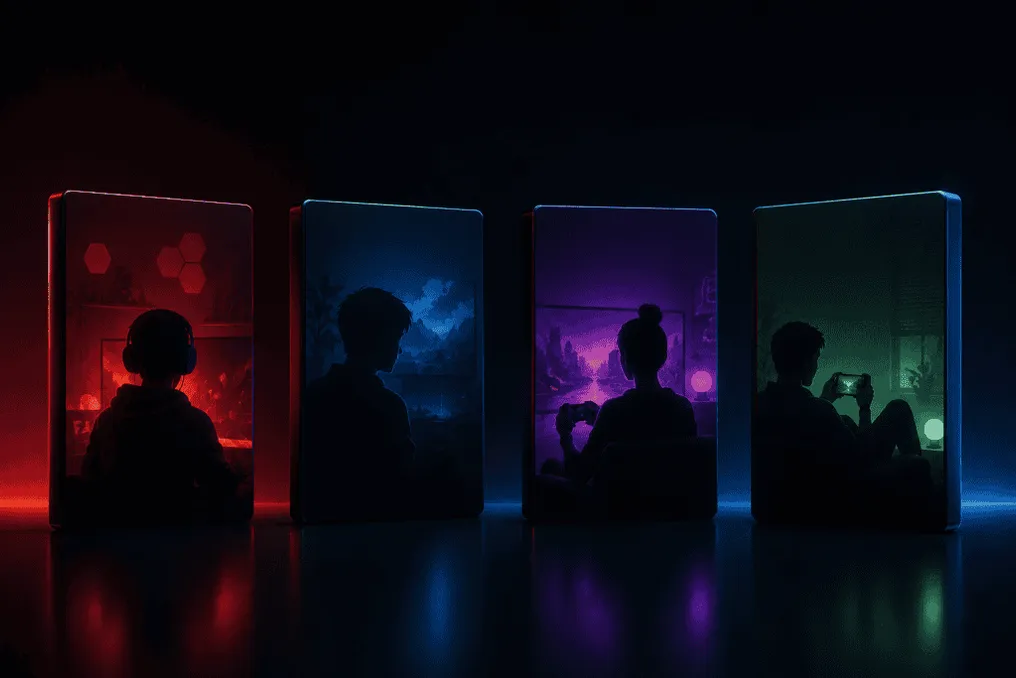
In the past, dedicating four or five consecutive hours to exploring an RPG was considered completely normal. However, nowadays, many players mix quick matches, thirty-second videos, WhatsApp messages, and other games before even finishing a mission.
It is questioned whether the generation influenced by TikTok has truly lost its concentration ability, or if the games themselves are adapting to new behavioral patterns. One author, while developing casual web games, noticed that what was casual ten years ago can now be classified as mid-core, simply by adding a bit more story or initial menus with a brief tutorial. This is already enough to fail to attract the young audience, who seems to have little patience for gaming.
When TikTok emerged, many initially thought it would just be another short-video focused social network. However, its impact was much deeper, as it helped establish a new way of consuming content: something fast, highly personalized, and driven by immediate rewards.
In seconds, the algorithm determines what will be displayed. If the video does not capture attention instantly, one gesture is enough for another to replace it. This almost endless cycle of novelty has reduced the time people are willing to dedicate to any content that takes time to engage them.
This behavioral pattern has not been limited to social media. Movies, series, news, and especially video games have started competing for attention in a scenario where the competition is no longer just between similar products, but against any form of entertainment available on the cell phone screen.
The gaming industry quickly identified this change in behavior. If previously it was common for a game to take hours to present its best ideas, today many need to capture the player almost immediately. This does not happen because people have lost the ability to engage with long experiences, but rather because the competition for attention has never been so fierce.
This change is visible in several aspects of modern design: tutorials have become shorter and more interactive, initial rewards appear sooner, and core mechanics are introduced in the initial minutes. The logic is straightforward: the sooner the player understands the pleasure of the game, the higher the chances they will continue playing.
This trend also explains the investment of many games in short-duration objectives, such as quick missions, daily challenges, frequent rewards, and constant progress bars. This generates a continuous sense of advancement, even in brief sessions. It is noticeable that many players feel they have 'achieved something' even with only fifteen minutes available.
Interestingly, the most popular games currently remain vast titles, such as Minecraft, GTA Online, Roblox, Baldur's Gate 3, and Elden Ring, which can require hundreds of hours. The difference lies in the fact that they have learned a crucial lesson: before asking for a hundred hours from the player, they must convince them in the first five minutes.
Although it may seem like long games are disappearing due to the battle for attention, the biggest recent successes prove otherwise. Titles like Elden Ring, Baldur's Gate 3, The Legend of Zelda: Tears of the Kingdom, Red Dead Redemption 2, and Minecraft continue to offer dozens or hundreds of hours of content, and millions of players remain willing to invest that time.
It is observed that these cited games still target the older audience, meaning this impact has not reached the industry as a whole. However, what has changed is not the willingness to experience extensive experiences, but rather the expectation regarding the initial moments of the journey. Previously, a game could take hours to reveal its maximum potential; today, it must convince the player much earlier that it is worth persisting. In other words, being great after twenty hours is not enough; it must be interesting from the very first minutes.
Perhaps the biggest effect of the TikTok generation has not been reducing the time spent gaming, but rather increasing the number of options competing for that same time.
The Developers' Challenge
The focus of developers has shifted from creating long experiences to capturing the player before they decide to open another application. Creating a good game has always been complex, but today developers face an extra obstacle: competing for the player's attention in an environment where any distraction is just a tap away.
Years ago, when someone decided to play, they generally remained focused on that experience for a long period. Currently, in a single session, it is common to switch between the game, a WhatsApp conversation, a TikTok video, a live stream, or a social network. This causes the video game to stop competing only with other games and start competing for space with practically the entire internet.
This reality directly affects development. The first minutes of gameplay receive increasing attention, interfaces need to be intuitive, mechanics are presented more quickly, and the pace of progression is meticulously planned to maintain player interest. The goal is not to simplify games, but to reduce the barriers between the player and the pleasure.
Simultaneously, there is a delicate balance. A game that only seeks constant rewards may end up neglecting exploration, narrative, and moments of reflection. The challenge for studios is to find a rhythm that can capture attention without sacrificing the depth that turns a good game into a memorable experience.
As with all technological transformations, the solution is not simple. The influence of short videos and the battle for attention have brought advantages, but they have also created new challenges for those who develop and for those who play. On one hand, modern games tend to be more accessible: tutorials are clearer, the first hours are more engaging, and progression is more evident, which lowers the barrier to entry for more people to enjoy the experience without having to spend hours just understanding the rules.
On the other hand, there is the risk that the incessant search for attention may result in design decisions excessively focused on immediate rewards. When every minute demands a new achievement, an unlocked item, or a completed progress bar, there is less room for discovery, contemplation, and the gradual building of a story.
Perhaps the biggest challenge for the industry is achieving balance. Memorable games have always known how to alternate moments of high action with periods of exploration, tension, and tranquility. If everything needs to happen constantly, there is a risk of turning the experience into an uninterrupted succession of stimuli, without giving the player time to absorb what they are experiencing.
In summary, perhaps the TikTok generation doesn't play less. It just expects something different. Current major successes demonstrate that there is still room for deep experiences and hundreds of hours of content, but winning that time has become significantly more difficult. Before, a game competed only with other games; today, it competes with practically the entire internet.