Unlike cars, where suspension is a dynamic control system affecting body roll and weight distribution during braking, on a motorcycle it represents a direct extension of the rider's spine. This results in a more intense connection with the road, which motorcyclists note.
When riding on two wheels, the rider becomes an active suspension mass, where the body forms a single ecosystem with the frame. When the motorcycle leans at a 45-degree angle in a turn, the rear suspension must absorb asphalt irregularities, working under a diagonal vector relative to gravity. Even a momentary loss of contact between the rear part and the road leads to a loss of trajectory.
Achieving the modern level of precision in motorcycle rear suspension has been the result of one of the most significant and inventive mechanical evolutions in transport. In the early periods of motorcycling, rear suspension was absent; the frame was a completely rigid steel structure known as a 'hardtail.' Shock absorption depended on tire deformation and the rider's ability to dampen jolts.
The industry's first solution was not to suspend the wheel, but to suspend the rider: saddle seats equipped with hinges, spring, or torsion springs appeared. While this saved the spine at low speeds, it did not provide a dynamic advantage because the rear wheel continued to bounce on the asphalt, which worsened grip and made fast turns extremely dangerous.
The first real attempt to give dignity to the rear wheel and connect an elastic element directly to the chassis was implemented in the form of a plunger suspension, popular in the 1930s and 1950s. In this system, the rear axle moved vertically inside two towers with springs attached to the ends of the rigid frame. However, the system had serious limitations: the travel was minimal (rarely exceeding 3–5 cm), the lack of effective hydraulic damping led to uncontrolled oscillations at high speed, and the constant change in distance to the engine sprocket due to vertical axle movement caused transmission wear.
The real revolution came with the introduction of the swingarm combined with two side shocks—the monoshock, which became established in the 1950s and dominated until the late 1970s. The articulation of the swingarm around a central pivot near the transmission sprocket significantly reduced chain tension changes. Initially, the shock absorbers were installed almost vertically, providing a direct lever arm.
The catalyst for the evolution was not the asphalt, but the motocross dust in the 1970s. Before that, rear suspension travel was about 8–10 centimeters. When rally and motocross racers realized that greater travel allowed them to overcome potholes and jumps faster, the travel sharply increased to nearly 30 centimeters. To accommodate such large travel without using shock absorbers the size of truck rods, engineers angled the shock absorbers forward on the swingarm, changing the leverage.
This leap in suspension use revealed two critical technical problems. The first was overheating and cavitation of the internal shock oil. Under intensive operation, the hydraulic oil created air bubbles and foam under low pressure, leading to a loss of damping. This problem was solved by inventing gas-charged nitrogen shock absorbers, which maintained constant oil pressure. Motorcycles became softer and faster, but the appearance of four-cylinder superbikes in the 1970s revealed the second problem.
The first drawback concerned the asymmetrical bending and twisting of the motorcycle's rear end: with the slightest asphalt irregularity, one of the shock absorbers could compress more than the other, causing the tubular steel swingarm to rotate. The second drawback was the trap of linear progressivity. In an effort to make the suspension soft over small bumps and stiff over hard impacts, the industry used progressive springs. However, the shock absorber hydraulics remained completely linear, which resulted in a worse outcome: the spring hardened too much at the end of the stroke, and the damper did not provide sufficient hydraulic lock for return, causing severe bouncing.
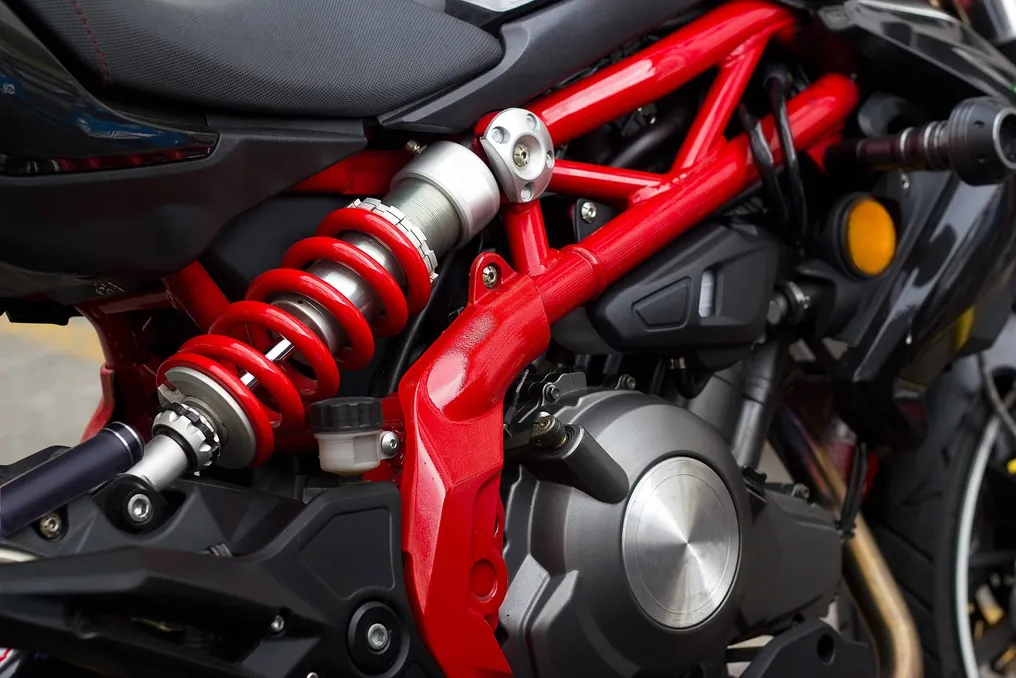
To eliminate these drawbacks, Japanese industry transitioned to the mono-shock system in the late 1970s. Yamaha first introduced the original Monocross system, placing one large shock absorber under the seat and tank, fixed at the center of the swingarm. This solved the problem of asymmetrical twisting, allowing the use of a larger shock absorber with a greater volume of oil and gas to handle the load.
However, in direct mono-shock systems (without pivots), compression still occurred relatively linearly. The final quantum leap came through the application of lever physics, leading to the creation of variable frequency systems using pivots—such as Honda's Pro-Link, Kawasaki's Uni-Trak, and Suzuki's Full Floater. In Honda's Pro-Link system, instead of directly mounting the shock absorber to the swingarm, pivots and triangular levers called links were created. As the rear wheel rises over an obstacle, the swingarm pushes the link, which changes the angle, force, and speed of the shock absorber compression, generating the concept of 'rising rate' (progressive compression speed).
The essence of this solution lies in changing the lever ratio. At the beginning of the stroke, the ratio is approximately 3:1. This means that when the wheel rises three centimeters due to a small irregularity, the shock absorber rod only needs to compress by one centimeter. With such slow oil movement, it passes smoothly through internal valves, allowing the motorcycle to softly absorb small impacts and maintain tire contact with the road. When the wheel hits a deep pothole or experiences acceleration in a turn, the change in the link angle changes the ratio to higher values, such as 4:1 or more, accelerating the rod's movement. This allowed the combination of spring stiffness and hydraulic damping at the end of the stroke, preventing sharp impacts while ensuring full support for the motorcycle.
Furthermore, concentrating all this dynamics in a single shock absorber located centrally and close to the center of gravity allowed the impact load to be evenly distributed across the frame, permanently eliminating asymmetrical swingarm twisting.
The Brazilian Exception
The transition from linear to progressive physics triggered important moments in Brazilian enthusiast culture. In the 1980s, when the national market was closed to imports, advanced global technologies seemed like an unattainable dream for the country's motorcyclists. Amid shortages, the figure of José Antonio Casarini emerged. A former racer, mechanic, and master mechanic, Zé Casarini gained legendary status, transforming street motorcycles into true racing machines in his workshop in São Paulo. In an era when there was no possibility of simply buying foreign parts online, he designed, machined, and welded components from scratch, becoming one of the brightest inventors in the history of Brazilian motorcycling.
The Honda CB 400 dominated Brazil, but it came with a standard and limited twin-shock system. Here, the genius of garage engineering shone through: Casarini decided to do what skeptics considered impossible for such an original chassis architecture. He gave up the space for the air filter and battery under the seat, designed and welded a structural reinforcing tower onto the original tubular frame, built a new reinforced swingarm, and manually installed the Pro-Link system with a central mono-shock. Projects like Casarini's were published in specialized magazines, proving in practice that converting a twin-shock motorcycle into a machine with a progressive mono-shock suspension radically changes handling precision.