
When returning home from working abroad, women bring to Uzbekistan not only financial assistance but also new skills, unique perspectives, and untapped potential for the country's economy. However, there is a need to provide these women with the necessary tools and support for successful adaptation.
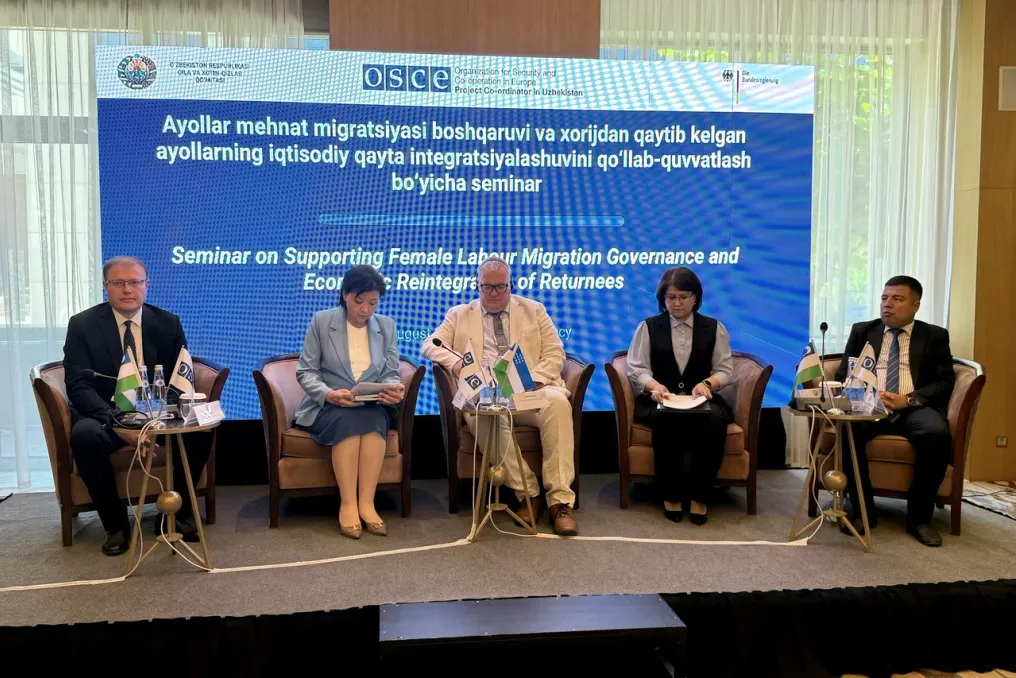
To address these issues, the OSCE Project Coordinator in Uzbekistan, together with the Committee on Family and Women and national partners involved in labor migration management, organized a seminar in Tashkent. The event aimed to discuss the experiences of female migrant workers, identify remaining difficulties, and seek practical measures to strengthen their economic reintegration.
Although migration opens up opportunities, the path for women is often associated with specific challenges, including navigating local labor markets and accessing financial resources upon return.
The discussions were based on data and lessons learned during the project implementation, as well as on the practical experience of state institutions and international organizations working to support female labor migrants and returnees.
Umida Abdullaeva, First Deputy Chairman of the Committee on Family and Women of the Republic of Uzbekistan, noted that comprehensive work is being carried out in Uzbekistan to support migrant families and provide them with multifaceted assistance. She added that, in cooperation with the OSCE Project Coordinator in Uzbekistan, a cascade training program is being implemented, aimed at the economic reintegration of returning women. This program plans to train instructors who will help master in-demand professions, IT skills, and financial literacy.
The seminar served as a joint platform for state structures and international organizations to exchange experiences, discuss current problems, and define practical, gender-sensitive approaches to improving labor migration management and supporting the economic reintegration of women.
Ambassador Anti Karttunen, OSCE Project Coordinator in Uzbekistan, emphasized the critical importance of cooperation between various stakeholders in forming safe, inclusive, and rights-enhancing migration systems. He stated that effective and gender-sensitive labor migration management lies in creating conditions that allow women to return home confidently, apply the skills and experience acquired abroad, and make a full contribution to the economic and social development of Uzbekistan.
The event also included a panel discussion with representatives of the OSCE POCUZ, the Committee on Family and Women, the Migration Service, the Ministry of Employment and Poverty Reduction, and IOM, focusing on strengthening institutional interaction and improving support services for female labor migrants throughout the migration cycle.
This seminar is part of a two-year project by the OSCE Project Coordinator in Uzbekistan titled 'Promoting Effective Management of Female Labor Migration and Economic Empowerment of Returnees.' The project supports national partners in strengthening gender-sensitive labor migration management, enhancing institutional interaction, and expanding opportunities for the sustainable economic reintegration of returning women. The project is financed by Germany, Norway, Turkey, and the Republic of Korea.