Imagine finding yourself on an island where there is no one to help you and no way to leave. Nevertheless, you have to fight for survival in these conditions. The story of one woman who lived off the coast of California in America is very similar to this description. She spent about eighteen years in isolation on a deserted island.
When she was discovered and brought ashore, no one in the world knew her native language anymore. This woman is known today as Juana Maria or the 'Lonely Woman of San Nicolas Island.' However, that was not her real name, and it remains a mystery what her true name was or what language she spoke.
Juana Maria was born in the early 19th century into the Nikolen tribe, which lived near the southern coast of California on San Nicolas Island. Even in childhood, she witnessed a terrible attack on her tribe. According to accounts, a fierce battle took place between fur trappers arriving from Alaska and the Nikolen people. After this, many members of the tribe were killed, leading to the near-complete disappearance of the Nikolen community; by the 1830s, their population had shrunk to about twenty people.
When the others left, she remained alone. Later, priests of the Franciscan order of Mission Santa Barbara sent a ship to bring the remaining Nikolen members to the American mainland. Most people left the island, but Juana Maria and her young son remained there. To this day, there is no exact answer as to why this happened. Some believe that her son could not board the ship, so she returned to the island for him. Others believe that her son was already on board, but Juana Maria returned to the shore, and they were lost forever. Historians note that there are many versions of this story, making it extremely difficult to establish the truth.
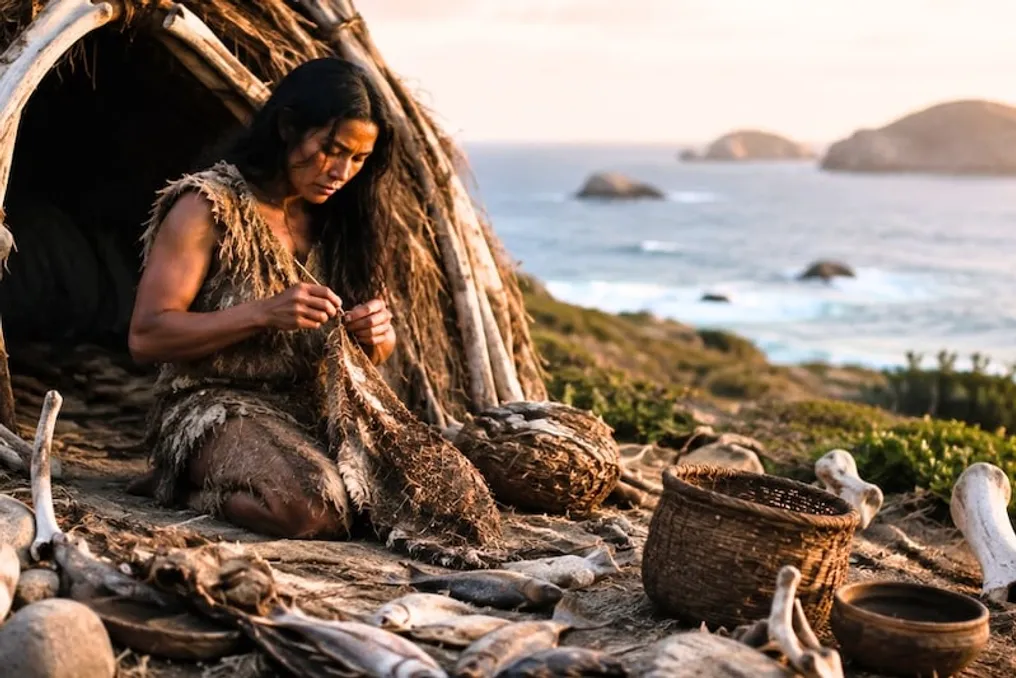
After this, Juana Maria spent about eighteen years in complete solitude on the island. Ships occasionally approached her, but no one could find her. During this time, her son died in a maritime disaster, presumably from an attack by a shark or a killer whale. After her son's death, Juana Maria was completely alone, but she did not give up. She built a shelter from whale bones and dry grass. She made clothes from bird feathers and animal hides. To sustain life, she fished and ate seal blubber. She had a piece of an old knife blade that helped her create needles, baskets, water containers, and nets.
Finally, in 1853, she was discovered. When found, she was dressed in feather fabric and lived in a house made of whale bones. She was transported to Santa Barbara in California. Local residents first showed her a horse, which, according to reports, she had never seen such a large animal. She was deeply struck by seeing a person riding a horse. Upon arrival in California, another surprising fact became apparent: no one understood her language. According to historians, the Nikolen language was almost completely lost, so everything Juana Maria said remained incomprehensible. Her language, songs, and conversations disappeared forever from history.
Shortly after arriving on the American mainland, she was baptized according to Christian beliefs, although it is unclear if she consented to this. Just seven weeks after leaving the island, she died of dysentery in Santa Barbara. Nevertheless, those who saw her up close said that she rejoiced in the new world. She often sang and danced, and the small gifts given to her by people, she shared with nearby children.
Today, Juana Maria's story is considered one of the most mysterious and inspiring true stories. It is not just a tale of one woman's survival, but also a wonderful example of human courage, patience, and the ability to withstand circumstances.