Karnataka is exploring cooperation with the artificial intelligence development company Anthropic to integrate AI into public administration, education, scientific research, and workforce development.
Karnataka is exploring cooperation with the artificial intelligence development company Anthropic to integrate AI into public administration, education, scientific research, and workforce development.
On Thursday, a meeting took place at Vidhana Soudha in Bengaluru between Chief Minister D.K. Shivakumar and an Anthropic delegation. The meeting was attended by Anthropic's Head of International Policy, Michael Sellitto; Karnataka's Minister for Electronics, IT/BT and Home Affairs, Priyanka Hardge; Finance Advisor L.K. Atiik; and other senior officials.
Following the meeting, Shivakumar noted that discussions focused on the transformative potential of artificial intelligence and opportunities to strengthen Karnataka's innovation ecosystem.
He stated in a post on X: 'We had a substantive discussion on the transformative potential of artificial intelligence and explored opportunities for collaboration in areas such as citizen-centric governance, upskilling, scientific research, startup support, and our AI University initiative.'
The state is interested in gaining Anthropic's experience in using AI for detecting and reducing fraud in government systems. The parties also discussed applying this technology to improve public services and enhance cybersecurity.
Another important proposal was the use of AI to improve the security, privacy, and efficiency of examination material preparation conducted by government institutions and educational organizations.
The discussion also covered the implementation of enterprise AI, with responsible deployment, data privacy, and data sovereignty being considered critical aspects when dealing with confidential citizen and state information.
Karnataka presented its plan to create an AI ecosystem around the proposed AI University, large-scale upskilling programs, and support for deep technology innovations.
Both sides reviewed AI certification programs, including the potential certification of Claude under the state's NIPUNA initiative. Claude is a family of generative AI models from Anthropic.
Healthcare and scientific research were also identified as potential areas for joint work. Karnataka further discussed ways to support its startup ecosystem, especially enterprises developing deep technology and AI-based solutions.
Shivakumar emphasized that the government will work to ensure that the benefits of AI remain inclusive, responsible, and accessible. He added: 'Our Government will continue to support joint initiatives that strengthen Karnataka's innovation ecosystem, creating better public services and more opportunities for our people.'
Although no official agreement or timeline has been announced yet, Karnataka and Anthropic agreed to continue dialogue regarding AI-driven governance, talent development, research, and innovation.
When the astronauts of the Apollo 11 mission set off for the first human landing on the Moon in 1969, they carried technology that seems unimaginable today. The computer responsible for the ship's navigation had less computational power than the cheapest modern smartphones, yet it played a decisive role in one of the most complex missions in the history of space exploration.
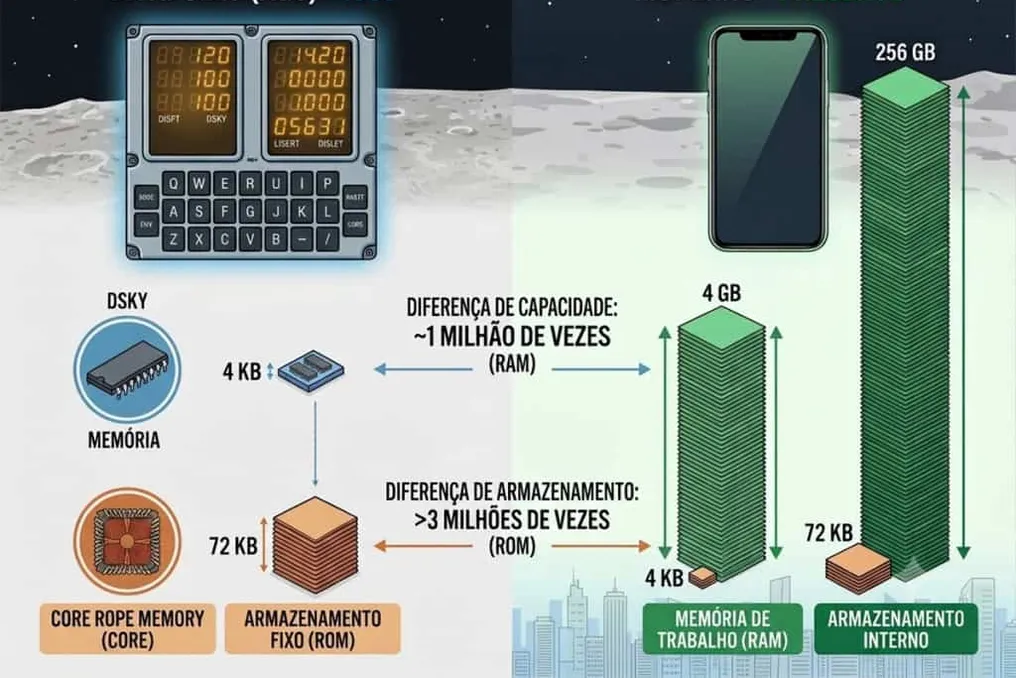
The Apollo Guidance Computer (AGC) only had 4 KB of RAM and 72 KB of permanent storage, which is less than many modern calculators. In comparison, a basic smartphone available today might have 4 GB of RAM and 256 GB of internal storage. The difference in memory capacity reaches approximately a million times, and even more if considering available data storage space.
Thanks to this, a modern smartphone could execute the Apollo 11 navigation software. Nevertheless, this comparison overlooks a fundamental point: the lunar mission computer was not supposed to be as powerful as a modern device, but it had to be exceptionally reliable.
The AGC was developed by the Massachusetts Institute of Technology (MIT) Instrumentation Laboratory and manufactured by Raytheon. The equipment operated with a processor of about 2 MHz and was designed to function in much harsher conditions than any electronic device used on Earth. Furthermore, the Apollo 11 computer did not operate in isolation; the most complex trajectory calculations were performed by large computers installed in NASA control centers in Houston.
The Saturn V rocket also had its own computer in the instrument bay. The lunar and command modules had their own AGC units. Thus, the mission utilized a network of specialized systems, not just one computer. During the flight, the AGC was responsible for critically important tasks such as aiding navigation, managing operations, and providing real-time information to the astronauts. Its main advantage lay not in memory volume, but in its ability to perform vital functions with high accuracy.
A modern smartphone has greater speed, but it is designed for a different purpose. The AGC functioned with a highly predictable control system designed to ensure critical tasks were completed on schedule. While modern systems like Android and iOS are designed to provide the user with a broader experience by balancing multiple processes simultaneously, they do not possess the same level of precision in controlling every operation.
Another important aspect was resilience. The Apollo computer was designed to withstand intense vibrations during launch and radiation exposure in space—conditions that could damage ordinary electronic equipment. This reliability was tested during the Apollo 11 descent to the lunar surface. The computer showed error signals 1201 and 1202, indicating processing overload, but the system managed to restart, discard less important tasks, and continue controlling the spacecraft. The software development was led by engineer Margaret Hamilton.
The comparison between modern phones and the Apollo 11 computer is often used to dispute the fact of the moon landing. However, there is independent evidence confirming the landing. The Apollo missions left reflectors on the lunar surface that bounce laser beams sent from Earth. Observatories in various countries still use these devices today to accurately measure the distance between the Earth and the Moon.
Furthermore, images taken by NASA's Lunar Reconnaissance Orbiter (LRO) have captured the landing sites, the modules left by the astronauts, and traces of their activity on the surface. The difference can also be seen in daily life: a single photo on a phone, about 4 MB in size, takes up dozens of times more space than the entire permanent memory of the computer that helped humanity reach the Moon.
In Brazil, the historical broadcast of Apollo 11 to a significant portion of the population was made possible because Embratel opened the Tanguá ground station in Rio de Janeiro several months prior, allowing the reception of satellite signals. More than half a century later, a regular phone continuously receives satellite signals to calculate its location using the Global Positioning System (GPS). This comparison demonstrates not only technological progress but also the outstanding engineering behind the computer that, despite minimal resources, helped achieve one of humanity's greatest accomplishments.
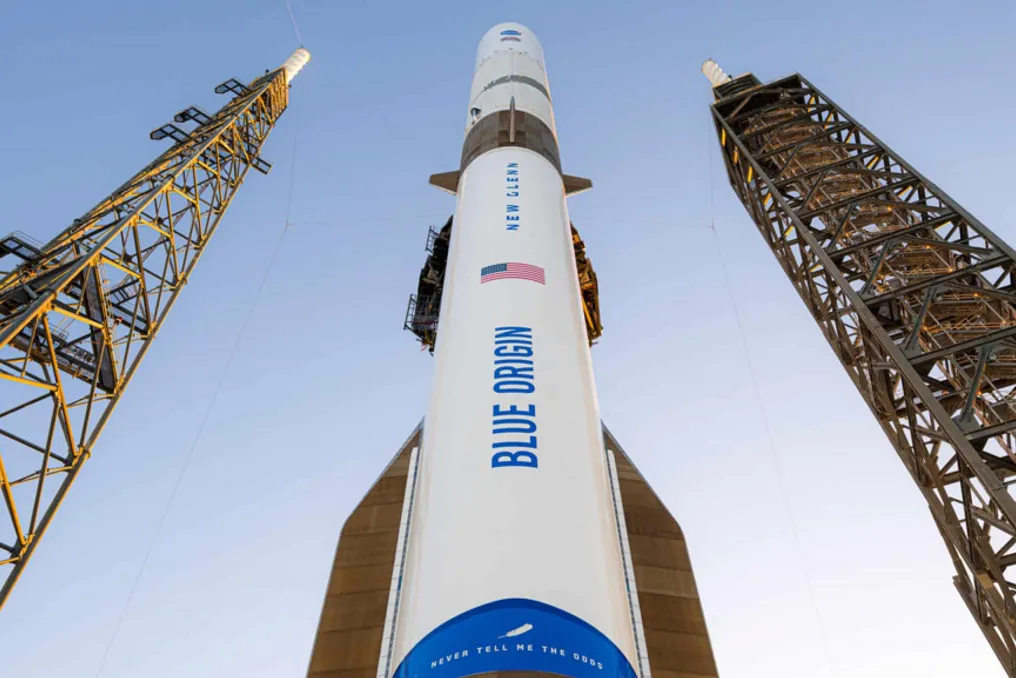
A routine test conducted on May 28 resulted in the explosion of the giant New Glenn rocket, an event attributed to an oxygen valve in one of the BE-4 engines. Blue Origin confirmed this finding after conducting detailed analyses of the damaged equipment.
The incident occurred at the Cape Canaveral Space Force Station in Florida. The detonation not only destroyed the rocket but also affected some structures located in the launch area.
The investigation conducted by Blue Origin indicated that the failure originated in the main oxygen valve of one of the seven BE-4 engines installed on the first stage of the New Glenn. This anomaly was later validated through the recovery and subsequent inspection of the hardware.
Dave Limp, CEO of Blue Origin, communicated that the conclusion about the problem was reached after recovering the parts and conducting meticulous inspections. To better understand the nature of the defect, the company conducted tests on components and engines.
The planned modifications to correct the issue involve adjustments to the component. The New Glenn, which is 98 meters tall, is one of the largest rockets developed by Blue Origin, and its first stage was designed to support a minimum of 25 launches, being reusable.
This rocket will play a crucial role in NASA's Artemis program. Blue Origin plans to use it to transport the Blue Moon lunar module, selected by the space agency for future crewed missions to the Moon.
Before moving on to crewed flights, the company aims to test the Mark 1 prototype in an uncrewed mission by the end of the current year. The primary objective of this phase is to evaluate the complete performance of the equipment.
The New Glenn debuted in January 2025, returned to flights in November of the same year, and again on April 19 of this year. In the most recent flight, the rocket failed to place the BlueBird 7 satellite, belonging to AST SpaceMobile, into the intended orbit, resulting in the loss of the payload.
Despite the setbacks, Dave Limp assured that the resolution is underway and that the necessary changes will be minor. He stated: 'The path forward is clear. We are making small modifications to the valve that can be quickly installed on the current engines.'
Blue Origin notified that the new components should be ready by the end of August. Meanwhile, the team continues to analyze all collected data to finalize the investigation and prepare for the next phase of New Glenn testing.
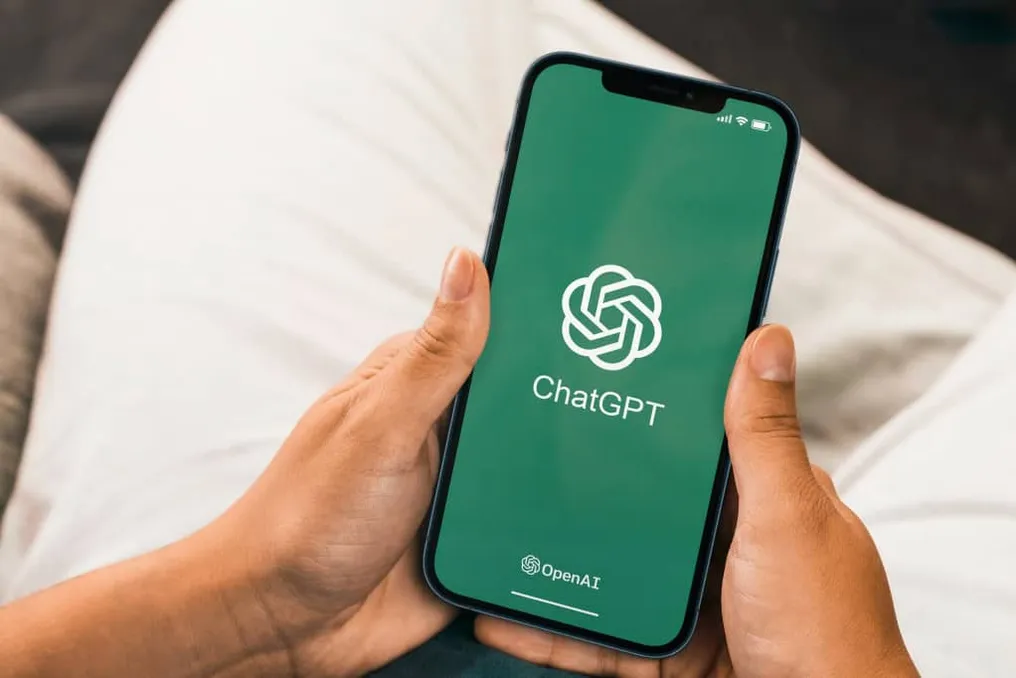
OpenAI announced significant changes to its plans, allowing users of the Free and Go versions to use ChatGPT with unlimited text conversations, in addition to introducing new reasoning features on the platform.
These modifications occur alongside the company's model updates, including improvements to GPT-5.6 Sol, intended for Plus and Pro subscribers, promising more reliable answers.
Starting next week, users of the Free and Go plans will be able to send text messages without worrying about current restrictions, although limitations for features such as images and files remain in effect.
Additionally, OpenAI will release a button called 'Think,' a tool designed to assist the chatbot in processing more complex questions, granting access to a higher degree of reasoning capability in these scenarios.
Another notable change will be the replacement of the standard model for these plans with GPT-5.6 Luna.
Among the disclosed changes, the main novelty for Plus and Pro plans is the update to GPT-5.6 Sol. According to OpenAI, this model has been enhanced with the goal of 'making fewer mistakes,' especially in responses involving dates, numbers, sources, rules, or assumptions.
The company also assures that the new version will be able to utilize the sources it finds more effectively to answer user queries. ChatGPT payers will also receive a new slider that will allow them to define 'how much thought ChatGPT puts into an answer.'
This feature will allow the user to modulate the level of artificial intelligence analysis according to their needs, whether to obtain faster answers or to perform more detailed evaluations.
OpenAI informs that the updated GPT-5.6 Sol will present 'more direct answers' and 'more concise formatting,' avoiding the addition of superfluous information when it is not relevant.
The updates regarding GPT-5.6 Sol and the reasoning control will be accessible starting Thursday, thus expanding the possibilities of using ChatGPT for various user profiles.