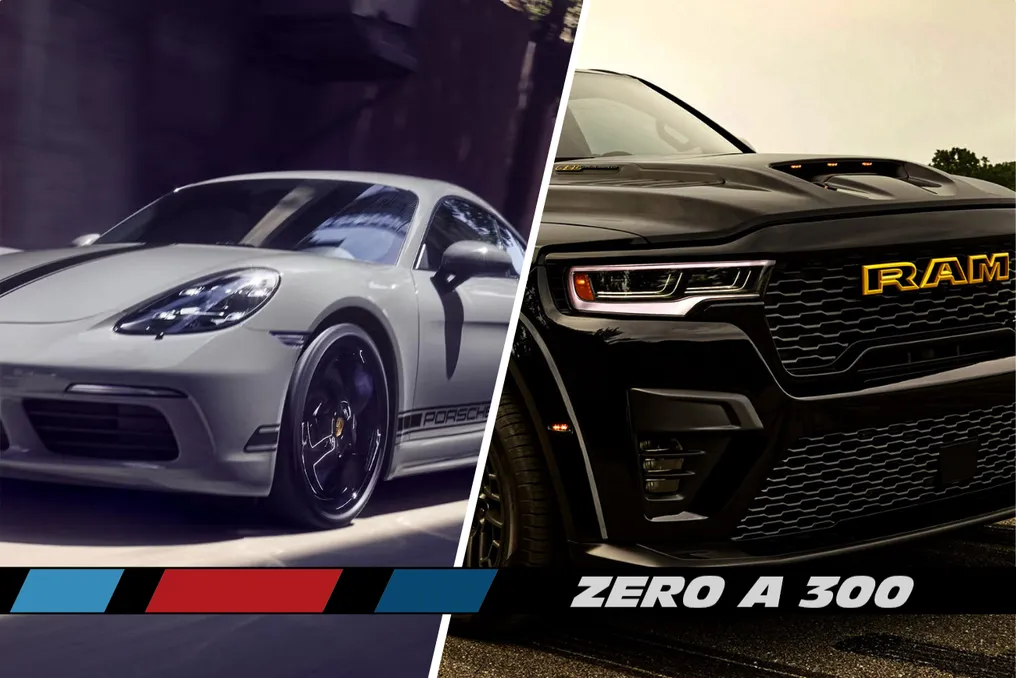
Although the production of the Porsche 718 Boxster/Cayman was discontinued in 2025, the future of the model remained uncertain. Subsequently, the German automaker revealed that the next generation of this rear-engined sports car would be fully electric, news that was initially not well received by the public.
In response, Porsche informed the press, back in December of the previous year, that the PPE (Premium Platform Electric) platform would be adapted to accommodate combustion engines. This fueled speculation that only track-focused variants, such as the 718 GT4, would be gasoline-powered.
However, in recent months, rumors have surfaced that the launch of the electric 718 would be delayed or even canceled. Nevertheless, CEO Michael Leiters clarified the situation when speaking with the German publication Frankfurter Allgemeine Zeitung, stating that the original plan remains valid and the electric 718 will be launched.
The executive declared: 'Regarding the electric 718, we have concluded that we will produce this model,' adding that the choice is due both to economic viability and the fact that it is a 'fantastic car.'
The financial justification is supported by 2025 sales figures, when Porsche recorded 280,000 sales, with 22.2% being pure electric and 12.1% being plug-in hybrids. In Europe, the penetration of electrified vehicles was even higher, reaching 57.9% of Porsche sales that year.
Additionally, the development of the electric 718 was already quite advanced, and the delivery deadline was extended due to the rework of the platform to accept combustion engines. Canceling a project at this stage would represent a financial waste. Considering that Leiters took over from Oliver Blume with the goal of recovering Porsche's profitability, which faces difficulties related to the Volkswagen Group crisis, this would be an economically imprudent decision.
On the other hand, under Blume's management, Porsche saw its profit drop by $2.1 billion, a direct result of excessive investment in electric vehicles, which reinforces the strategy of adapting combustion engines onto the PPE platform.
Despite the lack of enthusiasm from enthusiasts for the electric 718, this has little impact on Porsche's decisions. If, ultimately, this change helps stabilize the company and ensure the survival of the 911, this reality must be accepted.
Meanwhile, in the United States, the Ram 1500 Rumble Bee received a power boost even before it started being sold. Its most extreme variant, the SRT, equipped with the 6.2-liter Hellcat V8 engine, already boasts 787 hp.
Ram announced that the pickup truck will also participate in the Direct Connection program, a Mopar performance parts catalog. This program allows for an upgrade of the 2.4-liter supercharger to 3 liters, increasing total power to over 900 hp while maintaining the warranty. This kit costs nearly $11,000.
The supercharger kit is available for other engine configurations: the 5.7-liter engine of the initial version goes up from 400 hp to about 600 hp, and the intermediate version's 392 V8 (6.4 liters) goes from 476 hp to approximately 700 hp. The SRT variant already exceeds 900 hp.
Those who purchase the supercharger kit can add a Magnaflow exhaust system. Furthermore, the Rumble Bee and Rumble Bee 392 versions can receive a suspension package with 24-position adjustable coilover shocks and stiffer springs, lowering the front by 2.5 cm and the rear by 7.5 cm, which, according to Ram, improves traction and cornering performance.
The manufacturer confirmed that these packages will be released alongside the trucks, scheduled for late 2026 for the Ram Rumble Bee and early 2027 for the 392 and SRT versions.
In another sector, GWM introduced a work version of the Poer P30 pickup, making it the most affordable double-cab mid-size pickup in Brazil, priced at R$ 205,000.
This new configuration is R$ 22,000 cheaper than the Poer P30 Trail (R$ 227,000) and R$ 42,000 cheaper than the Exclusive (R$ 247,000). Comparatively, the direct rival Fiat Titano Endurance costs R$ 238,490, showing a difference of R$ 33,490.
Entry options from competitors like Ford Ranger, Chevrolet S10, and Toyota Hilux cost between R$ 248,600 and R$ 256,390, but they are chassis-cab models, whereas the Poer P30 Pro already comes with a double cab and standard bed.
To achieve the R$ 205,000 price point, GWM simplified the trim: alloy wheels were replaced with 18-inch steel wheels, and details such as the grille, mirrors, and door handles were finished in matte black and dark gray.
Internally, the multimedia screen was reduced from 14.6 to 12.3 inches, and the digital instrument cluster decreased from 10.25 to seven inches. The Pro version also lost features such as 360-degree camera, front parking sensors, electric mirrors, inductive charging, connected services, and transparent vision system. The front seats no longer have electric adjustments, heating, or ventilation, and the interior is entirely black.
The mechanical assembly remains unchanged: it uses the 184 hp and 48.9 kgfm 2.4 turbo-diesel coupled with a nine-speed automatic transmission. The 4x4 traction offers 2H, 4H, and 4L modes, in addition to electronic rear differential lock. The safety package includes six airbags, adaptive cruise control, lane keeping assist, autonomous emergency braking with pedestrian and cyclist detection, frontal collision warning, and license plate recognition.
Volvo reiterated the warning to owners of the EX30 involved in the battery recall: they should not charge the vehicles above 70% capacity until the repair is performed. The manufacturer identified a production flaw in the high-voltage battery cells of some units of the electric SUV, which could cause short circuits, overheating, and fire risk.
The recall covers EX30s manufactured between September 6, 2024, and October 25, 2025, affecting over 40,000 cars globally, with about 5,600 in Brazil. As a precaution, Volvo instructed owners to limit charging to 70% via the car's system until the batteries are replaced at a dealership. In certain markets, avoiding charging in enclosed or unsupervised locations was recommended.
Luis Rezende, Volvo's president for the Americas, emphasized in an interview with CBN radio that exceeding this limit is unsafe, asking all owners to comply with the recall. He stated: 'We ask the owners of the EX30, please follow the recall. The battery limit is indeed 70%. Charging above that is not safe and can really cause accidents.'
The recall requires inspection and replacement of battery components. The alert gained prominence after a Volvo EX30 caught fire in Rio de Janeiro, although there is no confirmation yet of a link between this incident and the fault that motivated the recall. Until the repair is completed, the guidance is to keep the charge at 70% and visit a Volvo dealership.
To celebrate 30 years of the manga Initial D, Seiko launched the Keisuke Takahashi RX-7 FD3S chronograph, in collaboration with the retail chain Premico. The watch is inspired by the character Keisuke Takahashi, driver of the iconic yellow Mazda RX-7 FD. The color appears on the dial, and the secondary dials replicate the car's instruments. The 12 o'clock marker mimics the rotor of a Wankel engine, and the RedSuns emblem is at the 3 o'clock position.
This quartz watch features a stainless steel case and bracelet. The back cover is engraved with the franchise logo and the individual unit number. 1,995 units will be produced, referencing the serialization year of Initial D in the Japanese magazine Weekly Young.
This is the second Seiko watch inspired by Initial D; last year, there was a release based on Takumi Fujiwara's Toyota AE86. It is common for Japanese watchmakers to partner with anime and manga, attracting a community of horology collectors.
The Seiko Keisuke Takahashi RX-7 FD3S began selling on August 3rd at the official Premico store for 65,780 yen (equivalent to about R$ 2,140). Importers like Hobby Genki also offer pre-sales for ¥ 71,980 (approximately R$ 2,340), with international shipping expected in January 2027. Due to the limited edition, prices on the parallel market can be significantly higher, as seen in the Takumi Fujiwara version, which can cost almost R$ 20,000 in Brazil.
Finally, Ford continues the development of its next Le Mans car. After confirming the Coyote-derived V8 and performing the first engine ignition, the racing division announced that the assembly can reproduce a complete lap at La Sarthe on the dynamometer.