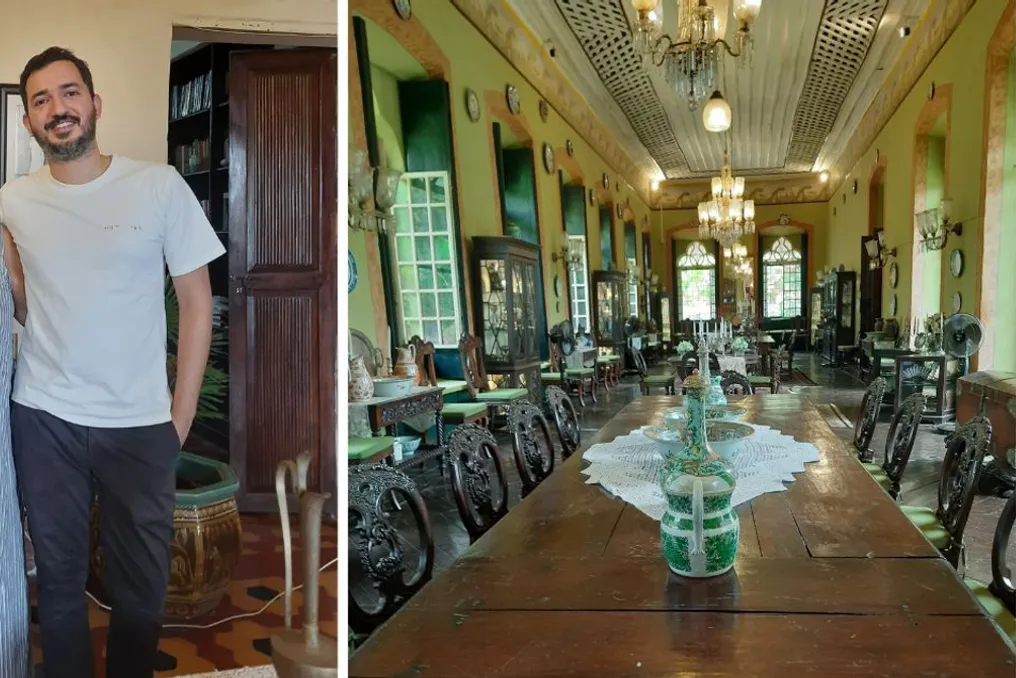
The article's author, at the end of their trip to Goa, visited the Figueiredo mansion, which is home to a family that identifies as custodians of this four-century-old heritage. The author traveled 550 km to see this place.
Before visiting the house, the author learned that the Figueiredo House is well-known in Goa. The house is located in Loutolim, South Goa, and dominates the region's landscape.
Pedro, a representative of the nineteenth generation of this family, explains that for him, the house was always just a family retreat in Goa, although it has now become a museum thanks to the efforts of his mother and himself.
Returning to a Forgotten Home
All of Pedro's knowledge about the house comes from the stories told to him by his maternal grandmother, Maria de Lourdes. He recalls that his grandmother and Aunt Georgina were matriarchs of the family, whose tales enriched the understanding of the place's history.
For the last decade, Pedro has been studying thousands of artifacts and collectibles adorning the rooms of the Figueiredo House, striving to learn the origin, purpose, and history of each item. He moved to Goa after graduating with a degree in graphic design in 2017.
He recounts that after his uncle's death, his grandmother maintained the house alone. His mother visited the house annually starting in 2008, and in 2014, she asked him to consider working with the house. This trip became a turning point as they encountered a house that had fallen into disrepair. His mother, Maria de Fatima Filomena Figueiredo de Albuquerque, remembers it as an 'unrecognizable' and 'ghostly house,' as the garden had turned into a forest.
The house, dating back to 1590, impresses with its grandeur, and the doors of the Figueiredo House are open to visitors. The guesthouse model was launched in December 2016, and this guesthouse includes nine rooms named after the family's ancestors.
During the tour, the author examined hand-painted wallpaper and reflected on the stories these walls might hold. Maria skillfully shares anecdotes about every corner of the house with enthusiasm and respect, revealing the significant place each part of the house holds in the family's hearts. These floors and walls have witnessed weddings, celebrations, sorrow, and family conversations.
Despite the decision to 'restore' its former splendor, the couple considered structural changes unnecessary, wishing to preserve the historical traditions of the house. Maria was guided by nostalgia, recalling her mother's stories and shared moments with cousins and aunts. She emphasizes that she never regretted moving from Portugal to Goa, focusing on happy moments. They did not aim to modernize the house, but only to preserve it as it was built in the sixteenth century. For them, it was a matter of honor, devotion, and respect for their ancestors.
Pedro recalls the first years of restoration when he himself cleaned the walls with a wire brush and planted grass. However, his efforts went beyond simple restoration because he wanted to study the artifacts. His main source of knowledge was his grandmother, who told hundreds of stories about the items in the house. Additional sources included the internet, historians, and museum visitors. In the first two years, he conducted all tours independently, forcing him to constantly learn.
Pedro thanks the women of the family for allowing the house with such rich heritage to withstand the tests of time.
Meeting the Matriarchs of the Figueiredo House
Pedro shares an anecdote about how his aunt refused to sell the house to former Prime Minister Indira Gandhi, despite the interest of her father, Jawaharlal Nehru. This incident demonstrates the resilience of the women in the family. There is also a story of how his grandmother insisted on playing cards with men, which contradicted the patriarchal society.
Pedro explains that when his grandfather served as a civil engineer in Mozambique, there were separate rooms for men and women. His grandmother managed to gain permission to enter the men's room to play cards, becoming famous for it.
Pedro stresses that maintaining property and collections in a traditionally patriarchal society was not an easy task, but the women in his family ensured the preservation of the house and its treasures. His aunt became one of India's first female judges working in the High Court, and his grandmother served as a member of parliament. Together, they preserved the heritage for future generations.
The author notes a similar resilience in Pedro's mother, who, after a successful 46-year corporate career, now exhibits the same mastery as a custodian of the family home.
Nurturing Amidst History
Even though it is their own home, the mansion continues to evoke awe in Pedro. When asked to choose a favorite spot, he ponders for a long time and chooses the balcony—a traditional covered veranda in Indo-Portuguese houses in Goa. He recalls enjoying hot summer days there as a child.
Another place that evokes special memories is the dining room, where numerous family dinners took place. From an early age, he was taught table etiquette, which he later understood as part of family values. Today, the table in the Figueiredo House is always full of seasonal delicacies, and his mother and son hope it will always be filled with family and joy.
Concluding the tour in the living room, the author stops again at the gates of the Figueiredo House, smiling, realizing that this conversation was truly the result of many years of effort.