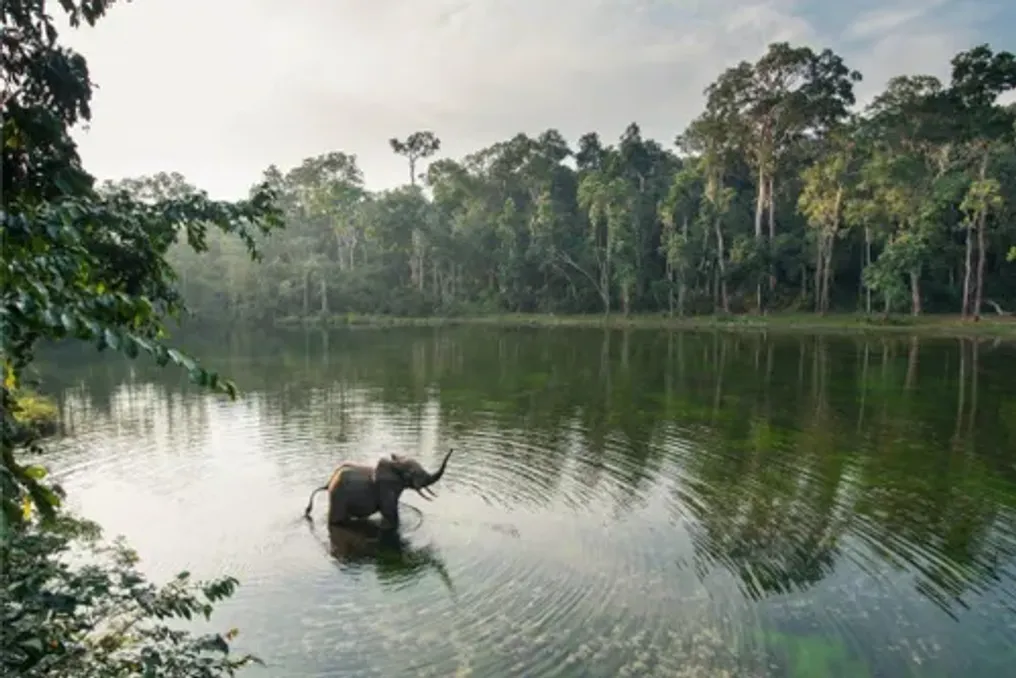
The Congo Basin is the world's largest tropical carbon store; its forest stretches across almost the entire African continent and covers an area larger than India. Despite its immense importance, very little is known about it.
Currently, a group of nearly 200 scientists comprising the Congo Basin Scientific Commission is making efforts to change this situation. The Commission presented its first report in Brazzaville, Republic of the Congo, in May, aiming to attract funding to train 1,000 PhD candidates over the next decade.
Experts note that expanding research is critically important for understanding and protecting this vast territory, which dictates the weather conditions of an entire continent, is home to one-fifth of the world's species, and absorbs as much CO2 as Germany emits annually. The forest is threatened by slash-and-burn agriculture, as well as logging, mining, and the demand for charcoal used by growing populations for cooking.
Commission Special Envoy Lee White, a zoologist born in the UK and formerly Minister of Environment of Gabon, stated: 'We need investment in better understanding the Congo Basin and in creating a generation of Congo Basin scientists who will protect this ecosystem. I am convinced that if we lose the Congo Basin, Africa will become uninhabitable.'
These efforts echo the work conducted by Brazilian researchers over the past three decades in the Amazon Basin, significantly increasing knowledge of tropical forests. Surveys show that about 120 scientists from Congo Basin countries publish on issues related to this forest, which is a small fraction of the thousands of Amazonian researchers.
White noted: 'It is quite disheartening. That is why we know much more about the Amazon than we do about the Congo Basin.' The Commission is appealing to potential funding sources such as the African Development Bank and the Hassoplatner Foundation, established by co-founder of German software giant SAP SE, to support this initiative, which White estimates will cost tens of millions of dollars. Currently, the UK government has provided 9 million pounds sterling ($12.1 million), enough to fund up to 30 master's and about 15 doctoral degrees.
Universities in Congo Basin countries often suffer from resource shortages, and local scientists have limited career opportunities. Bila-Isia Inogwabini, a professor of biodiversity at the Catholic University of Congo in Kinshasa, Democratic Republic of Congo, said: 'When people get doctorates in the Congo Basin, they move to ministries doing administrative work; they leave the scientific field. Or they go to the Western world, where they are offered better jobs. Many people I worked with in the UK consider me crazy for coming back.'
White and scientists like Inogwabini believe it is necessary to establish partnerships between wealthier universities in Europe and the US and institutions in the Congo Basin, which stretches from Cross River in Nigeria to the Rift Valley in East Africa. Commission scientists teach at universities in Cameroon and Gabon, as well as in the US, the UK, and the European Union.
Support from the Brazilian government was vital for a similar initiative in the Amazon, which launched its own scientific commission in 2019, according to Emma Torres, Strategic Coordinator of the Amazon Scientific Commission. She emphasized that the continuity of such support across different political cycles played a key role.
Central Africa is home to some of the poorest countries in the world, which limits state support for scientists and generates stigmatization, despite significant achievements in nature conservation. White stated: 'There is a negative perception that this is the heart of darkness in the Congo Basin, and that little can be achieved. I obviously disagree with this. If you look at the results of the Congo Basin in terms of creating new protected areas and so on, they are probably leading the world in progress.'
This stigma has also affected the careers of scientists from this region. Lydie-Stella Kutika, a soil scientist from the Republic of the Congo and one of the three co-chairs of the scientific commission, shared: 'I received my doctorate on the Amazonian Brazilian ecosystem. So it's quite funny. I saw the Amazon forest before I saw the forest ecosystem in the Congo Basin.'