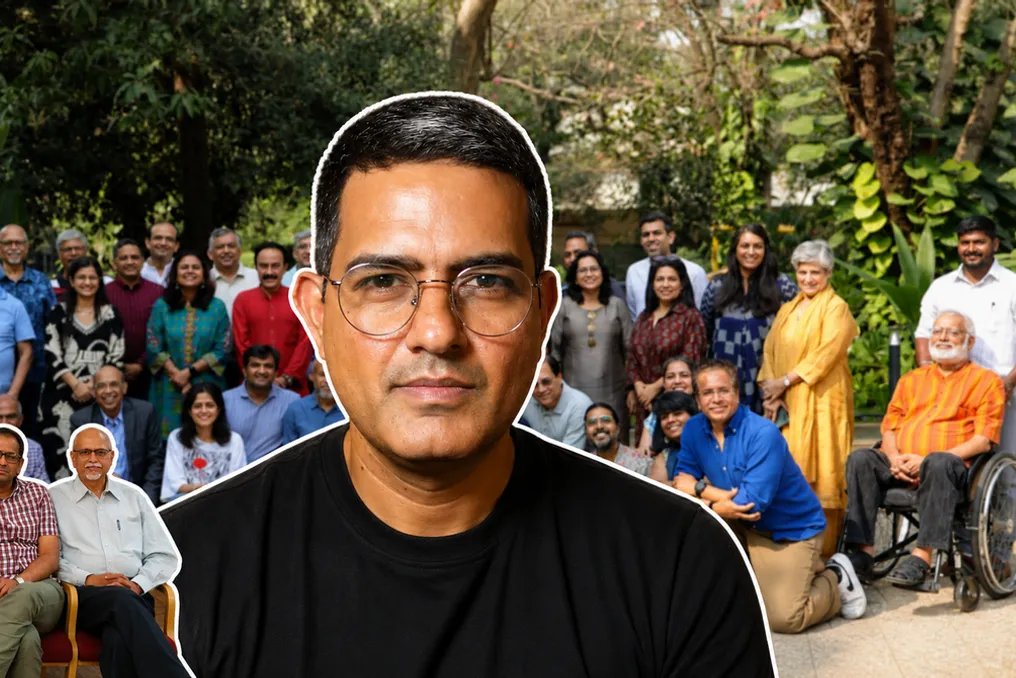
In 1995, an eighteen-year-old resident of Mumbai took a less obvious step: he mortgaged his family home to finance a editing studio in his father's garage, which was equipped with a single computer.
In 1995, an eighteen-year-old resident of Mumbai took a less obvious step: he mortgaged his family home to finance a editing studio in his father's garage, which was equipped with a single computer.
Despite the lack of proof that Indian visual effects could compete with Hollywood's, Namit Malhotra took a risk. Three decades later, the studio that started in that garage won eight Academy Awards for visual effects, working on films such as 'Dune,' 'Interstellar,' and 'Blade Runner 2049.'
Malhotra came from a family of filmmakers, which makes his choice of tools particularly noteworthy. His grandfather was a cinematographer in Bollywood, participating in one of India's first color films in 1953, and his father, Naresh Malhotra, produced hits like the classic 1988 film 'Shahanshah.'
Namit grew up among film sets and stories, dreaming of telling stories himself. However, instead of picking up a camera like his family, he focused on the computer. He hired three instructors from a recently completed computer graphics course and began building a company using that single machine.
Many around him were skeptical of his venture. The first employees were not experienced industry professionals; some were children of tea sellers and paan shop owners. As Malhotra later noted, this became a kind of joke in the industry: if you lacked experience, you went to Prime Focus, where fresh talent was trained from scratch. Malhotra believed that skills could be developed even where opportunities never existed, and it paid off.
Initially, the garage enterprise focused on television commercials and music videos. In 1997, it merged with his father's equipment rental business to form Prime Focus. The company pioneered digital intermediate and motion control technology in India, and in 2006, it listed on the Indian stock exchanges, with Malhotra serving as Managing Director.
From there, ambitions took on a global character. Prime Focus World expanded to London, New York, Los Angeles, and Vancouver, providing visual effects and 3D conversion work for Hollywood projects long before the arrival of DNEG. The company contributed to James Cameron's 'Avatar' in 2009, and based on this trust, secured several other contracts from Hollywood.
The 2008 financial crisis hit the company hard around the same time, and Malhotra spent several difficult years restoring its stability. What Prime Focus created was a system for training Indian VFX specialists capable of working on the world's largest projects.
A turning point came in 2014 when Prime Focus World merged with Double Negative, a London-based studio that had already won an Academy Award for its work on 'Inception.' The combined company became DNEG, and under Malhotra's leadership, it continued to win awards. Films such as 'Interstellar,' 'Ex Machina,' 'Blade Runner 2049,' 'First Man,' 'The Detonator,' 'Dune,' and 'Dune: Part Two' added to the studio's tally in subsequent years, ultimately bringing the total number of Academy Awards for visual effects to eight, with the last one awarded at the 2025 Academy Awards ceremony.
This period made DNEG one of the few studios capable of creating entire digital worlds for the biggest cinema screens. Today, it employs thousands of artists and technical specialists across four continents, a significant portion of whom are Indian, performing work previously considered the exclusive prerogative of studios in Los Angeles or London.
A notable aspect of Malhotra's trajectory is not just the number of awards. It is the fact that he created an alternative path into global filmmaking, one that passed through a garage in Mumbai rather than a film school in California, and one that was staffed primarily by people the industry was unwilling to seek out.
For many years, Malhotra spoke about his desire to eventually apply this same experience to a story closer to his roots: 'Ramayana.' This goal is taking shape within a large-scale film program, where DNEG is among the studios responsible for its visual effects, and Nitesh Tiwari is the director. For Malhotra, this is not so much a new chapter as a continuation of the same instinct that started it all: that Indian talent, given the right tools and enough belief, can create something that the whole world watches.
This is a fitting story for a person who started with one computer, a mortgaged home, and a handful of people no one else wanted to train. After three decades, the visual language he helped shape for Pandora, Arrakis, and space is finally heading to India.
At the age of 11, Vivek Shungari discovered an opportunity that would later change his life. This happened in 1987 when he was in the corridor of a school in Bhilai, Chhattisgarh. There, he saw technicians installing four BBC Micro computers. Ping-pong was running on one of the screens.
At that time, there were no computer science teachers or curriculum. There was only a thick manual and the BBC Basic programming language that launched upon turning on the machine. While his classmates played cricket during lunch breaks, Vivek attended the computer lab. He did this during every lunch break, every library class, and every game session.
When school time was insufficient, he found an alternative way. In Bhilai, some proactive citizens rented out computers hourly for 10 rupees. Using savings gifted to him by his grandmother to teach the value of saving, Vivek independently mastered computer skills.
Years later, these self-taught skills helped him survive homelessness, start companies, and achieve wealth. Today, Vivek has donated over 96 percent of his fortune to a trust supporting children who lack access to education. At 49, he notes: 'I will not romanticize what came next. Being homeless at 18 is not an adventure. It is cold, exhausting, and deeply lonely.'
His story also illustrates the work of LivingMyPromise—a community of Indians convinced that philanthropy can begin long before reaching billionaire status. Members of this community must be over 18 years old and have a net worth of at least 1 crore rupees. They pledge to donate 50 percent of their assets to charitable causes of their choice, either during their lifetime or in their will. This is a moral and personal promise made via email, without legal obligations.
Vivek lost his mother at the age of four. His father, who suffered from alcoholism and gambling, could not care for him and his younger sister. The children were given to an uncle who reluctantly took charge. Vivek was weak in academics. When he entered college, his uncle stopped funding his education and kicked him out of the house.
By then, Vivek had one reliable thing left—his ability to program. He approached the owner of a computer institute in Bhilai and told him about his coding skills. After passing a test, he was offered a job as a teaching assistant and lab assistant. He was allowed to stay at the institute, where he was surrounded by 20 computers and hundreds of books on computer science, mathematics, and physics, using them for self-study.
By the late 1990s, the IT revolution was gaining momentum in India. In October 1998, a friend returned from Bengaluru and gave Vivek newspapers from Bengaluru. The friend thought he was just giving him reading material, but for Vivek, the newspaper opened a new door. It contained a job vacancy from a Bengaluru company looking for newcomers skilled in C and C++, two of Vivek's favorite languages.
He borrowed money, bought a train ticket, traveled to Bengaluru, passed an interview, and returned to Bhilai to wait. The phone number on his resume belonged to the computer training center where he worked, as he did not have his own phone. When they called, they offered him 7000 rupees per month. He was gently informed that due to the lack of a formal degree, he would start at a lower rate and his work would be monitored. He agreed immediately over the phone and asked them to book him a train ticket, which they did.
Upon arriving in Bengaluru, his boss informed him that the work would involve ANSI Common Lisp and calculus. This frightened him, as a math teacher in school once called him a failure in front of the entire class. Now, the job required him to do what he considered impossible. However, his boss, based in the USA, became the mentor he never had. He advised Vivek to calm down, sent books from America, and provided time, patience, and the rare gift of belief in his potential.
After that, something changed. Vivek realized he was good at it. Mathematics, a subject that had previously been proof of his inadequacy, became something he genuinely loved. He recalls: 'It was my first real awakening. Not work. Not salary. The discovery that I am not the student who failed. I am a student who was never properly taught.'
Vivek immersed himself in learning so much that he began teaching others. First, he taught colleagues on weekends, then newcomers, and also the children of security guards, office workers, and any neighbor who wanted to learn. He says: 'My company provided me with resources. I gave everything I had. And I discovered something that defined every decision I have made since: the more you give, the more you receive. Not metaphorically. Literally. In all measurable aspects.'
After a year of working for a salary of 7000 rupees per month, the company raised his income to 40,000 rupees. In 2000, this was a huge sum for one person in Bengaluru. Vivek spent four years at ICS, and then worked at Andale and ICICI oneSource. In 2006, he founded AceNgage, which was acquired after becoming profitable in 2010. In the same year, he launched two other projects: the Vichaar Foundation and the company codeCraft.
Common Lisp, which once terrified him, became a central element of codeCraft's work. The company specialized in creating adaptive query resolution using artificial intelligence in ANSI Common Lisp at a time when AI was not yet a trendy word. Later, a Fortune 100 company entered India through its subsidiary. Its flagship search engine, A9, was written almost entirely in Lisp. The company needed Lisp engineers. CodeCraft happened to have the largest concentration of Lisp engineers in Bengaluru. They made an offer—it was an acquihire.
Vivek learned BBC Basic in the corridor of a school in Bhilai in 1987 because no one else could teach him. Twenty-six years later, a Fortune 100 company bought his firm thanks to this obsession and refusal to stop learning.
Vivek built companies and earned money, and then made a decision that confused many around him: he gave away almost all his funds. He asks with a gentle smile: 'I have my own home. I have health insurance. I am secure as a single person. What else do I need?'
This decision stemmed from a conviction he held since age 18. He recalls: 'When I was in a difficult situation in my youth, the Universe took care of me. I decided that when the right time came and I had my own resources, I would give back more than I received.'
Vivek secured enough investments for passive income to support himself and created a reserve fund. Everything else, including his salary from Ace Hacker, goes into a trust called Eklavya, which he founded with two friends. He no longer receives a salary, living off his investment income.
Eklavya has one mission: it finds children who cannot afford education and covers their needs—tuition, resources, and support. The work Vivek is most proud of takes place in rural areas, where the trust meets parents whose children work instead of studying. The team offers them a condition: allow the child to attend school full-time, study, and play, and the trust will cover all expenses. The only condition is that the child must never return to work. Vivek asserts: 'Education is not a partial agreement. Childhood cannot be negotiated.'
The first year was slow as they set up infrastructure, fraud detection systems, and processes to ensure the money reached the child. They sponsored a small number of children while setting up these systems. Over the last two years, Eklavya has sponsored 300 children. The trust spends between 80,000 and 100,000 rupees per child annually. To date, he has invested 2.5 crore rupees in 300 future generations. Vivek, who still does not have a university degree, believes that no child should be deprived of education due to lack of financial support.
This conviction also led him to LivingMyPromise. LMP was modeled after The Giving Pledge—a global initiative where billionaires commit to giving away a significant portion of their wealth. LMP uses a similar idea, adapting it for Indians who have achieved a certain level of financial stability.
The initiative was launched in 2018 by six members. Four of them were volunteers of Daan Utsav: Girish Batra, who first conceived LMP, Rama Arya, Bharati Dasgupta, and Venkat Krishnanan. The other two founders—Amit Chandra and Sridhar Rajagopalan—support Daan Utsav but are not active volunteers.
Daan Utsav originated from Joy of Giving Week—a national celebration of generosity that began in 2009. Girish participated in Joy of Giving Week that year, where he met Venkat Krishnanan, one of the founders of GiveIndia. For Girish, generosity was part of his upbringing. He recounts that the family was spiritually inclined, so giving was natural, and they never felt insecure about the future.
As he built his career, his own understanding of wealth changed. He supports the process of wealth creation but believes that the best use of wealth is giving back to society. He notes that from this perspective, the decision to donate 50 percent of his fortune became a priority for them. His wife, Tanu, a yoga instructor, is also a pledger.
The Giving Pledge at that time had about 200 pledgers, including four Indians such as Kiran Mazumdar-Shaw and Azim Premji. Girish notes that people from all walks of life are happy to help, citing examples of vegetable vendors and auto drivers who helped others.
Gunjan Taneja, who leads LMP, says the core idea was simple: if billionaires can make such a public vow, then financially secure Indians can also deeply consider what they truly need and how much they can give. To join LMP, a person must be over 18 years old and have a net worth of at least 1 crore rupees. LMP emphasizes that this is a qualification criterion for people who have achieved financial stability, including salaried employees, government officials, small business owners, and first-generation entrepreneurs who have gradually accumulated wealth.