Milk is a daily consumption product used in household life from morning till evening—from making tea to producing yogurt, cheese, and sweets. It is also included in children's diet to replenish calcium deficiency. However, there is a danger that the milk consumed daily may pose a threat to health due to the presence of various harmful chemical substances.
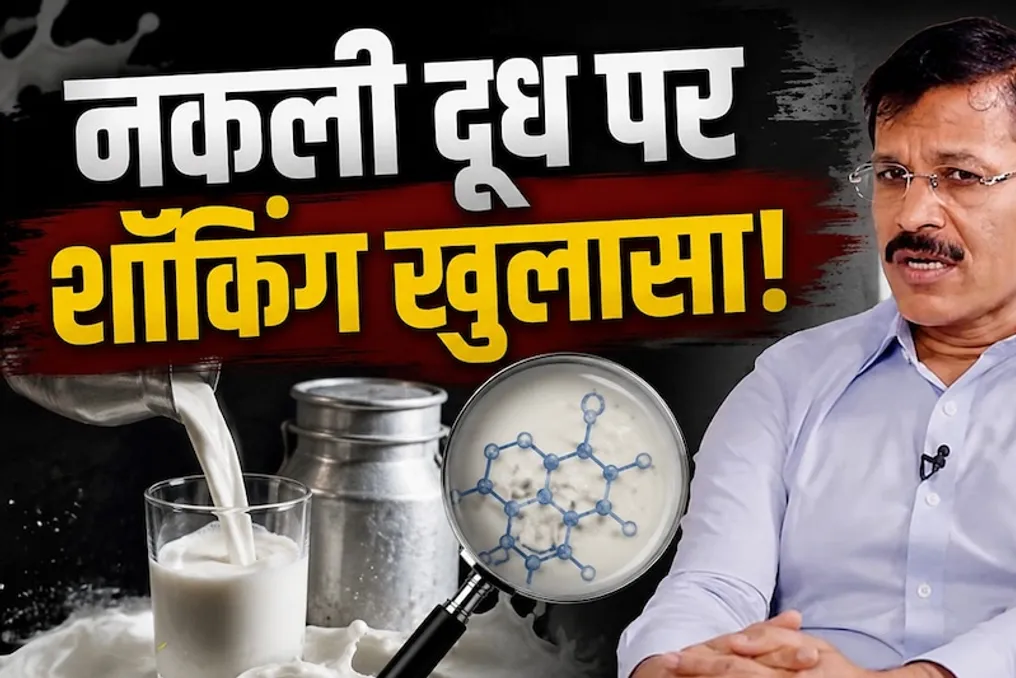
Recently, Tukaram Mundhe, Commissioner of the Food and Drug Administration of Maharashtra (FDA), made several shocking statements in a podcast about synthetic milk. He reported that some individuals prepare fake milk at a lower cost and mix it with real milk for sale.
Large-scale actions by the Maharashtra FDA
Tukaram Mundhe stated that since taking office on May 25, the Maharashtra FDA has been conducting continuous inspections. The department inspects more than twenty locations daily, and so far, over 1131 inspections have been carried out. During these checks, food raw materials worth about 49.57 crore rupees were seized, and approximately 1.6 lakh liters of suspicious milk with additives were discovered.
How is synthetic milk made?
In the podcast, Tukaram Mundhe revealed that during inspections, officials uncovered an entire parallel network producing synthetic milk from chemicals and counterfeit materials, in addition to real milk. This indicates that the counterfeit milk was prepared not due to a minor error, but as part of a large-scale illegal business.
According to him, some people use skimmed milk powder, chemicals, emulsifiers, caustic soda, and even substances like shampoo to create a mixture that is externally indistinguishable from real milk. Milk prepared this way costs significantly less than natural milk. Synthetic milk resembling cow's milk can cost around 15 rupees per liter, and goat-milk imitating milk can cost around 30 rupees per liter, whereas real cow's milk is sold in the market for a price of 40 to 50 rupees per liter. Thus, some try to make extra profit by mixing adulterants with real milk, which is an absolutely illegal and shameful act.
Possibility of additives at different levels
He also noted that such contamination does not occur in just one place; inspections showed that additives can be introduced at various stages—from the farmer level to milk collection and cooling centers. Only after this does the counterfeit milk reach dairy plants, from where other dairy products are then produced.
How to stop counterfeiting?
FDA Commissioner Tukaram Mundhe believes that the most effective way to curb the trade of fake milk is by implementing a traceability system, i.e., keeping track of the source of every drop of milk. Until it is established which farmer and which animal the milk came from, completely stopping counterfeiting will be difficult.
He added that milk collection centers already have records of how many cattle (cows or buffaloes) each farmer owns and what the total volume of milk collected was. These records are now being applied more strictly in Maharashtra. Digital technologies can greatly assist in combating milk adulteration, as they simplify the record-keeping of the number of cows and buffaloes in villages, as well as their average yields. This will allow for easy tracking of daily milk collection, and if the registered volume is exceeded, an inspection can be immediately conducted. Furthermore, he mentioned digital tagging of animals under the National Mission on Digital Livestock, which can largely prevent counterfeit milk from entering the market.