Children and young people who start using social media early tend to show lower performance in the school environment. This negative impact is notably more evident in specific subjects, such as mother tongue and mathematics.
Children and young people who start using social media early tend to show lower performance in the school environment. This negative impact is notably more evident in specific subjects, such as mother tongue and mathematics.
Italian scientists conducted a study analyzing data from numerous schoolchildren and concluded that starting to use social media at an early age correlates with a decline in students' academic performance.
Marco Guidi from the University of Bicocca in Milan and his team studied information on 5227 students from Northern Italy aged 7 to 16. Data on digital behavior was obtained through a special questionnaire, and academic performance was assessed based on the results of long-term tests in mathematics, Italian, and English.
According to the data, the median age of starting to use game consoles was in the fourth grade, and independent tablet use was in the fifth grade. Computers and smartphones with internet access became available in the sixth grade, coinciding with the appearance of the first messengers. By the eighth grade, 98% of students already owned smartphones. Regarding social media, 11.2% created an account in primary school, 29.5% in the sixth grade, 25.0% in the seventh, 18.0% in the eighth, and only 16.3% in the ninth grade (which is the minimum age according to Italian law).
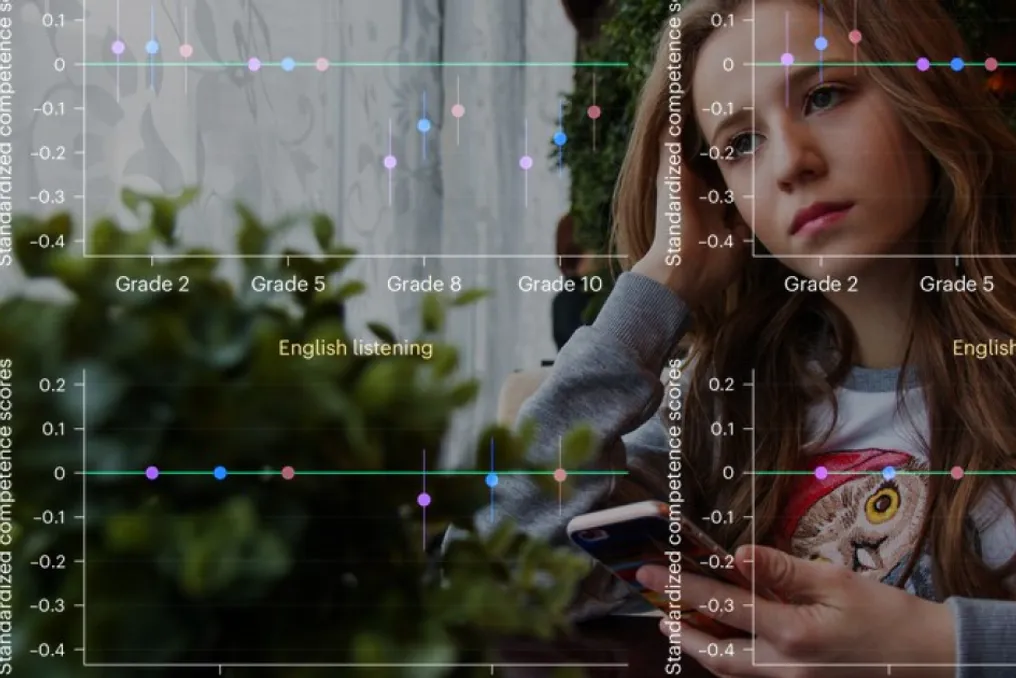
The analysis showed that the duration of time spent on social media by the eighth grade had a negative correlation with performance in Italian (a decrease of 0.05 standard deviations for each additional year) and mathematics (a decrease of 0.04). These relationships persisted even after accounting for other digital technologies (-0.06 and -0.02, respectively). The application of the difference-in-differences method, adjusted for confounding factors and previous results, demonstrated a causal negative effect of early social media use on academic performance.
Specifically, students who started using an account in the sixth grade had lower results in Italian by 0.22 standard deviations and in mathematics by 0.18 in the eighth grade; these deficits persisted up to the tenth grade (0.22 and 0.27 standard deviations). For those who started in the seventh grade, the effect was less pronounced but significant (0.14 and 0.10 in the eighth grade; 0.17 and 0.22 in the tenth). In the eighth grade, those who started later saw their Italian language performance drop by 0.11 standard deviations, and math by 0.07 (which did not reach statistical significance) in the same grade, but both subjects showed a decrease of 0.11 in the tenth grade. Furthermore, no influence of social media on English language proficiency was found.
Additional analysis revealed that more intensive smartphone use according to the SPS-A scale was associated with worse results in Italian and mathematics, as well as earlier creation of a social media account. Parental control and access to children's online activities proved more favorable for academic performance and later account creation. Students' subjective well-being showed no significant link to academic performance, demonstrating only a weak negative correlation with increased time spent on social media.
Thus, the data obtained confirm that premature immersion in social media negatively affects school academic performance, with the intensity of daily smartphone use playing a key role in this process.
The article also mentions that it was previously established that adolescents who overuse social media are less likely to maintain a healthy diet, and abuse of these platforms increases the risk of ADHD and early smoking, with social media and television being recognized as more dangerous for teenagers' mental health than video games.
A separate section presents data from the World Health Organization (WHO) on global tobacco use, noting that over 100 million people worldwide use vapes, of which at least 15 million are adolescents aged 13–15.