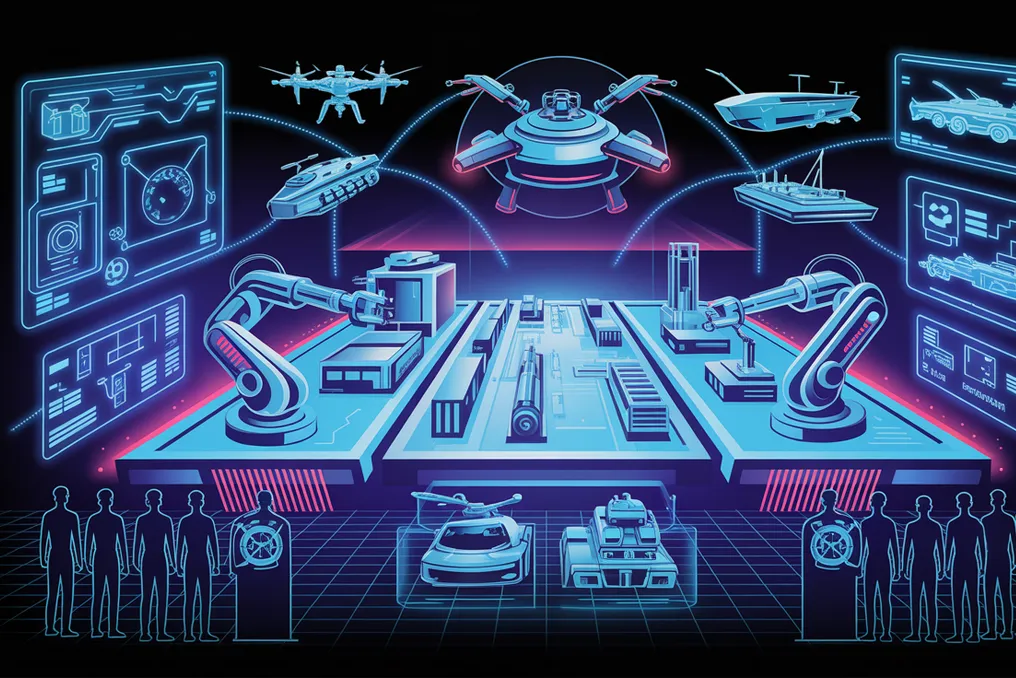
Hadrian has raised $1.37 billion in a new funding round to scale its software-driven automated factories. This move aims to address issues with outdated supply chains in the defense sector that cannot meet the demands of modern military equipment.
Hadrian has raised $1.37 billion in a new funding round to scale its software-driven automated factories. This move aims to address issues with outdated supply chains in the defense sector that cannot meet the demands of modern military equipment.
Defense production has long relied on fragmented suppliers and old manufacturing facilities. Problems such as an aging workforce, loss of skilled employees, and rising raw material costs have negatively affected small machine-building enterprises across the country.
Due to a sudden surge in demand driven by geopolitical conflicts, traditional manufacturers have been unable to increase production rates to meet military needs. Hadrian is addressing this weakness, asserting that physical manufacturing is a software problem.
At the core of the factory ecosystem is the proprietary Opus software stack, which ensures complete production autonomy. Opus automates complex processes, including planning, machine routing, and quality control. By replacing manual assumptions with real-time digital analytics, the company reduces the lead time for manufacturing parts from raw metal from months to just a few days.
High capital expenditure has historically hindered the rapid scaling of hardware startups, but Hadrian is changing the approach to defense manufacturing. Through its innovative Factories-as-a-Service model, large defense contractors can utilize ready-made, automated production capacity, avoiding the need to invest millions in building their own facilities from scratch.
This new capital injection of $1.37 billion will be directly allocated to expanding Hadrian's physical footprint. This major funding round brings the company's valuation closer to $8 billion, strengthening its position as a cornerstone of American industrial technology.
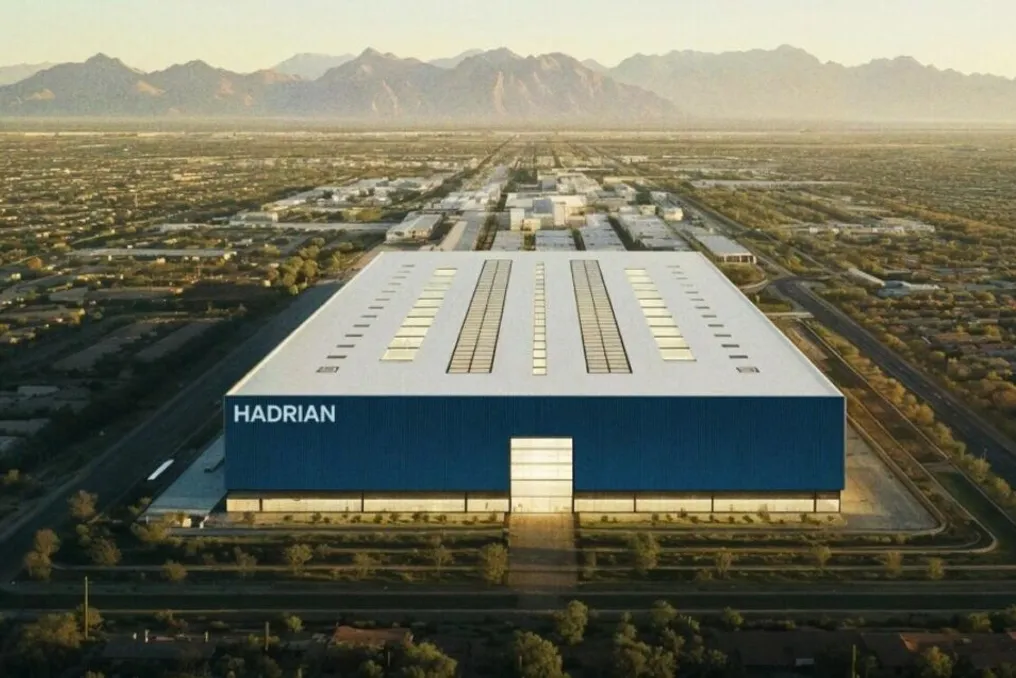
The company is actively building large-scale automated facilities, including a high-performance plant in Mesa, Arizona. The Arizona plant is capable of moving from construction start to full operational readiness in less than six months.
In addition to traditional aerospace equipment, Hadrian is expanding into naval defense and marine systems. Automated lines will now produce precision components for warships and submarines, helping to resolve serious backlogs in critical defense supply chains.
Founded in 2021 by CEO Chris Power, Hadrian was created with the goal of rebuilding America's industrial base to ensure long-term technological superiority. During global trade disruptions, it became clear that reliance on foreign supply chains poses serious national security risks.
The company emphasizes the importance of domestic manufacturing capability. Hadrian's solution demonstrates the ability of American production to be both fast and cost-competitive. The startup utilizes complex artificial intelligence, robotic automation, and specialized workforce.
Hadrian aims to provide tools that allow for daily increases in production output at factories. The company is developing both the physical and digital infrastructure necessary for the nation's reindustrialization, as demand for defense manufacturing has reached historic highs. Hadrian employs a different approach to creating components for missiles, fighters, and autonomous defense systems. The company has received support from leading venture capital funds, including T. Rowe Price, Founders Fund, and Lux Capital.
Aurelius Systems has successfully raised $40 million in a Series A round, with the funds intended to be used by the company to expand production, increase operational activities, and support the supply chain in the United States amid growing demand for high-performance drone countermeasures.
Draper Associates and KAS Venture Partners participated in the round, leading the process, along with General Catalyst, Hanwha Defense USA, Outlander, Alumni Ventures, Bravo Victor Venture Capital, Detroit Venture Partners, Decisive Point, and other investors.
The new funding reflects the increasing need for autonomous defense technologies as governments increase spending on drone countermeasure capabilities. Defense organizations are seeking systems capable of rapidly responding to evolving aerial threats while reducing operating costs and enhancing mission readiness.
The received funds will accelerate the technical development and increase the production capacity of Aurelius's flagship defense platform, Archimedes. The company also plans to achieve vertical integration to strengthen production readiness and significantly reduce risks of long-term supply chain disruptions.
This strategy improves access to necessary materials supporting reliable production and future expansion of product output across various defense markets. In addition to Archimedes, the company plans to expand its product range and enter additional segments of the global defense industry.
CEO Michael Laframbois noted that coordinated drone attacks have fundamentally changed the modern global defense landscape. He emphasized that Archimedes was developed as a scalable platform to protect people, infrastructure, assets, and critical defense targets.
Aurelius Systems, based in San Francisco, develops AI-based autonomous air defense systems utilizing robotics and directed energy. These technologies allow for the detection, tracking, and neutralization of aerial threats without the need for constant human intervention during active operations worldwide.
Archimedes is an autonomous laser anti-drone system designed to protect military forces and critical infrastructure from attacks. This platform provides faster response times and lower operational costs compared to many traditional air defense systems today.
Autonomous directed energy technology ensures continuous protection against increasingly sophisticated and rapidly evolving drone threats globally. Andy Tang from Draper Associates praised Aurelius for demonstrating key technologies and successfully building strategic deployment partnerships.
The financing followed a series of important operational achievements by Aurelius. He stated that these successes position Aurelius as a leader in autonomous directed energy systems—from concept to commercial deployment and adoption.
Recently, the company entered into an integration partnership with American Rheinmetall to expand the deployment capabilities of the Archimedes platform. Furthermore, it completed compatibility testing with control and management systems during Operation Jailbreak and successfully tested its platform under the T-REX 26-2 program.
These achievements have strengthened confidence in the platform's readiness for future defense deployments while supporting further investment in manufacturing capabilities. Aurelius is currently hiring 19 people and expects to grow its staff to over 40 employees by the end of 2026 as production scales up.
The Series A round allows Aurelius to scale up production and ensure long-term manufacturing sustainability in the United States. The company is investing in domestic supply chain infrastructure alongside strategic partnerships to improve delivery times and reduce reliance on external suppliers.
As autonomous aerial threats become more prevalent in military and critical infrastructure environments, Aurelius aims to provide scalable, AI-based protective systems that can be rapidly deployed across various sectors.
This latest investment provides the resources needed to expand the company's production capacity, strengthen its technological platform, and accelerate deliveries to customers amidst the continued growth of the autonomous defense technology market.
Due to the exponential growth of artificial intelligence in recent years, many types of AI chips have emerged, designed to solve various tasks. The company Olix has raised $312 million with the goal of creating a single chip capable of processing all stages of an AI model's operation.
As a result of this round, the company's valuation grew to $3.3 billion, which is three times higher than the approximately $1 billion mark Olix reached just six months ago after raising $220 million.
Olix was founded by James Dockomb in London in 2024 when he was young, after having created a previous company specializing in brain monitoring technologies. Dockomb argues to investors that universal chips from Nvidia are reaching the limits of their capabilities.
According to Dockomb, a data center performing AI inference is essentially a token-generating factory, and each such token requires hundreds of different operations. However, most companies continue to perform all these operations on the same chip.
Olix's solution is the development of the X-1 chip, which distributes the model's workload across multiple chips instead of limiting the work of a single processor. These chips communicate with each other using light rather than copper wires, which, according to Olix, reduces latency and power consumption.
The company's first chip, DX-1, is responsible for the decoding stage—the moment when the model actually generates its output. In the modelPlus with 100 billion parameters, the company claims it can generate over 10,000 tokens per second per user while using less energy than a standard chip of the same size.
Olix asserts that the same architecture is designed to scale up to models with 10 trillion parameters or more. An important aspect of the design is that Olix avoids using advanced packaging and high-bandwidth memory, as these are two components with limited supply in the current chip industry. This conscious decision is aimed at avoiding the same supply queues as everyone else chasing Nvidia.
Thanks to the capital raised, Olix hired two experts: Matt Bryers and Nick MacQueen, who now join the board of directors. Bryers previously worked as CFO at Wise, and MacQueen is known for his co-authorship of software-defined networks and OpenFlow. This indicates that the founder is very meticulous about the scaling issue.
Olix is not the only startup aiming to capitalize on this opportunity. Fractile from Bristol managed to raise $220 million in May with support from Accel and Founders Fund. At these figures, Olix's $3.3 billion valuation, even after tripling in six months, appears to be a smaller player in the market.
The AI chip industry is already valued at $84 billion, and the market is projected to more than triple by 2030. There is huge demand and a strong reason to pay attention to Olix. The company currently has over 140 employees working in London, Bristol, Toronto, Austin, and San Francisco.
The company plans to make DX-1 available to customers in the second half of 2027. How well the claimed throughput metrics match reality outside of presentations will matter much more than the size of the current round.