Celestial bodies known as rogue planets, which travel through space without orbiting a star, have always been studied by astronomy. However, there was uncertainty about what happens to the moons of these planets when they are ejected from their original systems. A new study sought to clarify this issue by conducting thousands of stellar encounter simulations.
Scientists from the Leiden Observatory, located in the Netherlands, examined approximately 34 thousand scenarios where a star passes near a planetary system, modifying its gravitational dynamics. The findings, published in the arXiv preprint repository, demonstrate that the survival of a moon is fundamentally linked to the distance at which it orbits its planet. Additionally, the characteristics of these orbits can help astronomers understand how the ejection of these systems occurred.
This work was conducted by Yannick Badoux and Simon Portegies Zwart, monitoring the fate of planets and their respective moons during close approaches with other stars. According to the simulations, the determining factor is the so-called Hill radius, which defines the area around a planet where its gravitational attraction is stronger than the influence of the host star. It is within this limit that a moon can maintain its orbit.
The researchers found that moons located up to about 40% of the Hill radius tend to follow the planet even after it is ejected from the system. Conversely, those located beyond this limit quickly lose their gravitational bond. From approximately 50% of the Hill radius, the separation between the planet and the moon becomes virtually inevitable.
The scientists suggest that this behavioral pattern may help distinguish rogue planets ejected after passing another star from those ejected by gravitational interactions with other planets, since each process tends to leave distinct signatures on the orbits of the surviving moons.
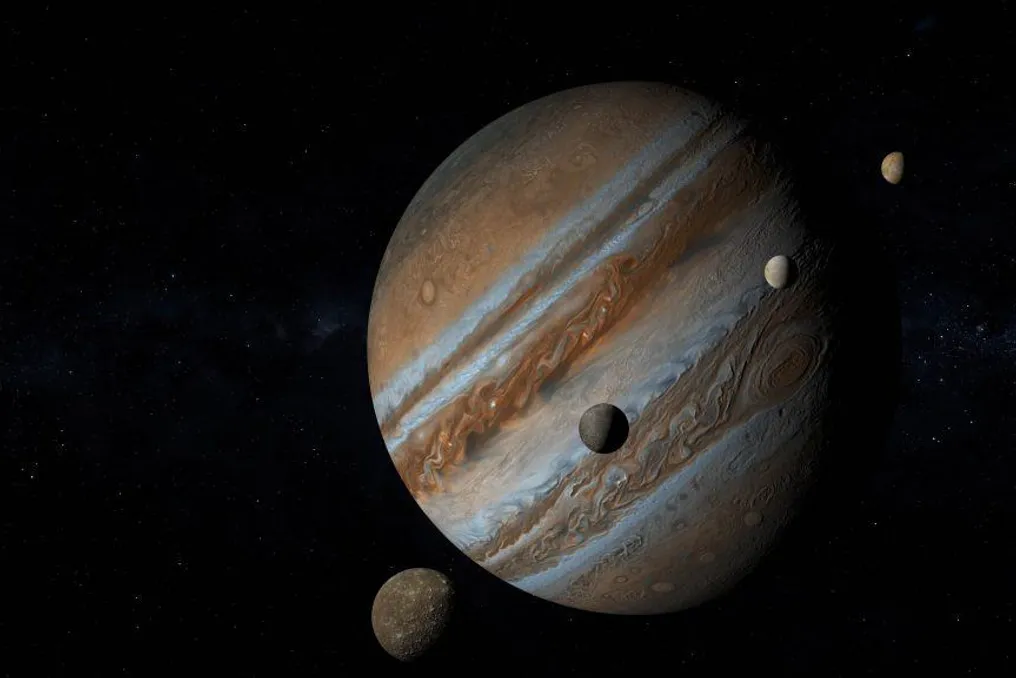
The conclusions obtained were applied to a well-known example from our own Solar System. The study points out that if Jupiter were removed from the Solar System by a nearby passing star, the moons Io, Europa, Ganymede, and Callisto would continue to orbit the gas giant. This is because these four moons are very close to the planet, occupying less than 1% of Jupiter's Hill radius.
The authors emphasize that the gravitational encounter leaves different marks on the remaining moons. Those that remain in closer orbits tend to maintain nearly circular trajectories, while those that barely escape exhibit more inclined and elongated orbits.
Furthermore, the simulations indicate that in approximately 87% of ejection events, the distance between the planet and the moon varies by less than 10%. The researchers believe that this characteristic allows astronomers to reconstruct the history of these systems just by observing the moons' orbits.
The team also used the model on an object already identified through the gravitational microlensing technique, cataloged as MOA-2011-BLG-262L. This object could be a rogue planet accompanied by a moon smaller than Earth's, although current data still allow for other interpretations.
If this hypothesis is confirmed, the simulations suggest that the system probably originated between 1.3 and 5.9 astronomical units from its star, with a slight preference for about 5.2 astronomical units, a distance comparable to that separating Jupiter from the Sun.
The study also highlights a notable consequence of these moons remaining with their planets. Certain moons can generate internal heat due to the gravitational forces exerted by the planet they orbit, regardless of starlight. Europa, for example, has a subsurface ocean whose existence is attributed to this heating. Thus, if a planet is expelled taking its moons, this heating mechanism can continue even in interstellar space, keeping these satellites warm without the need for a star.