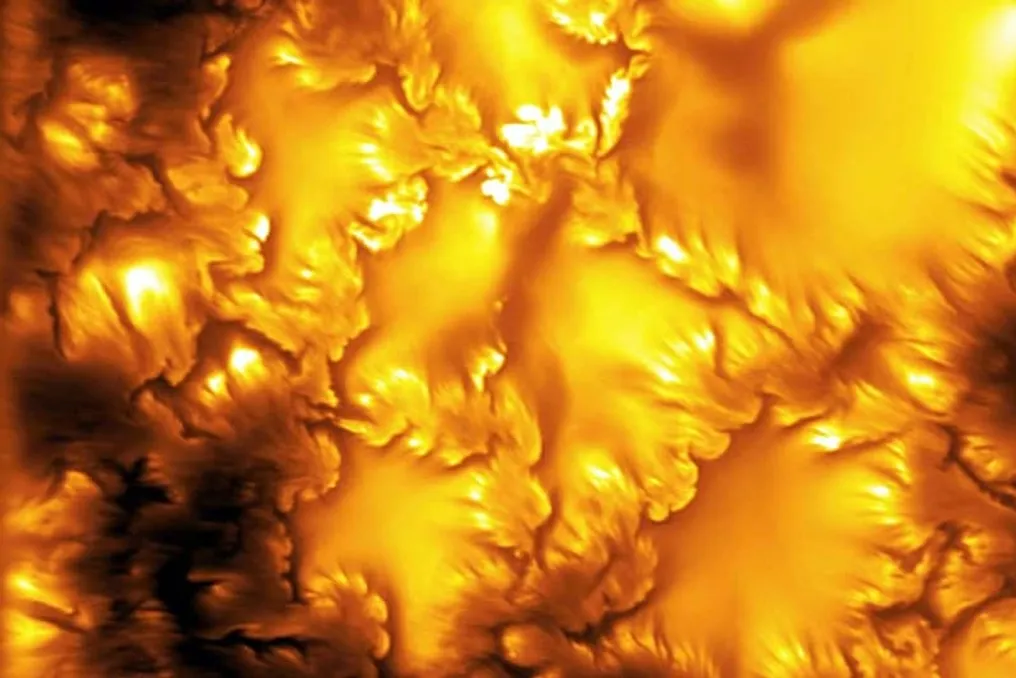
The most powerful solar telescopes, such as the Daniel K. Inouye Solar Telescope, have managed to obtain the clearest images and video recordings of the Sun's surface to date. This research was published in the journal Nature on August 5th. Scientists used this telescope, located on Maui Island in Hawaii, to examine an area near a sunspot in great detail.
During observations, tiny rotating magnetic whirlpools were discovered on the Sun's surface. According to scientists, this discovery could significantly aid in understanding how solar storms occur and why the Sun's outer atmosphere, the corona, remains so hot.
Although the Sun appears calm from a distance, its surface is constantly in motion. Hot plasma moves continuously there, and magnetic fields also change. Thanks to new images and computer modeling, scientists were able to clearly see these small vortices for the first time. They believe that these vortices play a key role in the formation and propagation of magnetic energy in the Sun.
The process observed by scientists is called Kelvin-Helmholtz Instability (KHI). It occurs when two streams of plasma or gas pass past each other at different speeds, leading to the formation of small rotating vortices. This process has previously been observed in clouds, ocean waves, and the atmospheres of planets like Jupiter. However, it was seen on the Sun in such clear photographs for the first time.
According to the lead author of the study and a scientist at the National Solar Observatory, Dr. David Curridge, these small vortices distort and tangle the Sun's magnetic fields, contributing to the accumulation of magnetic energy. This energy is later suddenly released, causing phenomena such as solar flares and coronal mass ejections (CMEs). If these events are directed toward Earth, they can affect satellites, GPS systems, radio networks, and power grids.
Scientists have long tried to figure out why the Sun's outer atmosphere, the corona, is hotter than its surface. According to this new research, these small vortices divide large plasma flows into smaller parts. This allows energy to reach smaller levels and be released as heat. Scientists believe this could be one of the main reasons for the elevated temperature of the corona.
This discovery was made possible by the Daniel K. Inouye Solar Telescope, which is located on Maui Island in Hawaii. Its primary mirror has a diameter of 4 meters (about 13 feet). The telescope is equipped with technology that reduces image blurring caused by Earth's atmosphere. It is thanks to this that scientists were able to clearly observe the smallest details of the Sun.
Scientists note that this discovery will help in better understanding solar storms in the future. If the relationship between these small vortices and large solar eruptions is fully understood, preparing to protect satellites, communication systems, and power grids will become easier.