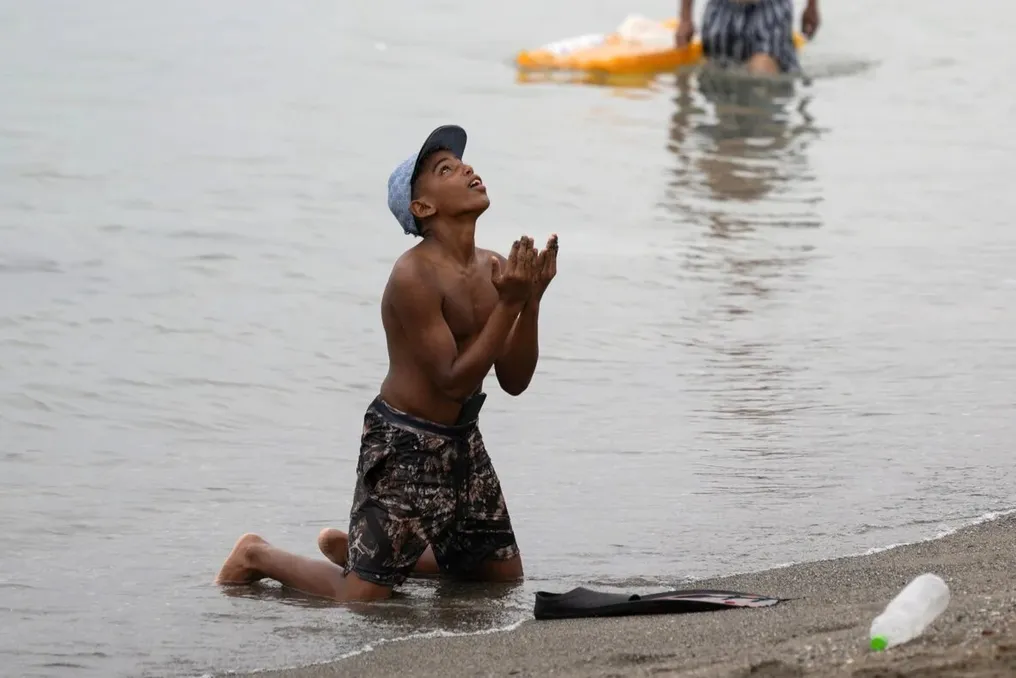
Recent days have been marked by a mass migration crisis in the Spanish enclave of Ceuta. According to the latest data, 72,000 people illegally entered the territory from Morocco last week. The Spanish government reported that 70,000 people have since been returned.
While there are no clear explanations for the unprecedented border crossing that began on July 31st, the Day of Ascension of King Mohammed VI, various theories are being put forward. Some believe it was a spontaneous reaction from Morocco following the visit of Spanish Prime Minister Pedro Sánchez to Algeria. Other commentators suggest involvement from Israel or the US due to Spain's firm stance against the genocide in Gaza and the war in Iran.
However, it is evident that thousands of people, including about 8,000 children, felt they had no other choice but to risk their lives in search of a better future. At least 141 people have died during this crossing, and this number is expected to rise.
The Moroccan Human Rights Association (AMDH) issued a statement noting that the 'heavy scenes' at the border reflect deep despair among the youth. This despair is fueled by lack of prospects, widespread corruption, rising authoritarianism, lack of social justice, as well as unemployment and poor living conditions.
AMDH placed 'full responsibility on the Moroccan state' for this exodus, comparing the current situation to conditions in military and conflict zones.
The Moroccan Ministry of Interior stated on August 1st that the surge in migration is due to a misinterpretation of data spread on social media, as well as the activities of human trafficking networks that exploited the Spanish Supreme Court's decision of July 8th banning the immediate return of migrants arriving by sea.
Nevertheless, Carla Hobbs, head of the Madrid office and research fellow at the European Council on Foreign Relations (ECFR), disputes the claim that 'Moroccan border guards stood aside and watched our crossing.' She believes such an event would be impossible without Morocco's complicity.
Hobbs agrees that the immediate trigger was a viral online campaign following the court ruling, but she also pointed to the timing of the crisis. Just 10 days before, Sánchez visited Algeria, which contradicts Morocco's interests due to Algeria's support for the Polisario Front's pursuit of independence for Western Sahara.
'Reduced border control; migrants' own accounts of their authorities encouraging them to cross; and consistency with an established pattern of coercion by Morocco—all point to Moroccan complicity,' she told Middle East Eye.
Hamza, a 19-year-old resident of Kenitra who walked about 41 kilometers from Tetouan to Ceuta, told MEE that Moroccan guards encouraged the migrants: 'The Moroccan border guards stepped aside and watched us cross; they told us: 'Come on, hurry up, get into the water'.' Hamza noted that violence only occurred if migrants hesitated: 'Then the Moroccan police beat the migrants with a stick,' shouting: 'If you don't want to cross, go back home.' Spanish guards were also willing to help: 'They said: 'Give me your hand, stand up, get in!' '
Refusing to return, Hamza explained: 'Even if they try to force me, I will never go back. Morocco gave me nothing.' He added that despite having diplomas, 'Morocco doesn't value them. You can work for just a few dirhams even in a big city; that's why we ran.'
Asmae, a 23-year-old woman from Casablanca, reached Ceuta after seeing posts on Instagram about the crossing. She agreed that the authorities were passive: 'The Moroccan police treated the migrants well; they didn't beat us unless we started fights or caused trouble, they spoke to you calmly and diplomatically.' Asmae noted that people 'leave voluntarily; the police won't grab you or hit you.'
The latest wave of migrants mainly consists of young Moroccans like Asmae and Hamza. In Hobbs' view, this marks a strategic shift compared to historical attempts to cross the border, which were usually led by sub-Saharan migrants confronting the Moroccan police.
Referring to a similar anomaly during the 2021 crisis, when thousands of people entered the Ceuta enclave amid a diplomatic dispute between Spain and Morocco over Western Sahara, Hobbs emphasized that recent reports by The New York Times show that 'Moroccan police did not stop sub-Saharan Africans, allowing Moroccans to pass [into Ceuta].'
Another young Moroccan, Younes, made this journey, like thousands of others, full of hope. Despite having a bachelor's degree and knowledge of several languages, he feels there is nothing for him in Morocco. 'I felt that in Ceuta I would finally get a chance in life,' he told MEE.
As Younes swam through the final stretch before arriving in Ceuta, he saw three teenagers drown in the water. 'Who knows if their parents know they disappeared,' he said.
Upon arriving in Ceuta, Younes experienced 'unparalleled happiness.' However, this feeling was short-lived as he was beaten by the authorities. He quickly noticed that all shops in Ceuta were closed, and there was no water: 'People are suffering; people arrived and collapsed unconscious, some were threatened with guns.'
Younes' dream quickly turned into a nightmare: 'My dream was to get there, and now I swear to God, I advise every parent not to send their children here,' he warned about the risk of violence.
Family members are still waiting at the border, trying to find out if their loved ones made it. Najat, mother of six children, is one of them. She told MEE that three of her children tried to reach Ceuta. Her two daughters, aged 12 and 13, took their birth certificates and wrote down their mother's phone number before running.
Her mother, unable to cope with the anxiety, said: 'They told me they would call, but I heard nothing. I just want to know if they arrived safely, and whether my son [14 years old] is alive or dead.'
Najat expressed deep fear for her daughters and the risk of sexual violence. 'I work to take care of my children; I don't want them to emigrate this way. I deny myself everything to give the children.'
The non-profit organization No Name Kitchen (NNK), which responds to shifts or bottlenecks in migration flows, is on the ground and has witnessed the authorities using what the NNK coordinator, Rick Fernandez, describes as irregular return processes. 'We saw the army use a 'fishing' tactic, forming human chains to force them to the border with shoves, kicks, shouts, and insults, threatening further beatings if they didn't move,' Fernandez told MEE.
NNK has filmed police beatings; Fernandez stated that this happens 'at night and out of sight when people refuse to get into trucks used for group deportations.' He described the situation as 'horrible,' noting that no one, including the police, Guardia Civil, or military, 'asks people how they feel, what they need, or why they came to Spain... Even if we feel they are running from hell, the priority is to send them back to it.'
The NNK team helps by mobilizing resources and connecting migrants with housing. Fernandez reported that they had to increase their usual team of four in Ceuta to 18 people.
One of the most difficult challenges has been reaching vulnerable people hiding in mountains and warehouses. 'NNK does not want the police to track us and become bait that reveals their location. That is not our role,' he added.
Fernandez noted that extensive work is underway to process legal documentation for registering all cases of vulnerable people entitled to international protection. 'NNK's main concern is that by the time these cases are reviewed and legally confirmed, these people may already leave, be returned, or suffer the worst possible consequences. But we will not give up.'
Both Spain and Morocco are gradually restoring relations after they deteriorated in 2021, when Madrid allowed Polisario Front leader Brahim Ghali to receive medical care, which angered Rabat over the Western Sahara dispute. Hobbs believes that recent events will lead to relations that are 'smooth on the surface, but deteriorating underneath.'
Hobbs added that the official line 'should never publicly accuse Morocco,' as Spain needs this country in the medium and long term for migratory and defense operations overall.
However, she stressed: 'This last [migration] step will not be forgotten by the Spanish government, especially with the approaching elections in Spain and images that are perfect for Vox,' the ultra-right anti-immigration party in Spain.
Describing bilateral relations as deeply asymmetrical, Hobbs noted: 'Madrid does not have many opportunities for concessions after changing its position on Western Sahara after the last round of coercion.' In Hobbs' opinion, from Rabat's perspective: 'I would find an immediate EU reaction very encouraging—it confirmed that migration pressure is worth very little, producing no unified European response. There is no reason why Morocco wouldn't use this lever again.'