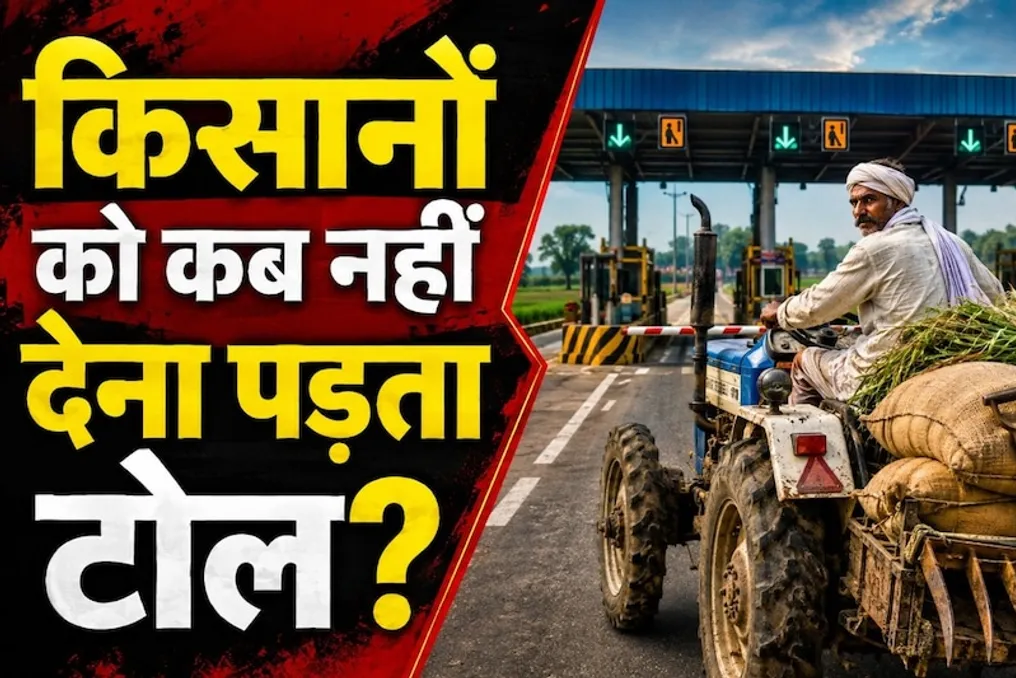
It is crucial for farmers who use tractors or combine harvesters for agricultural work and travel on national highways to know the rules regarding toll payments. Disputes often arise at toll collection points between farmers and staff about whether agricultural vehicles are subject to the fee. Many farmers are unaware of the current regulations, leading to unjustified difficulties.
Recently, Lok Sabha MP Gurjit Singh Aujla questioned the government on whether all agricultural vehicles were exempted from road taxes nationwide, and why tolls were still being collected from farmers at some collection points. In response, the Ministry of Road Transport and Highways provided full information on the rules and clarified which specific vehicles are entitled to the exemption.
Changes in Rules in 2017
The government stated that a notification was issued in the gazette on March 14, 2017, amending the charge for using national highways. Previously, the exemption applied only to tractors; however, after the 2017 amendments, combine harvesters were also included in the list. This means that no user fee (road tax) is charged at national highway toll plazas for tractors and combine harvesters.
What Do the 2008 Rules Stipulate?
This exemption is linked not only to the 2017 notification but also to the National Highway Toll Collection Rules (determination of rates and collection) of 2008. According to these rules, no fee is charged when using national highways, bridges, bypasses, or tunnels with two-wheelers, three-wheelers, tractors, combine harvesters, and animal-drawn vehicles. However, there is an important condition.
According to government rules, if there is a service road or an alternative route adjacent to the national highway, then three-wheelers, tractors, combine harvesters, and animal-drawn vehicles must travel along this alternative path. They are not permitted to use the main highway if a separate service road is provided for them.
The rules are slightly different for two-wheelers. If a motorcycle or scooter driver uses the main highway despite the availability of a service road, they may be charged a fee equivalent to 50 percent of the tariff set for cars.
Is Every Farmer's Vehicle Free?
The answer to this question is no. Many mistakenly believe that farmer status automatically grants free passage for all their vehicles, but this is not the case. The toll exemption is granted not to the farmer himself, but to specific types of agricultural machinery. If a farmer travels in their own car, pickup, SUV, truck, or other commercial vehicle, the general toll rules apply. That is, the farmer's status alone does not make all vehicles free.
Why Are Farmers Being Charged at Some Places?
The government explained in parliament that this rule applies to all toll plazas constructed with government funds, as well as many BOT (Build-Operate-Transfer) projects initiated after March 14, 2017. Nevertheless, some older BOT projects continue to operate according to their original concession agreements. In such cases, the toll collection rules may differ, which explains the varying situation at different toll plazas.
What to Do If Payment Was Incorrectly Deducted?
Today, almost all toll plazas use the electronic method via Fastag. If a payment was mistakenly deducted from a tractor or combine harvester, an inquiry can be made. For this purpose, Toll Management and Control Centers (TMCC) have been established by the National Highways Authority (NHAI) and Indian Highways Management Company Ltd (IHMCL), where all transactions at toll plazas are monitored. If the investigation proves that the fee was collected in violation of the rules, the excess amount paid can be refunded. Action can also be taken against the relevant toll collection agency.
If a toll plaza employee demands money while you are driving a tractor or combine harvester, do not panic. First, you should ask him for information on the applicable rules. If your vehicle falls into the exempt category according to the rules, you must inform him. If a dispute still arises, you can file a complaint with NHAI or the relevant authorities.
Agricultural expenses are constantly rising. Farmers are already incurring significant costs for diesel, fertilizers, seeds, labor, and transportation. In such a situation, if they are charged despite existing rules, their costs increase. Therefore, every farmer must know which vehicles are exempt from tolls and which are subject to general rules.
What Do NHAI Rules State?
The Minister of Road Transport and Highways, Nitin Gadkari, informed the Rajya Sabha in a written reply that the 100% Electronic Toll Collection (ETC) system, known as Fastag, has been implemented across the country since December 15, 2019. To ensure better control over toll collection, NHAI has identified about 60 of the busiest toll plazas in the country. At that time, 82.55 million Fastags had been issued nationwide. The Minister also noted...