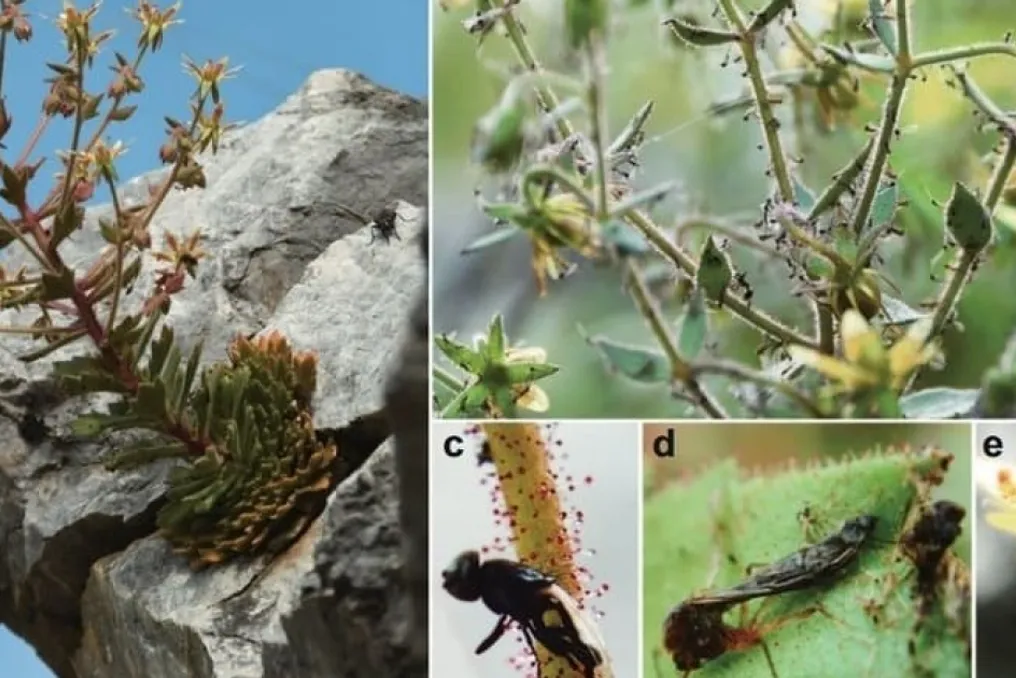
Researchers from China were able to confirm Charles Darwin's hypothesis, put forward more than a century and a half ago, regarding the possibility of a predatory lifestyle in some species of high-altitude saxifrage.
Researchers from China were able to confirm Charles Darwin's hypothesis, put forward more than a century and a half ago, regarding the possibility of a predatory lifestyle in some species of high-altitude saxifrage.
The authors of the scientific work demonstrated that the plant Saxifraga candelabrum is capable of catching insects, using them to obtain necessary nutrients. Darwin initially hypothesized such a phenomenon back in 1875 while studying plants with sticky glandular hairs, but his experiments at the time did not yield a definitive result, and for a century and a half, saxifrages were not classified as carnivorous.
Modern scientific methods allowed for the retesting and confirmation of this theory. Specialists found that this plant actively attracts and traps small insects using sticky hairs. Subsequently, it secretes digestive enzymes, breaking down the captured prey, and absorbs nitrogen, which is a critical element for growth, thereby fulfilling all conditions for recognizing the plant as carnivorous.
Scientists explain the shift to this type of nutrition due to nutrient deficiency in the soil. Saxifraga candelabrum grows in mountain crevices where there is a deficit of nutrients, especially nitrogen, so insects serve as an additional food source for it.
Furthermore, genetic analysis revealed the presence of genes in this new carnivorous species similar to those found in other carnivorous plants responsible for digesting and absorbing nutrients. According to the authors, this indicates that carnivory may have arisen independently in different groups of flowering plants. This discovery also provides grounds to believe that there are more such species in nature than previously assumed.
Botanists were able to confirm Charles Darwin's assumption that certain species of stonecrops might be predatory plants, 150 years after this idea was proposed.
During a detailed study of the stonecrop Saxifraga candelabrum, which grows in the Tibetan Plateau, it was established that this plant is capable of catching small insects. The hunting mechanism is based on the use of sticky hairs located on the stem, which attract insects due to the flower's specific aroma.
After capturing prey, it is digested by the plant, from which necessary nutrients are then absorbed. According to information published in the journal Nature Communications, it is suggested that these stonecrops may have initially used sticky hairs solely for protection against invertebrate herbivores, but over time they evolved into predators.