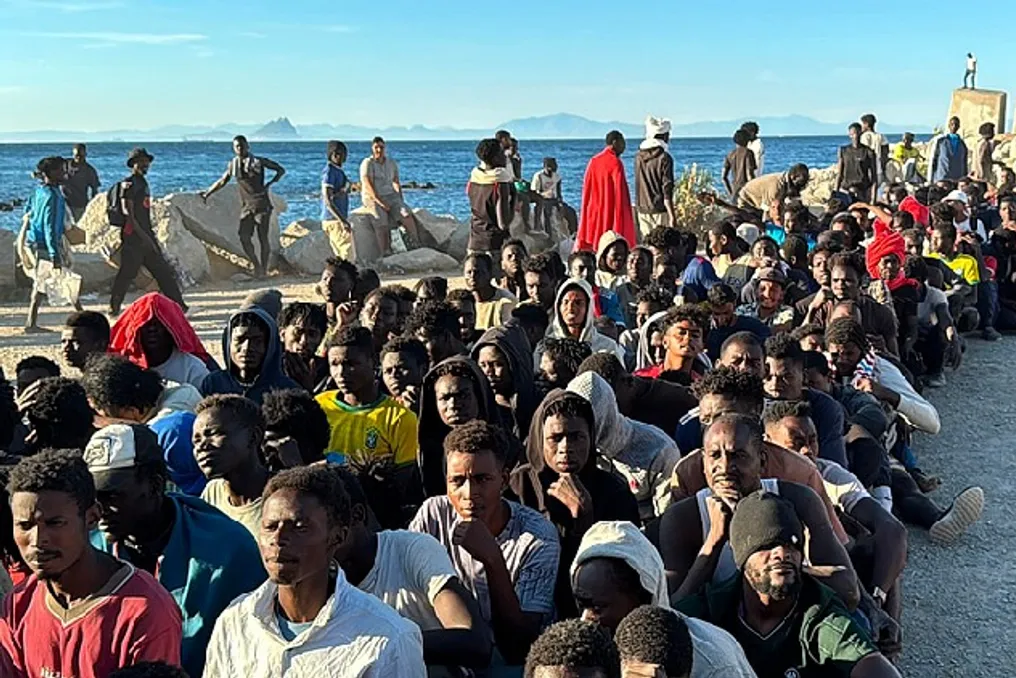
European Union Interior Ministers called for more decisive action against migrant smuggling networks and stricter return policies after approximately 72,000 migrants entered the North African enclave of Ceuta last week, causing alarm across the bloc.
At an emergency meeting, the ministers also insisted on closer cooperation with non-EU states to curb irregular migration and prevent a recurrence of this surge, which began on Thursday at one of the bloc's two land borders with Africa shared with Morocco.
The Spanish government delegation in Ceuta confirmed on Tuesday that three more bodies linked to the mass crossing were discovered since Monday, increasing the confirmed death toll from the incident to 75 people.
European Commissioner for Home Affairs and Migration, Magnus Brunner, stated at a press conference following the emergency meeting of EU Justice and Home Affairs ministers that the influx was provoked by criminal smuggling networks and disinformation on social media. He declined to comment on whether Morocco bears any responsibility but highly praised Rabat's cooperation with Spanish authorities regarding returns.
Spanish Interior Minister Fernando Grande-Marlaska reported after the meeting that about 70,000 migrants had been returned to Morocco.
The ministers reviewed several measures, including improving intelligence sharing, closer monitoring of social media for early detection of migration surges, and strengthening the protection of the EU's external borders.
Some analysts questioned whether Moroccan authorities turned a blind eye to these crossings, noting previous instances where Rabat was accused of using migration as a political lever. The last major surge occurred in May 2021, when Moroccan authorities seemingly relaxed border controls—a move widely interpreted as a response to Spain placing the leader of the Western Sahara independence movement. This territory is disputed, with Morocco claiming its sovereignty.
Brunner also mentioned that the EU is negotiating a comprehensive strategic partnership agreement with Morocco.
On Monday, Morocco rejected accusations of responsibility for the surge, stating that Spain should have foreseen the consequences of a judicial ruling that stipulated that migrants arriving by sea cannot be immediately deported unless a barrier is established. Grande-Marlaska reported on Monday that Spain had established a maritime barrier off the coast of Ceuta as quickly as possible after the ruling, adding that Spanish intelligence gave no indication of planning a mass crossing.
Grande-Marlaska noted: 'There are things that happen where there doesn't necessarily need to be someone responsible.' The EU increasingly relies on migration agreements with North African countries to curb irregular arrivals, but critics argue that this approach makes the bloc vulnerable to pressure from transit countries, which may weaken or threaten to weaken border controls in pursuit of political or economic concessions.
According to government statements, Denmark and Italy used emergency talks to push for tougher migration measures. Danish Immigration Minister Morten Bodskov called for increased EU funding to ensure border security. Italian Interior Minister Matteo Piantedosi urged the bloc to adopt 'new models of centers for external processing of asylum applications and returns to safe third countries.'
Marlaska explained that Ceuta has special arrangements within the Schengen system, and no one can leave the enclave and enter mainland Spain without undergoing effective document checks. Thus, the Schengen area has never been under threat, according to him. European Commission President Ursula von der Leyen previously stated that no person involved in the mass crossing reached mainland Spain or any other part of the EU from Ceuta.
Nevertheless, Italy suspended visa-free Schengen agreements with Spain for one month, although they do not apply to Ceuta, while 22 of the 27 EU member states called for coordinated action to strengthen the bloc's external borders.
Greek Prime Minister Kyriakos Mitsotakis wrote in an article for Politico published on Tuesday that the EU should allow for a temporary suspension of asylum registration during sudden mass arrivals.
The central government of Spain estimates that about 2,500 migrants remain in Ceuta, while local authorities state this figure is between 3,000 and 5,000. According to local authorities, at least 1,000 of those remaining are minors. Spain's Minister for Inclusion, Social Security and Migration, Elma Saiz, announced on Tuesday that the central government would provide Ceuta with an additional 25 million euros (about $29 million) for the accommodation and care of unaccompanied minors in the enclave.
Migrants remaining in Ceuta have been seen sleeping on beaches and using showers. Maurice Valente, Director General of the Spanish Refugee Aid Commission, stated that Spain must provide them with conditions where they can be housed with dignity and properly processed, including the opportunity to apply for asylum if appropriate. He emphasized: 'If they think that by holding people in bad conditions they will make them return (home), we consider that a bad decision and poor management.'
Many migrants flee poverty, conflict, or instability and risk dangerous journeys in search of safety or better opportunities.