Next Wednesday (the 12th), the Moon will completely cover the Sun for 1 minute and 40 seconds over part of northern Spain. Scientific groups from various institutions plan to use this time window to study the magnetic field, atmosphere, and solar storms. These storms, when reaching Earth, are capable of disabling satellites, endangering astronauts, and causing auroras at high latitudes.
A total solar eclipse is a rare phenomenon that has historically contributed to scientific discoveries. For instance, on May 29, 1919, British astronomer Arthur Eddington observed an eclipse on Príncipe Island in West Africa and confirmed Albert Einstein's theory of relativity by recording the effect of gravitational lensing—the bending of light—from stars made visible due to the blocking of blinding sunlight.
During a total eclipse, one can also observe the chromosphere, a layer of the atmosphere located between the corona and the surface. Brun noted the geometric coincidence that makes this phenomenon possible: the Moon is 400 times smaller than the Sun but is 400 times closer to Earth. This allows it to block sunlight without obscuring the surrounding atmosphere. The astrophysicist stated: 'We are incredibly lucky.'
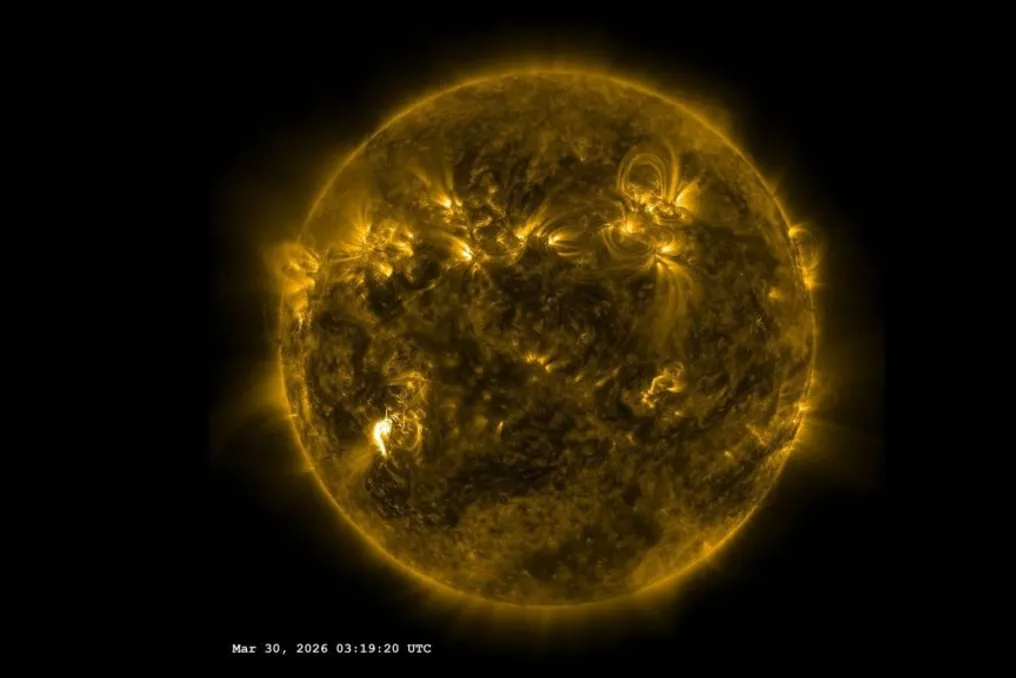
The Sun constantly emits charged particles and matter. Sometimes it releases solar storms—giant bursts of plasma and other particles. When these materials reach Earth's magnetic shield, they can damage satellites, threaten astronauts, and create colorful auroras in the northern and southern latitudes. Brun reported that 'these phenomena follow a regular cycle, peaking every 11 years,' and added that 'in 2024, the star reached the peak of its 25th cycle.'
The European Space Agency (ESA) will also analyze the eclipse with a focus on the solar wind. Karol Mundell, ESA's Director of Science, posed the questions: 'How do solar storms propagate? What is their structure, and can we develop models to predict them?'
ESA's Solar Orbiter satellite, launched in 2020, is already collecting data on the atmosphere and solar wind. For Michèle Jeanvier, a principal co-investigator of the mission, eclipses represent an opportunity to 'test how good or bad our models are.'
Another ESA mission, named Proba-3, is currently operating with three spacecraft flying in synchronized formation to create miniature artificial solar eclipses. There are also plans for the MESOM mission, which intends to send a spacecraft into the Moon's shadow to obtain a longer observation window for this phenomenon.
Lucy Green, a specialist in solar physics at University College London (UK) and a participant in the MESOM mission, told AFP that total solar eclipses 'inspire everyone, both artists and scientists.' She added: 'What we see on Earth inspires what we want to do in our space research.'