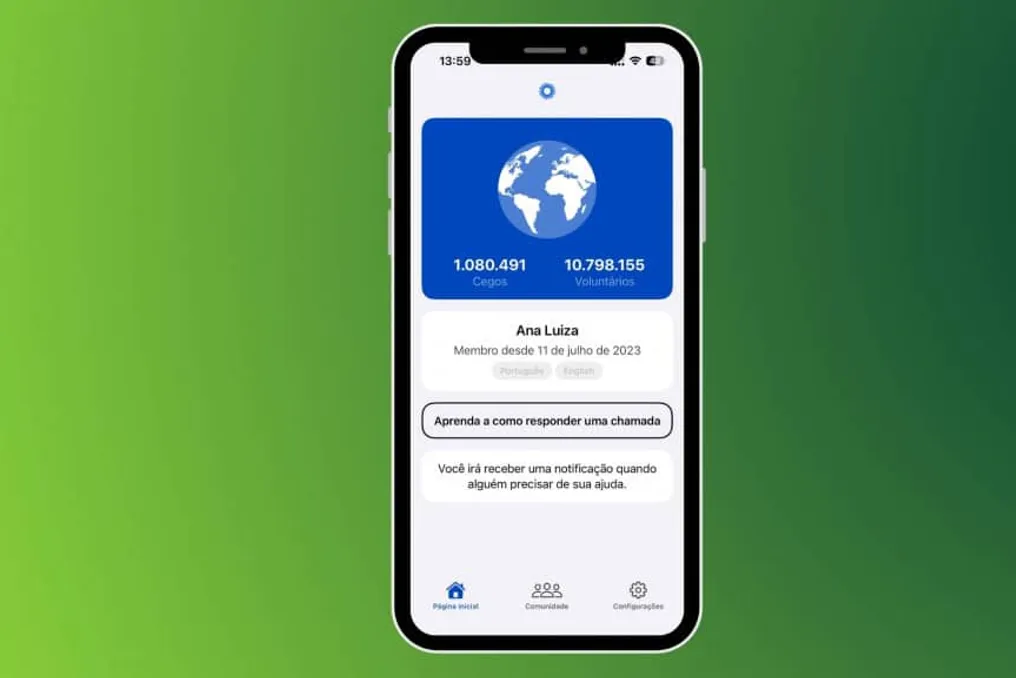
Be My Eyes, whose name in English means 'be my eyes,' was created with the purpose of connecting individuals with visual impairments or low vision to volunteers ready to provide assistance via video calls. This application enables the completion of daily tasks, such as identifying products, locating household items, or checking the temperature of an oven. Currently, the platform has over 10 million volunteers and approximately 1 million users distributed across more than 150 countries.
Over the last decade, the Danish company has implemented improvements to the platform, integrating artificial intelligence (AI) features and establishing collaborations with major technology corporations. Its business model is structured to keep the service free for both users and volunteers. Instead of charging users, Be My Eyes developed a service targeted at companies looking to offer more accessible support to blind or low-vision customers.
In an interview given to Olhar Digital, Hans Jørgen Wiberg, the founder of Be My Eyes, detailed the origin of the company from a daily need. He explained how he managed to finance the platform without burdening its users and addressed the impacts of AI, privacy challenges, and the organization's future plans.
Origins and Inspiration
The conception of Be My Eyes dates back to 2012, a period when Hans Jørgen Wiberg was working at the Danish Federation of the Blind. Part of his responsibilities included visiting people with visual impairments to present the organization's services, such as audiobooks and other accessibility resources. It was during one of these visits that he got the inspiration to develop the application.
A young man reported using his new iPhone to make video calls with his sister whenever he needed help identifying an object or confirming some visual information. The dilemma was that his sister was not always available, and he did not have an immediate alternative contact. Faced with this, Wiberg conceived a platform that would allow anyone to quickly connect with a willing volunteer.
Wiberg confessed to Olhar Digital that he had no knowledge of technology and did not know how to develop an application. The idea led him to participate in a Startup Weekend, where he found developers and other professionals who helped him convert the concept into a functional product.
Growth and Business Model
At the time of launch, the team's main uncertainty was not whether there would be blind people interested in the platform, but rather whether there would be enough volunteers to meet the demand. This concern was quickly dissipated: in the first 24 hours, about a thousand blind people registered on the app, accompanied by over 10,000 volunteers. The founder recalled that they immediately realized that the project was something people genuinely wanted to integrate.
Since then, the platform has expanded its reach to over 150 countries and begun offering support in 185 languages. According to Wiberg, adapting the application to new languages was a relatively simple process. However, the biggest persistent challenge lies in maintaining effective communication with such a diverse community, generating newsletters and other content for users spread globally.
From the beginning, Be My Eyes was designed as a free service for people with low vision or blindness. Despite its strong social mission, the company was established as a for-profit venture. Hans Jørgen Wiberg justified that the decision to keep the application free was made in the first few days, given that this audience often faces financial restrictions and should not have to pay for a tool that increases their autonomy.
The organization's financial sustainability was achieved through an alternative path. Instead of charging end-users, the company began providing a service to companies interested in making their customer service more accessible to visually impaired customers. Companies such as Microsoft, Google, Spotify, LinkedIn, and Hilton started using the platform to provide specialized support to this audience. Be My Eyes' client portfolio also includes entities like Procter & Gamble (P&G), Salesforce, Zendesk, Barilla, National Federation of the Blind, Royal National Institute of Blind People (RNIB), National Health Service (NHS), and Zain.
This business opportunity arose during a conference on visual impairment held in the United States. In dialogue with Microsoft representatives, the team noted that many blind customers had difficulty receiving technical support because most attendants were not prepared to guide them. From this deficiency, an integrated solution within Be My Eyes itself was born: through the app, users can directly contact partner companies and are directed to trained professionals to assist them.
The founder summarized this dynamic by stating: 'We help these large companies to be better for their blind customers. In return, they pay a monthly subscription to Be My Eyes.' He added that this model allowed the application to remain free, even in regions where the company does not yet have commercial operations. For Wiberg, a notable aspect of this format is the contrast between the modest size of Be My Eyes and the prestige of its clients.
Future Initiatives and Technology
Hans Jørgen Wiberg also mentioned the launch of the Be My Eyes Foundation, an initiative created to raise funds and ensure the continuous free availability of the application. The foundation serves as a safeguard against the instability of the current business model and the still uncertain costs associated with artificial intelligence. This organization, which receives donations, plans to establish an endowment fund intended to finance the platform's strategic priorities.
Among these priorities are expanding Be My Eyes to countries located in the Southern Hemisphere, developing functionalities for people who are deafblind, and a firm commitment that the computational costs of AI will never be passed on to users, treating accessibility as a fundamental right.
When accessing Be My Eyes, a user with low vision or blindness has the option to choose different modes of assistance depending on the task. To describe an environment, read a label, or identify an object, for example, it is possible to send an image to Be My AI and receive a response in seconds. The system also supports additional questions about the same photograph, simulating a conversation.
If the situation requires real-time interaction, the user can initiate a call to a volunteer. The application sends the request simultaneously to several volunteers and connects the call to the first available person who speaks the same language. According to Be My Eyes, the average waiting time is less than ten seconds. The call uses only video from the user's side and audio for both participants, allowing the volunteer to narrate what they see through the phone camera.
There is also a third option: the Services Directory. Through this, users can contact partner companies directly, such as electronics manufacturers or hotel chains, to obtain specialized support without having to leave the application.
After free registration, the volunteer only needs to keep the application notifications active. When a user asks for help, a notification appears on the phone screen. If the call is not answered, it is automatically redirected to another available volunteer, without any penalty for those who did not respond.
In practice, competition among volunteers tends to be fierce. A volunteer reporter since July 2023 reported receiving few calls during this period and observed that often, just a few seconds of delay were enough for another volunteer to accept the request. This behavior explains the low average waiting time for users.
When the call is accepted, the volunteer only sees the image captured by the user's camera, while communication occurs via audio. The platform guarantees that it does not share personal data between the parties and focuses on connecting people who share the same language. The service operates 24 hours a day, with no limit on calls per user.
According to the company itself, most interactions last only a few minutes and involve simple daily tasks, such as identifying an item, checking information in a document, or guiding the camera framing to solve the problem.
For many years, accessibility technologies for blind or low-vision people focused on features such as screen readers, optical character recognition (OCR) for reading text, and color or object identification applications. While useful, these tools generally performed very specific functions and offered little user interaction.
The advancement of multimodal artificial intelligence models changed this landscape. Instead of just describing an image, these systems began to interpret the context of a scene, answer questions about photographs, and sustain conversations about the analyzed content. This allows for a more natural exploration of environments and obtaining complementary information without the need to take a new photo for every doubt.
Despite this progress, AI does not yet fully replace human assistance. Situations requiring real-time guidance, interpretation of movements, or more subjective decisions remain, in many cases, dependent on the support of another person. It was precisely by seeking to unite these two methodologies that Be My Eyes integrated artificial intelligence into its platform.
The biggest change in the platform since its launch occurred in 2023, with the introduction of Be My AI. Hans Jørgen Wiberg stated that this new feature was quickly assimilated into users' routines and expanded the assistance options available in the application. However, the initial expectation of the team was different; they predicted that the novelty would drastically reduce the demand for volunteers. 'We thought that calls to volunteers would drop drastically, but that didn't happen,' the founder told Olhar Digital. According to him, the volume of calls remained almost stable, while the use of AI grew.
In Wiberg's analysis, this occurred because each feature assumed a distinct role on the platform. While artificial intelligence demonstrates greater efficiency in image analysis and answering questions about them, activities requiring immediate guidance—such as locating a lost object, finding the entrance to a building, or adjusting equipment—remain better suited for a conversation with a volunteer. Another point that, according to the founder, distinguishes volunteers from AI is human interaction. He observes that many blind people live alone and that brief conversations during a call, even after a simple task, are part of the experience offered by the application. 'At least in the way AI exists today, I don't think we can replace that with computers anytime soon,' he commented.