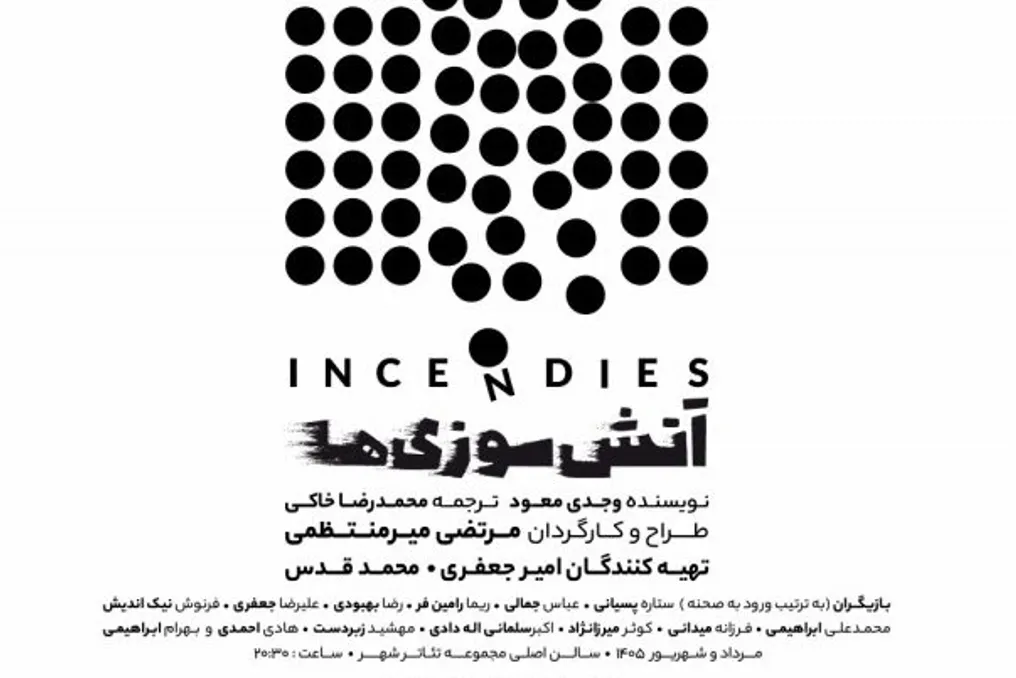
The production of Wajdi Mouawad's play 'Incendies,' written in 2003 by the Lebanese-Canadian playwright, is being staged at the City Theatre in Tehran.
The production of Wajdi Mouawad's play 'Incendies,' written in 2003 by the Lebanese-Canadian playwright, is being staged at the City Theatre in Tehran.
The production was directed by Mortaza Mirmontazami. The cast includes actors such as Setareh Pesyani, Abbas Jamali, Rima Raminfar, Reza Behboudi, Alireza Jafari, Farnoush Nikandish, and Bahram Ebrahimi, according to a report from IRNA.
The plot of 'Incendies' tells the story of the journey of twins Jeanne and Simon, who attempt to uncover the mystery of their mother's life. After Jeanne and Simon Marwan lose their mother, Nawal, they receive a difficult mission that sends them to the Middle East in search of their tangled roots and a long-lost brother.
This play has been presented in many countries around the world, including the USA, Brazil, Austria, Germany, Mexico, Spain, and Australia. Notably, the 2007 production at the Tarragon Theatre in Toronto received several awards. The Burgtheater in Vienna commissioned this production for Stefan Bachmann, and it subsequently received high critical acclaim, winning the 'Nestroy Award' in 2007.
'Incendies' was also adapted into a 2010 film of the same name by director Denis Villeneuve, starring Melissa Dezermo-Pulin, Maxime Godet, and Lubna Azabal. The film was nominated for the Academy Award for Best Foreign Language Film in 2011 and won the Genie Award for Best Feature Film at the 31st Genie Awards ceremony.
Wajdi Mouawad was born in Lebanon in 1968 but was forced to leave his homeland at the age of eight due to the civil war. This marked the beginning of a period of exile, which first led him and his family to Paris. In 1983, he was forced to leave this adopted home because the French state denied him the necessary documents for residency. He then moved to Quebec, where he studied and graduated in 1991 from the National Theatre School of Canada in Montreal with a degree in acting.
In 2000, he was offered the position of artistic director of the Théâtre de Quatre-Saisons in Montreal for four seasons. Five years later, he co-founded the theatre companies Abé Carré Cé Carré in Quebec and Au Carré de l'Hypoténuse in France with Emmanuel Schwartz.
Since September 2007, he has been the artistic director of the French Theatre at the National Arts Centre in Ottawa, and in January 2008, he collaborated with his French company at Espace Malraux, the national stage in Chambery and Savoie.
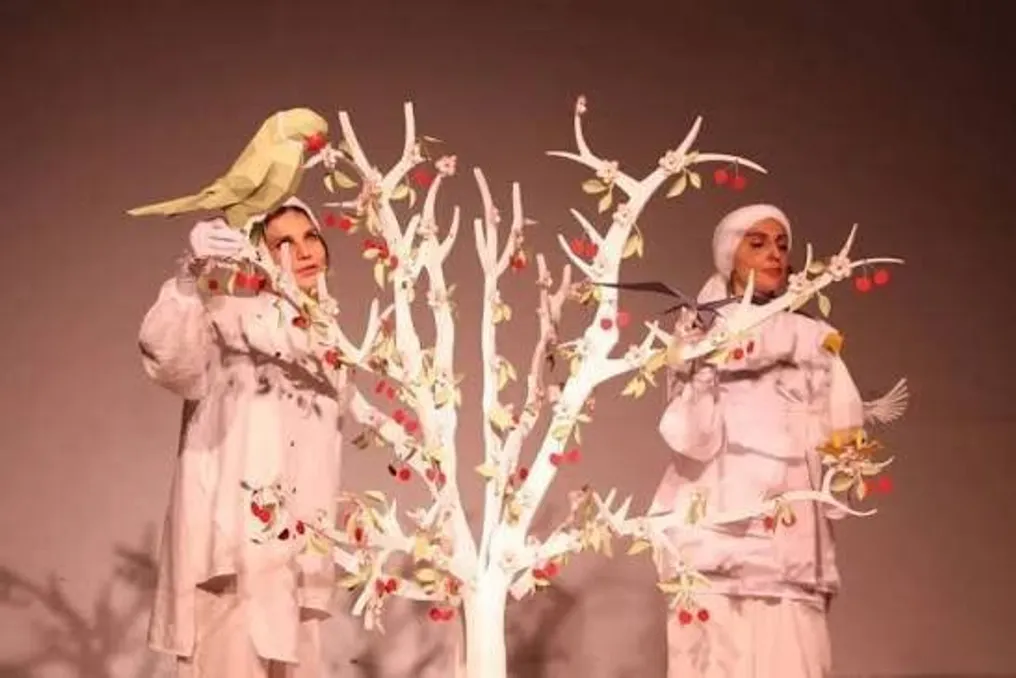
The puppet show 'Cherry Tree,' directed by Sharareh Tayyar, is currently running at the Mehran Theatre Artistic Bureau in Tehran. The performance employs an allegorical and indirect approach, exploring themes of freedom and resilience in the face of oppression through a visual and narrative language adapted for children and adolescents.
The script is based on a story from the book 'Why? Why? Why?' by the French author and children's book illustrator Claire Jobert. The original book is a retelling of the life of Imam Hussein (AS) and the events of Ashura; similarly, the play uses symbolic storytelling to convey core moral and spiritual values to a young audience.
The plot centers around a beautiful tree that serves as a refuge for various birds. The world is disrupted by the appearance of a mischievous woodpecker, causing widespread anxiety among the inhabitants. However, with the arrival of a nightingale, the birds find the inspiration and unity needed to resist the woodpecker's tyranny.
The production, which previously received significant acclaim, was recreated upon the request of the Omid Theatre House. The play was written by Sharareh Tayyar and Mohammad Hossein Habibi. The creative team includes Fahime Barouti, Amir Hossein Ensafi, Sharareh Tayyar, and Amir Mohammad Ensafi as puppet designers. Ammar Tafti serves as the narrator, and Paria Tayyar provides the voiceover.
Ashura refers to the tenth day of Muharram, the first month of the Islamic calendar, and commemorates one of the most important events in Islamic history—the martyrdom of Imam Hussein (AS), grandson of the Prophet Muhammad (PBUH). In 680 CE, Imam Hussein led a small group of family members and companions against the vast army of Yazid I, the Umayyad Caliph, on the plains of Karbala in modern-day Iraq. This conflict was not merely a political struggle for power but a profound moral stance against tyranny and injustice.
Despite the numerical superiority of his opponents and the denial of water for several days, Imam Hussein and his followers steadfastly adhered to their principles until his martyrdom. The legacy of Ashura transcends time and geography, serving as a universal symbol of the struggle between truth and falsehood. For millions worldwide, Imam Hussein is revered as the 'Prince of Martyrs' and an eternal icon of courage, self-sacrifice, and integrity.
His refusal to swear allegiance to a corrupt ruler, even at the cost of his own life and the lives of his loved ones, continues to inspire movements for liberation and human rights. Today, Ashura is observed with mourning rituals, processions, and reflections on the enduring victory of the oppressed over the oppressors. The play 'Cherry Tree' will run until August 7th.