The ground-based DKIST telescope was able to obtain images of the Sun's photosphere with unprecedented clarity. This allowed for the first detection of Kelvin-Helmholtz instabilities in this layer of the star.
The ground-based DKIST telescope was able to obtain images of the Sun's photosphere with unprecedented clarity. This allowed for the first detection of Kelvin-Helmholtz instabilities in this layer of the star.
These instabilities are visualized as highly dynamic, small-scale vortex structures and bands. They are observed in areas adjacent to the boundaries of dark pores and bright convective cells.
The research results were presented in the scientific journal Nature.
The LINK satellite, launched into near-Earth orbit in early July 2026, has encountered serious problems. On July 28, 2026, two out of three flywheel engines in the attitude control system failed, causing the spacecraft to begin rotating and experience communication difficulties.
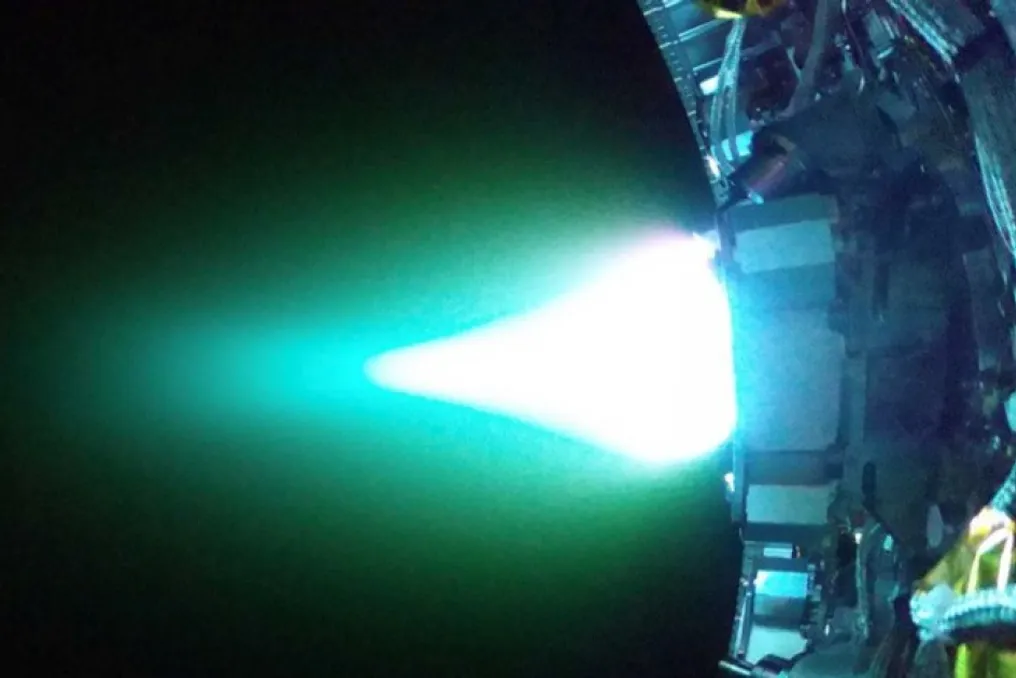
Furthermore, a decrease in the efficiency of the propulsion system, which uses three xenon thrusters, has been noted. These malfunctions are linked to incorrect functioning of the power supply system. Despite this, the satellite retains the ability to charge its batteries and maintain contact with the ground control center. It is planned that once attitude control is restored, updated software will be installed on the spacecraft.
LINK was developed by Katalyst Space Technologies for NASA. The primary objective of this spacecraft is to connect with the Swift gamma-ray observatory using three manipulators and raise the telescope's orbital altitude almost back to its original level. If this does not happen, the telescope risks burning up in Earth's atmosphere within the coming months.
After launch, the satellite successfully deployed its solar panels, established contact with Earth, and conducted initial system diagnostics and transmitted images. However, almost two weeks after launch, an anomaly was detected in the operation of one of the flywheel engines, which was promptly resolved.
The text also mentions images captured by the Artemis-2 crew during the flyby of the far side of the Moon on the night of April 6–7, 2026, which were demonstrated to NASA. One of these images shows the crescent Earth setting behind the lunar horizon. The astronauts' goal was to reproduce a known image of the Earth's sunrise taken by the Apollo-8 crew in 1968. Such observations are possible due to the Moon's libration, but they are limited both by the observation area for low orbits near the satellite and by time, as the Orion crew only had a few minutes to capture the planet's sunrise or sunset. Additionally, one of the images recorded a total solar eclipse, which was observed by humans from cislunar space for the first time.