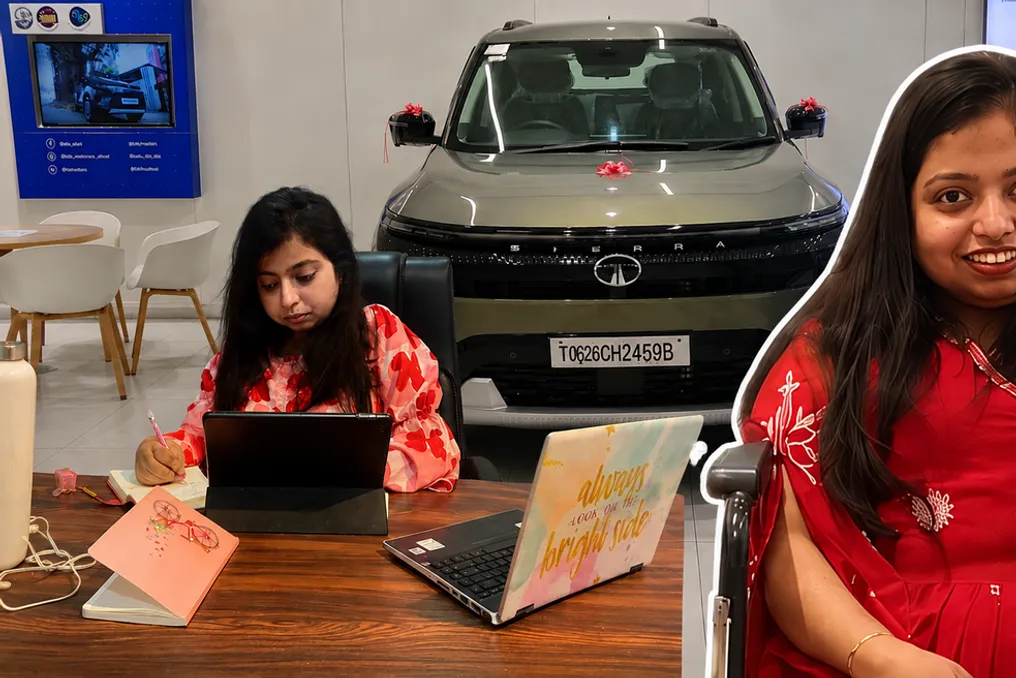
Himanshika Sharma shares her personal experience living with Juvenile Rheumatoid Arthritis (JRA), recounting how she managed to build an independent life and career despite her illness.
Recalling the past, she remembers moments when her father helped her, such as carrying her up the stairs because she couldn't go down by herself. Years later, he stood beside the car she had purchased with her own money, running his hand over the hood with quiet disbelief.
Between these two events unfolds the story of an illness that took away many expectations but could not take away the most important thing—the ability to build a meaningful life.
Growing up with an uncertain future
The first signs of the disease appeared when she was only three years old. Five years later, she was diagnosed with Juvenile Rheumatoid Arthritis (JRA)—an autoimmune condition affecting the joints. She remembers little about her early years, including hospital visits, injections, or treatments her parents tried in the hope of recovery; she only heard about this from her mother, who often recounts these stories emotionally.
In a way, the lack of memories was a blessing. She never knew herself without this illness; it didn't interrupt her life, but became the reality around which it was built.
As she grew older, JRA gradually damaged her knees, wrists, fingers, hips, and neck. While other children carefree awaited sports days and school trips, she learned early to live with pain, fatigue, and physical limitations. However, childhood can make even the most difficult realities familiar until they stop being so.
The Staircase That Changed Everything
In 2010, while in the 10th grade, she was standing on the top step of her ancestral home in Ambala, dressed for school. She looked down at the steps and found she couldn't move; her legs simply refused to obey. She cried there until her father heard her. He rushed upstairs, lifted her, and carried her down.
At that moment, it seemed like just another difficult morning. Looking back, she realizes it was one of the first moments that forced her to confront the reality she was trying to ignore. Her body was changing, and her future was changing.
In the following years, walking became increasingly difficult. By 2014, she began using a wheelchair. Not only did her mode of transport change, but so did how the world reacted to her. She realized how many buildings, offices, public places, and everyday situations were designed assuming everyone could walk. When that is not possible, even the simplest tasks become complicated.
The Invisible Labor of Living with a Chronic Illness
People often imagine chronic illness as a series of dramatic moments. In reality, most of it is invisible. It is the constant calculation of whether there is enough energy for the day. It is the decision about which tasks can be postponed and which cannot. It is learning to work around the pain instead of waiting for it to disappear.
Over the years, she has undergone numerous courses of treatment and surgeries. Some brought hope, others disappointment. What she considered a simple path to better mobility turned into years of complications, infections, and repeated hospitalizations. Today, she lacks the right hip, and several planned surgeries remain postponed indefinitely.
For a long time, she believed that these setbacks meant her life would always be defined by what her body could not do. She was wrong. The illness could affect her mobility, but it could never decide what she was capable of.
The Discipline of Her Days
Mornings remain the hardest time. Almost every day she wakes up with pain and stiffness, and the first hour reminds her of what she lives with. However, she has learned that movement, not rest, helps her feel better. Every day begins with a 45-minute home physiotherapy session. She also pays close attention to her diet, avoiding foods that trigger inflammation and flare-ups.
Sleep is also not optional. She cherishes it because she needs to wake up with enough energy to meet the day, not just survive it. None of this looks glamorous; it is routine, it is repetition. There are days when it is the last thing she wants to do. But it is the price she willingly pays for the freedom to live by her own rules.
However, the biggest shift happened not in her joints, but in her mindset. She decided early on that she would not let this illness become the defining chapter of her life. She intentionally keeps herself busy, takes on projects, pursues goals, and fills her schedule because she understood that idleness is when anxiety begins to creep in.
Throughout this journey, her mother was her greatest support. She served as her primary caregiver for many years, and when she is not around, her sister takes care of her without hesitation. Without them, she would not be where she is now. Outside of work, she enjoys reading and traveling. Recently, she bought her own car, meaning she no longer depends on others for transportation.
She manages JRA not by fighting it every minute of every day. She manages it by refusing to shrink her life around it, while simultaneously listening to what her body tells her when it is time to slow down.
How Writing Became Her Independence
One of the greatest gifts in her life came quietly. It came in the form of words. As a teenager, she fell in love with writing. By seventeen, she had one dream—to publish her first book. The only problem was that they couldn't afford it. Her mother sold one of her gold rings to make it happen, and her father took out a loan for the remaining amount. The book was published. She never received a single rupee in royalties, and at the time, that felt like a big disappointment.
But life had other plans. The book introduced her to a community of writers. Through them, she met people who built successful careers working on writing entirely from home. For the first time, she saw a possible future—a future where her mobility would not determine her earning potential. A future where people would value her ideas more than her physical limitations.
This realization changed everything. What started as small freelance assignments gradually turned into professional opportunities, and then into a full-fledged career. Many clients who hired her never knew she could walk. They only knew the quality of her work. After many years of feeling that her identity revolved around her medical condition, it was incredibly liberating.
A Promise Made to Her Sister
One of the most important decisions in her life was made on her birthday. Her younger sister was eight years old. Money was scarce, and there wasn't enough for a celebratory cake. Instead, her mother brought home two samosas. Her sister took a knife, cut one in half, and smilingly announced, 'Everyone eats cake on their birthday. No one cuts samosas. That's different.' She still vividly remembers that moment, remembering how easily she found joy in a situation that could have easily disappointed a child.
On that day, she made a silent promise to herself: as long as she lived, her sister should never have to bear the burden of financial instability if she could help it. This promise became her greatest motivation. Every project she took on, every skill she learned, and every opportunity she missed was driven by the desire to build a better future for her loved ones. Today, her sister is graduating from one of the leading universities in their region, and she was able to fund her education. She often tells her that she wouldn't have achieved this without her, but the truth is that her sister gave her something equally valuable—a reason to keep going during the toughest years of her life.
The Freedom She Didn't Expect
For years, even leaving the house required coordination. Some taxi drivers refused to take her when they saw the wheelchair. Others hesitated loading her into their cars, fearing damage to the vehicle. Every trip was accompanied by explanations; every outing depended on someone's willingness to help. Then someone told her father, 'Your daughter can't even ride a bicycle.'
They didn't know that no one can predict another person's future. Earlier this year, she bought her own SUV. She became the first woman in her family to own a car in her name. For many, this might look like a financial milestone, but for her, it meant something much more personal. It meant freedom. It meant not worrying about whether someone would agree to lift her wheelchair. It meant independence. It meant dignity.
Watching her father next to this car, gently running his hand over the hood, she couldn't help but remember that staircase many years ago when he carried her down because she couldn't do it herself. Neither of them could imagine that moment back then. Life led them much further than they ever thought possible.
Building More Than a Career
The achievements she is most proud of are not those listed on a resume. They are those that changed her family's life. In 2024, they left Ambala and started a new chapter together. One of the biggest achievements was helping her father open his own small restaurant. After many years of uncertainty and financial hardship, he finally had his own business.
Today, her sister is finishing her studies. Her parents no longer carry the financial burden they once did. And she has built a career that allows her to contribute, create, and support the people who stood by her through every difficult phase of her life. None of these stages erased the problems associated with living with a chronic illness. But they taught her something important: success is not always about getting back what was lost. Sometimes it means building something meaningful with what remains.
What Her Illness Did Not Take Away
She still experiences pain. There are times when her body needs extra time to cooperate. There are opportunities she has to decline, and places that are hard to reach. There are still moments of disappointment. But there is also immense gratitude.
Over the years, she has learned that a body that struggles is not the same as a life that has failed. Her illness took away her mobility. It took away her confidence. It took away the future she once envisioned for herself. But it never took away her ability to think. Never took away her love for writing. Never took away her ability to learn, create, support her family, love deeply, or dream of a future that looked different from what others expected.
The staircase. Surgeries. Wheelchair. Setbacks. All of this is part of her story. But it is not the whole story. The whole story is this: the life she built did not come from expecting circumstances to get easier. It came from the daily choice to build her future around what remained, instead of mourning what was lost.