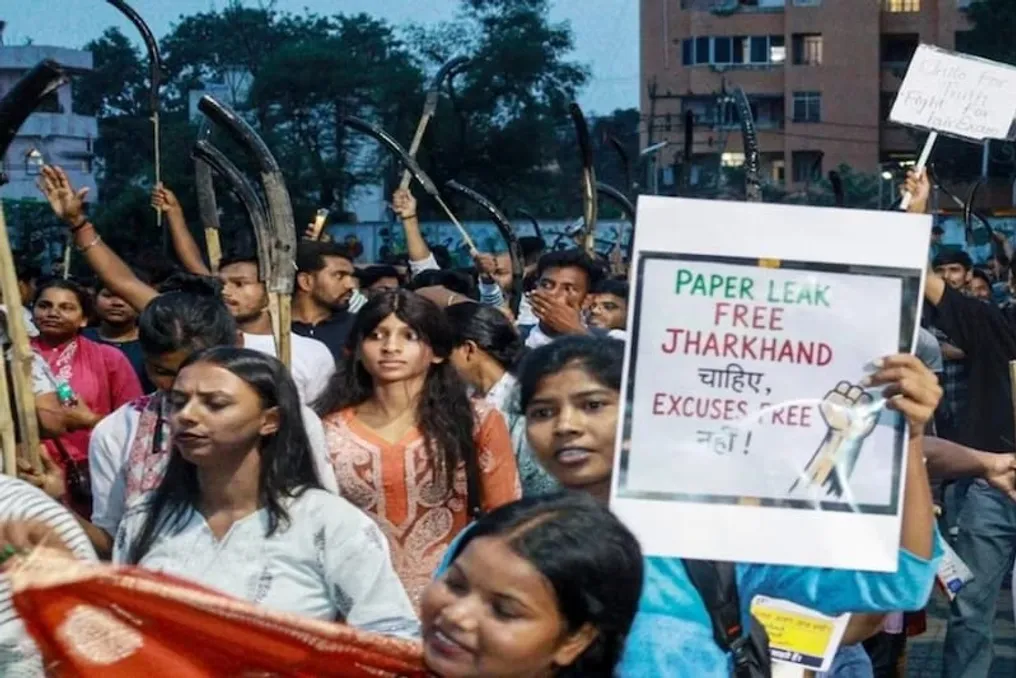
Student protests, which started with relatively minor issues such as increased mess fees in hostels, gradually evolved into large-scale movements capable of changing government decisions and influencing the political course in India. These events are part of the rich history of student movements in the country.
Today, students across the country are taking to the streets, raising issues related to the education system, job entrance exams, examination leaks, employment, tuition costs, and other topics. Governments are advised to learn from the past, carefully listen to activists' demands, and consider the mood of the electorate.
In the age of social media, it has become extremely easy to unite over any violations or malpractice. The recent 'Cockroach Janata' party, which emerged from social media, is a prime example of this. However, this is not a new phenomenon; consider other movements that initially did not attract serious attention from the authorities but whose protest voices later managed to shake their positions.
In December 1973, there was an increase of about 20 percent in the mess fee at an engineering college in Gujarat. Students protested against this hike and demanded a reduction in the bill from the administration, but their demands were ignored. This is when the Nav Nirman movement originated. Initially, student protests were confined to the campus, where they held rallies against the administration.
Within a few days, this movement expanded to cover issues of inflation, corruption, and food shortages. Students, teachers, traders, and ordinary citizens joined the protests. The 'Nav Nirman Youth Committee' was formed to maintain discipline within the movement. Soon, the movement spread throughout Gujarat. Due to continuous demonstrations and public pressure on the government, the then Chief Minister Chimanbhai Patel was forced to resign, and the Gujarat Assembly was subsequently dissolved. This is considered the first major movement in independent India that compelled the elected state government to step down.
Just a few months after the Gujarat movement, in 1974, students in Bihar began protesting against corruption, unemployment, inflation, and the state of the education system. Students from Patna University organized protests under the banner of the 'Bihar Student Action Committee'. Later, India's hero Jayaprakash Narayan joined this movement, advocating the slogan 'Total Revolution'.
After this, the movement ceased to be exclusively student-led and transformed into a nationwide movement. It exerted immense political pressure on the central government, playing a significant role in subsequent political events, including the 1975 Emergency and the 1977 general elections. Although this movement was not the sole cause of these events, it is considered an important component.
In Assam, the All Assam Students' Union (AASU) initiated protests regarding alleged irregularities in voter lists and illegal immigration. Although the movement started at the local level, it gradually grew into the largest statewide national movement. Numerous strikes and large demonstrations took place over approximately six years. Eventually, the Assam Accord was reached in 1985 between the central government and activists. Following this, student leaders founded the Asom Gana Parishad (AGP) and came to power. This is considered one of the most successful student movements in India.
In 1990, the central government announced the implementation of the Mandal Commission recommendations, which provided 27 percent quotas in government services for representatives of other socio-economic classes (OBC). In response, students from many educational institutions across the country, including Delhi University, took to the streets. The protests intensified after the suicide attempt of student Rajiv Goshe in Delhi. Demonstrations took place in many cities, and educational institutions remained under the influence of this movement for a long time. This movement had a profound impact on Indian politics and public discourse.
The strength of student movements persists to this day. Thanks to social media, a protest that begins in any university or college can become the subject of national discussion in just a few hours. Students continue to voice their opinions on issues such as education, job entrance exams, examination leaks, employment, and tuition costs.
India's history shows that student movements cannot be viewed merely as local campus affairs. Often, a protest that starts with a minor demand becomes a societal issue. The voice of students has always been important in democracy, and when this voice unites with broad public support, governments are forced to reconsider their decisions.