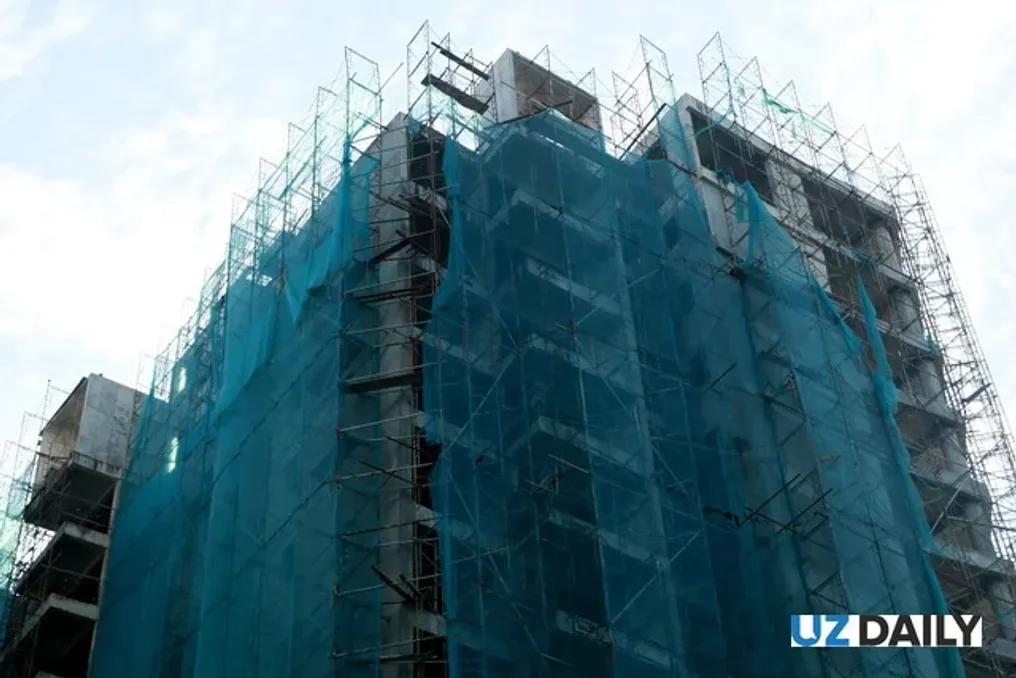
According to the National Statistical Committee data, the total volume of construction work in Uzbekistan reached 192.0 trillion Uzbek soums from January to June 2026.
According to the National Statistical Committee data, the total volume of construction work in Uzbekistan reached 192.0 trillion Uzbek soums from January to June 2026.
The largest volume of construction activity was recorded in Tashkent, where the figure amounted to 61.2 trillion Uzbek soums. The Tashkent region took second place with a volume of 18.8 trillion Uzbek soums, and the Fergana region came in third with a figure of 12.1 trillion Uzbek soums.
The top five regions by construction volume also included the Bukhara region, where construction was carried out for 10.7 trillion Uzbek soums, and the Samarkand region with an amount of 9.9 trillion Uzbek soums.
Following these were the Kashkadarya region with a volume of 9.4 trillion Uzbek soums, the Andijan region—9.0 trillion Uzbek soums, the Navoi region—8.6 trillion Uzbek soums, the Khorezm region—8.5 trillion Uzbek soums, and the Namangan region—8.4 trillion Uzbek soums.
During the reporting period, construction was completed in the Surkhandarya region for 7.9 trillion Uzbek soums, and in the Karakalpakstan Republic—6.6 trillion Uzbek soums. Figures were also noted for the Jizzakh region—4.8 trillion Uzbek soums, and the Syrdarya region—3.7 trillion Uzbek soums.
The National Committee of the Republic of Uzbekistan on Statistics published preliminary estimates of the gross regional product (GRP) for all regions of the country, as well as for the city of Tashkent and Karakalpakstan, for the period from January to June 2026, on July 30.
The republic's total GDP for the first half of the year reached 1,072.7 trillion soums, showing a real growth of 8.5%. Among the regions, the city of Tashkent showed the highest GRP volume—226.0 trillion soums, with a growth rate of 113.3%, which is the best result among all regions of the country. The Navoi region ranked second with 113.9 trillion soums (growth of 106.7%), and the Tashkent region followed with 103.8 trillion soums (growth of 108.7%).
The highest growth rates were recorded in the Republic of Karakalpakstan (110.2%), Samarkand region (109.7%), as well as in the Khorezm and Fergana regions (both at 109.1%). Meanwhile, the Navoi region showed the smallest increase among the regions with a figure of 106.7%, which was below the national average.
In January-June 2026, the city of Tashkent contributed the most to the national GDP, accounting for 21.1%. The next positions were held by the Navoi and Tashkent regions with shares of 10.6% and 9.7%, respectively. Following these were the Samarkand region (6.3%), Fergana region (6.1%), and Andijan region (5.6%). Jizzakh (2.8%) and Syrdarya region (1.8%) had the smallest share in GDP generation.
The profiles of the regions vary significantly. The National Statistical Committee noted that in the Jizzakh (36.6%) and Surkhandarya (35.4%) regions, the share of agriculture, forestry, and fishing was the highest. Industry dominates the Navoi region, making up 81.9% of its GRP, which distinguishes it from other regions due to the concentration of mining and processing industries. The Tashkent region ranks second in industrial share with a figure of 46.6%.
The largest shares in construction were recorded in the city of Tashkent (12.0%) and the Khorezm region (10.9%), while the services sector is led by the city of Tashkent (67.9%) and the Samarkand region (52.0%). In terms of growth rates, the construction sector demonstrated the greatest momentum in almost all regions: Karakalpakstan showed growth of 140.2%, Samarkand region—135.4%, and Navoi region—127.2%. The fastest growth in industry was noted in Samarkand (109.8%) and Jizzakh (112.3%).
By the indicator of GRP per capita, the Navoi region topped the list with a value of 102.1 million soums at current prices. The city of Tashkent took second place with 70.7 million soums, and the Tashkent region completed the top three with 32.7 million soums. The lowest GRP per capita figures were registered in the Surkhandarya (11.9 million soums) and Namangan regions (14.2 million soums). However, the city of Tashkent led in GRP per capita growth rates at 111.0%, surpassing the national figure of 106.6%.
The share of small businesses in the national GDP was 50.5%. At the regional level, the picture is uneven: the highest share of small businesses was observed in the Surkhandarya region, accounting for 76.0% of the total regional gross value added, followed by the Fergana (74.2%) and Namangan regions (72.7%). The smallest share of small businesses was recorded in the Navoi region—only 14.6%, reflecting an economic structure dominated by large industrial enterprises. The Tashkent region also showed a relatively low share of small businesses—49.7%, slightly lower than the city of Tashkent (52.9%). The data published by the National Statistical Committee are preliminary and take into account statistical surveys assessing the informal economy; figures for January-June 2025 have been revised.
According to the results of the first half of 2026, Tashkent, the capital of Uzbekistan, demonstrated the highest rates of economic growth among all regions of the country. This success was achieved through attracting a record volume of foreign investment, significant export growth, and the creation of about ten thousand new jobs.
According to information provided by the city administration's press service, Tashkent's gross territorial product reached 226 trillion soums. This exceeds the figure for the same period last year by 13.3%, allowing the capital to surpass the projected figure of 11.2% and secure its leadership position in the republic.
The industrial sector also showed a positive trend: the volume of produced goods amounted to 109.6 trillion soums, which is 8% more than the previous year. However, the main driver of growth was investment. In the first six months, $4.3 billion in foreign investment and loans were brought into Tashkent's economy, which is one and a half times the volume of the previous year.
Thanks to the funds received, 249 investment projects were launched in the capital. New production facilities with a total value of $657.5 million were commissioned under these projects, contributing to the creation of 9.8 thousand jobs. Additionally, exports from Tashkent enterprises exceeded $1.5 billion over six months, which is 43% more than the previous year.
The localization program is actively promoted, within which 77 projects with a production volume of 4.9 trillion soums have been implemented, which is 48% higher than planned. Such initiatives help reduce imports, making products more affordable, and also strengthen cooperation between enterprises. The Hokimiyat considers the creation of jobs, the launch of modern production, the improvement of the population's living standards, and the development of the capital's industrial potential as key achievements.
It should be noted that World Bank analysts believe that due to reforms being carried out in logistics, tourism, and pharmaceuticals, Uzbekistan is capable of attracting between $5.2 and $6.4 billion in private investment and providing employment for over 300 thousand people.