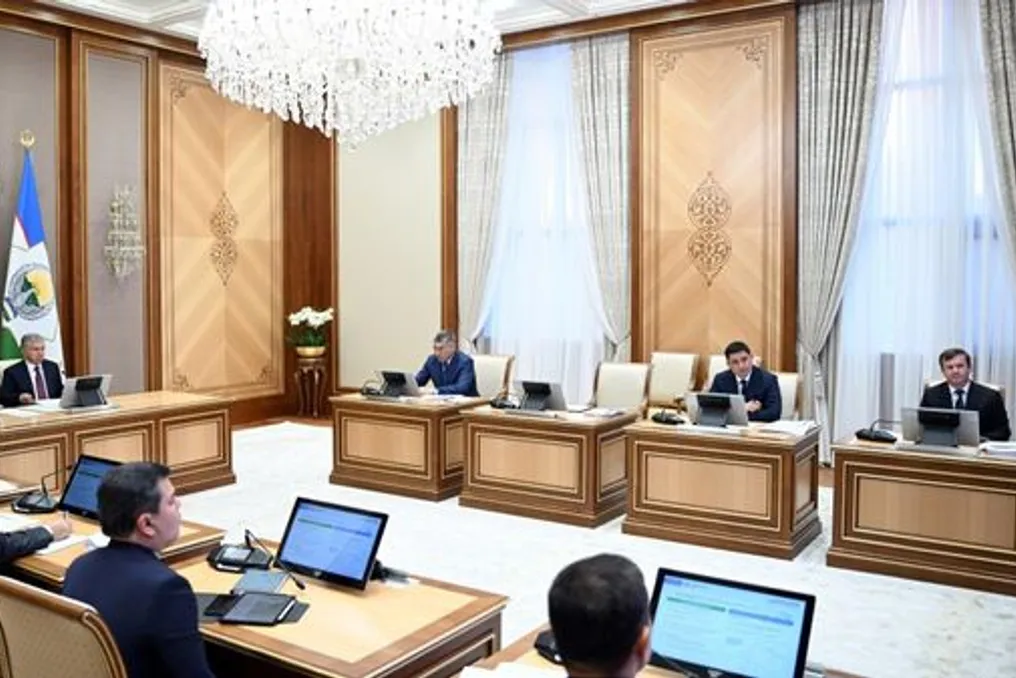
President Shavkat Mirziyoyev reviewed a presentation concerning the reorganization of the Cadastral Agency's activities and the simplification of services provided to the population and entrepreneurs. According to the state press service, several proposals for process optimization were put forward.
In the first half of this year, over one million applications for the use of cadastral services were received, of which 330 thousand, or 30 percent, were rejected. This means that one out of every three submitted applications was not satisfied.
The current system requires citizens to submit several separate applications and pay for each one to solve a single problem. For example, dividing a plot between brothers requires four applications, and dividing an inheritance into three parts requires six applications.
Currently, the review process for each application at the district, regional, or republican level takes an average of 15–20 days, as it goes through 30–50 stages at each level.
During the presentation, the work of the Cadastral Agency and the Cadastral Chamber as separate local structures was criticized, as well as the fact that the system is managed by two heads. It was proposed to decentralize the provision of cadastral services, expand the powers of regional units, and transfer at least 30 percent of republican-level employees to district structures.
Furthermore, it is planned to merge the Cadastral Chamber and service provision structures at the republican, regional, and district levels. During the implementation of changes, the goal has been set to launch the 'Cadastral Consultation Corner' and 'Fast Cadastre' services within one week so that the population is not left without support.
A proposal was made to organize the agency's activities on the principle of 'one application—one payment.' Proactive service will be provided by automatically generating an application when a right to real estate arises.
It is planned to reduce over 200 thousand applications per year by providing all cadastral services under one application. A transition to a fully online format for registering rights to real estate is also provided for, which will allow 500 thousand applications to be processed in seconds instead of the current 10–15 days.
In addition to this, it is proposed to soften liability for voluntary removal of illegal construction, and for individuals who have not registered their right to real estate within the established period, issue a warning instead of the first fine.