The article's authors note that every August, attention in South Africa focuses on women, as billboards change color, and the government, NGOs, and corporations hold discussions and seminars. However, the authors argue that during the first week of this month, the focus inevitably narrows down to one topic—Gender-Based Violence and Femicide (GBVF).
Researchers and activists who participated in marches emphasize that daily attention to GBVF is necessary, and they support this focus. Nevertheless, they believe something important has been lost in the process. They remind us that Women's Month was never intended to be a monthly watch documenting human rights violations, crimes, and violence against women.
Originally, August should have been a month of celebrating defiance, strength, capability, and the victories of women in all their diversity. This contrasts with what is happening now, where the month turns into an illumination of trauma.
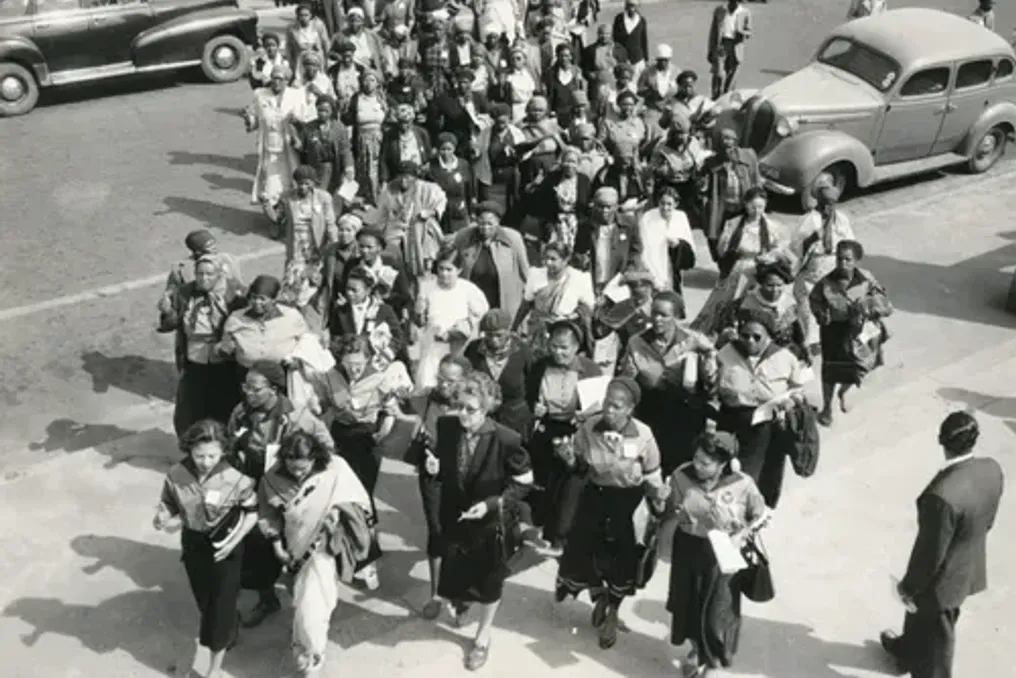
On August 9, 1956, over 20,000 women marched to the Union Buildings in Pretoria to protest the expansion of pass laws for women. They were led by Lillian Ngoyi, Helen Joseph, Rahima Musa, and Sophia Williams-De Bruyn. Women from different racial groups, under apartheid rule, united in a single act of civil disobedience.
These women were not victims needing pity; they acted as strategists, organizers, and societal leaders who executed one of the most disciplined mass actions. This is the memory August should preserve—a memory of self-determination, not just suffering, pain, and hopelessness.
Sixty-two years later, on August 1, 2018, another large group of women marched to the same Union Buildings. The #TotalShutdown march was, by some estimates, the largest coordinated women's protest in South Africa since 1994. Thousands of women, girls, and gender non-conforming people from all walks of life gathered in Pretoria to march to the Union Buildings. This march was organized in response to a wave of femicide cases dominating headlines at the time.
Both marches share a common route and destination, and both reflect women's refusal to remain unnoticed. Although their motives were opposite—the 1956 march was an assertion of power against the state before it could tighten control over freedom of movement, and the 2018 march was a demand for protection after accumulated abuses and deaths of women—both demonstrate the same thing: when South African women organize, the state reacts.
The Total Shutdown movement arose partly from frustration with society and the government, which annually marked August as 'Women's Month' but failed to ensure women's protection from violence at other times. The authors call this fair and accurate criticism of empty symbolism. However, the response to a month that celebrated women but did not act should never be a month that mourns without celebrating anything in return. They believe they have not eliminated the void in commemoration, but merely replaced one unfinished story with another.
It would be dishonest to pretend that the shift to focusing on GBVF happened accidentally or improperly. It happened because South African women continued to die, and civil society rightly refused to let the month intended to honor women pass in silence while violence against these same women remained unaddressed.
Unfortunately, at some point, urgency becomes a standard program, and the celebratory aspect of Women's Month quietly disappears from programs in many sectors. In recent years, there has been a rise in requests from experts and GBV activists to participate in Women's Month interviews, panels, and events, which are increasingly focused on GBVF.
These events and discussions have not taken their rightful place in August, displacing the legacy of the marches; instead, they have filled the vacuum created when the rest of South African women's history ceased to be actively curated. The result is a strange inversion: a month named after collective female strength and achievement is slowly transforming in practice into a month defined by crisis discourse about collective female vulnerability.
When a month created to celebrate supremacy gradually transforms into a month dedicated to illuminating trauma, we lose the radical meaning of August 9, reducing it to a general month of 'women's issues' and erasing the political sharpness of what actually happened. Three things happen quietly in this process:
- Women's achievements remain uncaptured in the single window created to celebrate their defiance and victories;
- Girls are forced to internalize the narrative of danger before they internalize the narrative of possibility and potential. A ten-year-old girl watching Women's Month content should hear and see stories of figures like Kaster Semena, Thuli Madonsela, Miriam Makeba, Mandisa Maja, Professor Lizel Tsulke from UCT, Mary Vilakazi, the success of the Banyan Banyan team, Zozibini Tunzi, and many others;
- The messages about GBV become less effective due to repetition without renewal. When the same crisis framing is repeated every August, and then repeated during the 16 days of activism against violence against women and children without a new strategy, the audience tires. True urgency begins to sound like background noise.
This is not a call to abandon the discussion of GBV in August; that would be self-erasure. It is a call to stop reducing the month to a single narrative and a set of 'symbolic' actions that create the impression of universal societal response, while women still do not feel safe in their homes, workplaces, churches, and communities.
The authors argue that constantly repeating that women are unsafe and presenting statistics to demonstrate harm is not equivalent to ensuring their safety. Restoring the meaning of the month means emphasizing the celebration of women, highlighting their successes, defiance, strength, and capabilities, while simultaneously demanding accountability from every sector for steps taken to combat GBVF.
These discussions should not be separated; a woman cannot advance at work, in politics, or in her own home while her safety remains temporary. This is not a new request. Government, business, labor relations, and civil society already agreed to this at the second Presidential Summit on GBVF in November 2022 under the theme 'Accountability, Acceleration, and Amplification, IMMEDIATELY!'
The summit's resolution included tracking and reporting progress on six pillars of the National Strategic Plan on GBVF. Restoring the meaning of August means finally holding this commitment accountable and treating 'acceleration' and the advancement of women as measurable goals, not just slogans. This will lead to fewer public relations and conversations without measurable impact, and more public reporting on sustainable actions accompanied by real celebration and recognition of the unseen women (often volunteers and unpaid) who are the actual mechanism of women's movements and civil activism.
Herein lies the difference between a month that talks about women and a month that makes institutions answer to them. They call for honoring the legacy of August 9, 1956, and August 1, 2018, holding both truths simultaneously: naming the violence women still face, but not allowing it to become the whole story, and providing equal, uncompromising space for women's resilience, brilliance, and leadership in this country every day, not despite what August 1956 represented, but because of it.