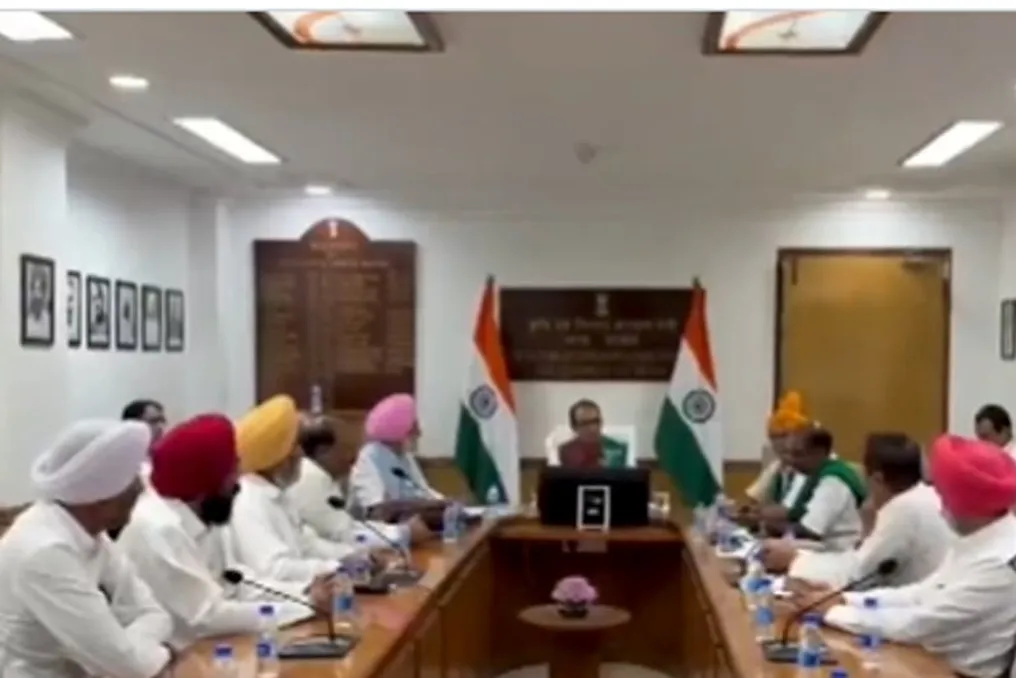
Amid protests against ethanol, the government received support from farmers following a meeting with the Agriculture Minister. The Union Minister of Agriculture, Farmers and Rural Affairs, Shivraj Singh Chouhan, held a meeting with farmers to support the use of ethanol. Farmers stated that ethanol will increase their income and ensure the country's energy security. During the meeting, farmers emphasized that ethanol represents a new opportunity for agriculture.
The All India Kisan Coordination Committee (AIKCC) called for joint cooperation between farmers and the government to refute false narratives regarding ethanol. Farmer representatives from various states informed Union Minister Shivraj Singh Chouhan that the future of the country depends not on gasoline, but on field-derived ethanol.
On Tuesday, while AAP chief Arvind Kejriwal was attempting to march to the Prime Minister's residence against ethanol, AIKCC representatives met with Minister Shivraj Singh Chouhan in support of ethanol. Farmer organizations noted that ethanol is a great chance for agriculture, provided that the policy is farmer-centric and a fair price for the harvest reaches them directly. Minister Shivraj Singh listened carefully to all the farmers' suggestions and assured them that the government would take their views on the ethanol issue seriously. He stated that farmers are like gods to him, and the doors of the agricultural building are always open to them.
Leaders of farmers from across the country gathered at the agricultural building, where they openly discussed the issue of ethanol. At the agricultural building in New Delhi, AIKCC representatives met with Union Agriculture Minister Shivraj Singh Chouhan. The meeting brought together farmers from Punjab, Haryana, Maharashtra, Uttar Pradesh, Madhya Pradesh, Telangana, Tamil Nadu, and other regions. The main focus of the meeting was on ethanol, farmers' income, MSMEs, the market, and national agricultural policy; however, the farmers clearly stated their support for ethanol. They only insisted that the main benefit of this program should go to the farmers, and not just to companies or intermediaries.
At the meeting, farmers clearly outlined their position on ethanol, stating that produce from the fields would not be limited only to markets, but would also reach fuel stations and the energy market, thereby creating a new and more sustainable market for farmers. Obtaining ethanol from sugarcane, corn, rice, and other raw materials would attract more buyers for farmers and reduce problems with crop spoilage or storage.
Farmers stressed that they fully support ethanol and are not against it, but it is crucial that farmers receive a fair price for any harvest, whether it is corn or sugarcane. Farmer representatives expressed a desire for ethanol policy to become a new path for agriculture, rather than a source of new problems for them. They stated, 'We are with ethanol, if ethanol is with us.'
Some farmer leaders at the meeting mentioned that disinformation is being spread on social media and some platforms under the guise of ethanol. Rumors are circulating that ethanol damages cars or harms farmers. Farmers demanded that the Ministry of Agriculture and farmer organizations jointly clarify which crops will benefit from ethanol and how to transition from water-intensive crops to less water-demanding crops. They also noted the need to demonstrate the true picture of ethanol to the youth through short videos and local gatherings.
Union Agriculture Minister Shivraj Singh Chouhan constantly listened attentively to the farmers, asking questions to understand the ground situation. He stated that the central government's goal is clear: the benefit of the ethanol program must cover the entire chain, from the field to the fuel tank, but the largest share must go in the interest of the farmer. Shivraj Singh Chouhan noted that ethanol will strengthen the country's energy security and improve the financial condition of farmers. He emphasized that their priority is the absence of injustice towards any crop or state.
Shivraj Singh Chouhan assured that the policy would be revised to maintain a balance of prices and demand for corn, rice, sugarcane, and other raw materials. Decisions would be made considering the interests of farmers, especially those growing corn. Responses to negative narratives would be based on scientific research and technical reports, as well as dialogue with farmers based on facts.
At the end of the meeting, AIKCC representatives reported that they would convey to rural farmers the message that misconceptions about ethanol will be dispelled based on facts and practical experience, and the policy development process would be strengthened in partnership with the government in the interest of the farmers. Shivraj Singh Chouhan also made it clear that farmer organizations are not opponents of the government, but its partners in policy development. He concluded that they had listened carefully to the farmers' views on ethanol, and now their task is to create a structure that strengthens the farmer, the country, and energy simultaneously.
The delegation included farmers from various states, including the national president of AIKCC and Bhupinder Singh Mann, former MP from the Indian Farmers' Union (MAN), as well as national vice-presidents of AIKCC and the chairman of the National Association of Farmers Producers.