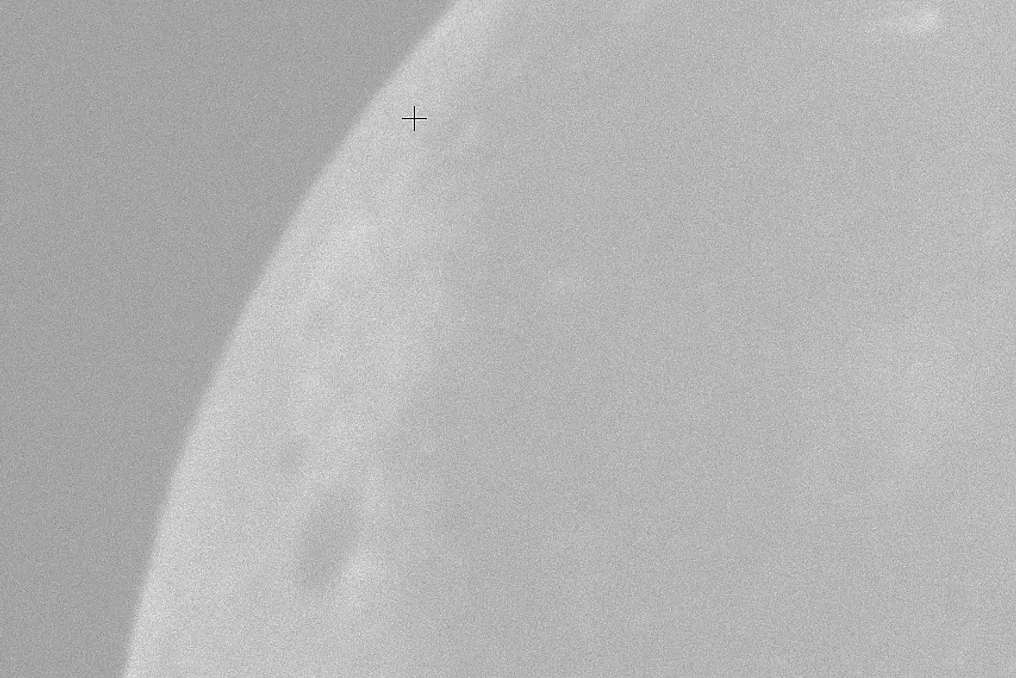
A SpaceX rocket fragment that has been in space since last year was expected to collide with the Moon at high speed on Wednesday. The Al-Khatem Observatory in the UAE attempted to record the consequences of this impact on the lunar surface.
Astronomical calculations indicated that the upper stage of the SpaceX Falcon 9 rocket was scheduled to impact the lunar surface on August 5, 2026, at 06:34:31 UTC. This object was launched as part of a mission on January 15, 2025, during which the Falcon 9 rocket delivered two lunar landers—the American Blue Ghost and the Japanese Hakuto-R—to trajectories near the Moon.
After the two spacecraft were placed on their trajectories, the rocket's upper stage separated and remained in a highly elongated near-Earth orbit, influenced by the gravitational forces of the Earth and the Moon, as well as solar radiation pressure.
Scientists could not confidently state whether the collision effects would be visible from Earth. Forecasts ranged from observing a brief flash to detecting a cloud of dust and rocks ejected during the impact, or no visible consequences at all, with the latter considered the most likely outcome.
Nevertheless, the uncertainty made the event worthy of observation, according to the Astronomy Center. From the Al-Khatem Observatory in Abu Dhabi, the collision was recorded during the daytime, at 10:35 AM local time, when the Moon was only 16 degrees above the horizon. These conditions complicated observation due to the brightness of daylight and atmospheric turbulence, which reduced the clarity of the lunar image because of the object's low altitude.
Estimates suggested that the collision would eject about 450 cubic meters of lunar regolith and rock, equivalent to approximately 1100 metric tons of material, based on an average density of 2.5 grams per cubic centimeter. In the Moon's weak gravity, the material released at the calculated velocity would continue to rise for about a minute, reaching an altitude of approximately 3 kilometers above the lunar surface before beginning to descend and falling back down about a minute later.
Since the collision was expected near the lunar limb (the outer edge or boundary of the visible disk of the Moon as seen from Earth), some ejected particles might have become visible above the lunar limb. However, the maximum angular separation from the lunar disk was estimated to be only 1.5 arcseconds—an extremely small distance that would make detection difficult even with large telescopes.
These calculations depended on numerous assumptions. Some rocks might have been ejected at a significantly higher velocity—possibly up to 300 meters per second, allowing them to remain airborne for three minutes and reach altitudes more than nine times the baseline estimate. Such a scenario would increase the chances of detection. For this reason, observers were advised to point telescopes at the predicted impact site before the event and continue monitoring for several minutes afterward in hopes of spotting a flash or a cloud of ejected material.
The Al-Khatem Observatory directed its main telescope toward the Moon and continuously filmed the impact site from one minute before the predicted collision until five minutes after it. Neither a collision flash nor visible emission of lunar material was detected. Researchers worldwide are now awaiting data from other ground-based observatories and space telescopes that monitored this event to analyze the collision results.
The Astronomy Center shared an image of the Moon two minutes after the impact. The impact site is located on the left edge of the Moon, slightly to the left of the plus (+) marker. They also published a timelapse video of the entire observation session from the observatory, which lasted about six minutes.