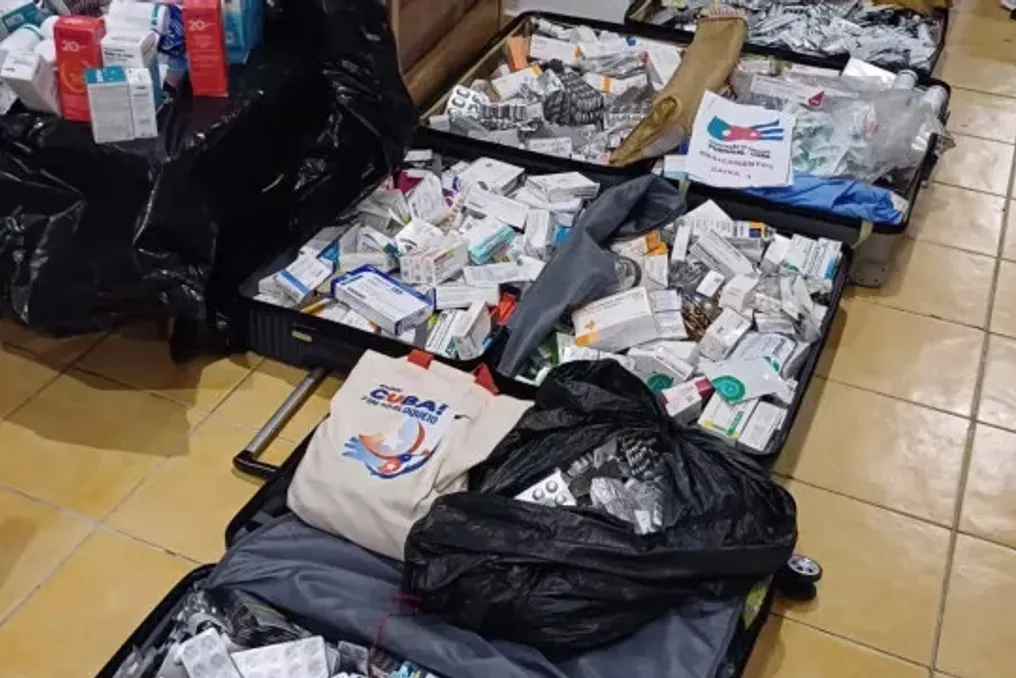
The Vice-President of the Portugal-Cuba Friendship Association, João Terreiro, reported that a group of Portuguese people transported over 150 kilograms of medicines from Portugal to the Calixto Garcia Hospital.
Speaking to Lusa from Havana, João Terreiro detailed that he and six other Portuguese citizens managed this medical support while more than seven thousand containers of humanitarian aid awaited unloading in Cuba.
According to Terreiro, the blockade imposed by the United States prevents shippers from unloading these containers at Cuban ports. He emphasized that although this maritime blockade is not militarized like in the Strait of Hormuz, it is part of a 'war' that has been ongoing for many years.
The association's vice-president mentioned that the blockade against Cuba has persisted for over 66 years, preventing anyone linked to the United States from negotiating with the island.
When questioned about the fear of armed conflict by Cubans, João Terreiro praised the resilience of the inhabitants, stating that for them the war is already underway. He clarified that the war is not limited only to weapons and missiles but also manifests in other forms.
Terreiro, who is a doctor, highlighted that the Health sector is one of the most affected. He pointed out that since the imposition of the oil embargo by Washington, the infant mortality rate in Cuba has doubled compared to the previous year, according to UN data.
He made a comparison with the situation in Gaza, arguing that while bombs are dropped on children there, in Cuba they are suffocated in another way.
The US blockade of the island began after the capture of former Venezuelan President Nicolás Maduro and resulted in the complete interruption of oil deliveries from Caracas to Havana. Although Cuba can extract oil domestically, this production covers only 40% of the island's needs, and the power plants themselves do not receive parts for maintenance due to US sanctions.
João Terreiro described that this constant lack of energy subjects the population to a 'psychological war.' He exemplified that people cannot even keep a refrigerator running, causing food to spoil easily, and the heat prevents them from cooling down or sleeping peacefully.
In addition to the US energy blockade, pre-existing economic sanctions and recent sanctions imposed by the administration of US President Donald Trump are added, affecting companies in the energy sector and hindering Cuba's acquisition of fuel, even for humanitarian purposes.
United Nations Human Rights experts condemned these sanctions and called on the international community and civil society to 'act quickly to prevent Cuba from becoming a 'silent Gaza'.'
For João Terreiro, the purpose of the United States became evident under the Trump administration: to destroy 'the capital of world communism.' He stated that the goal is to end the socialist dream, which he considers a 'danger to American imperialism.'
The island recorded its sixth general blackout this year on Monday, and the power supply was only restored a day later. Cuba has faced a serious economic crisis for years, characterized by shortages of fuel, food, and medicine, inflation, and frequent power cuts, a situation that the Cuban government attributes mainly to US sanctions. Washington justifies the pressure on Havana by citing the human rights situation and the lack of political reforms on the island.