Ather Energy, the first listed next-generation company in the Indian electric motorcycle sector, has announced achieving a positive Earnings Before Interest, Taxes, Depreciation, and Amortization (EBITDA) margin. This result marks an important milestone for an industry that has long prioritized growth over profitability.
In the quarter from April to June, the Bangalore-based company demonstrated an EBITDA margin of 0.8 percent, a significant improvement compared to the negative figure of 15.7 percent the previous year. Total revenue grew by 87.2 percent year-over-year (Y-o-Y) to 1,260 crore rupees, while net loss decreased from 178 crore to 51 crore rupees.
This success coincides with the acceleration of electric vehicle (EV) adoption across the country. According to a JMK Research & Analytics report, EV registrations in India increased by 63.18 percent in July 2026, reaching 307,752 units. Electric motorcycles remained the largest segment of the market, accounting for 61.37 percent of all registered EVs that month.
Significance of Ather's Achievement
As demand grows and manufacturers focus more on cost reduction, localization, and production efficiency, Ather's results raise a broader question: can pure-play Indian EV manufacturers finally reach a point where scale allows for sustainable profit generation? However, it is first necessary to understand why Ather's achievement matters, given the high fixed costs associated with building EV infrastructure.
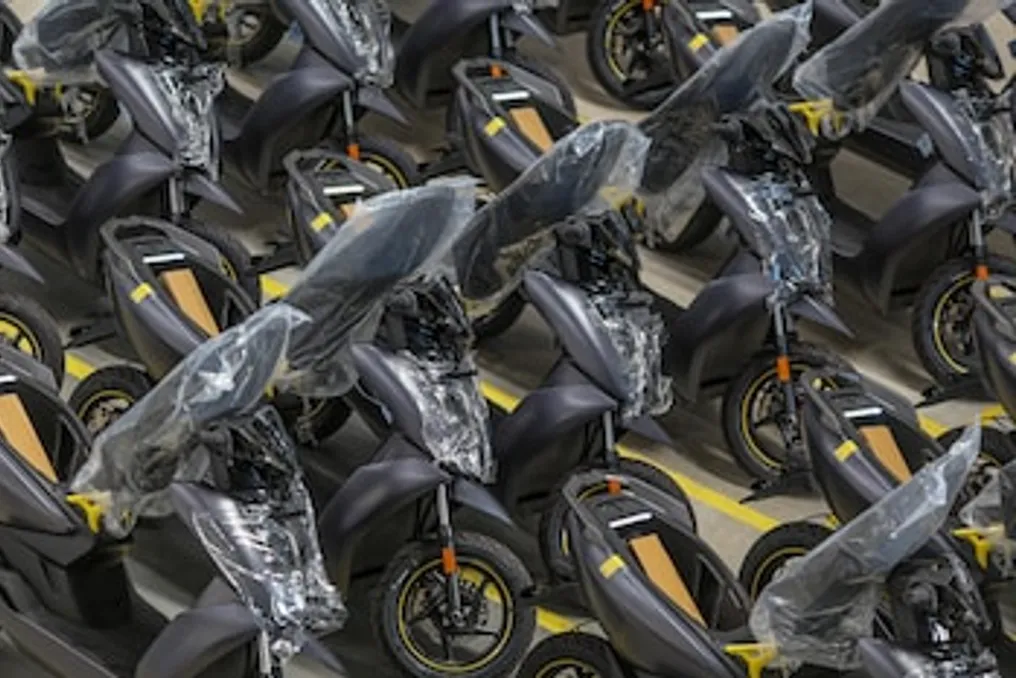
According to company documents, during the period from April to June of FY27, Ather delivered over 83,000 electric scooters, exceeding the growth of more than 80 percent compared to the same period last year, with consolidated revenue reaching 1,260 crore rupees. Simultaneously, EBITDA became positive at 9 crore rupees, whereas the operating loss was 106 crore rupees the previous year.
In FY26, Ather had already managed to reduce its annual EBITDA margin to a negative 6.7 percent from a negative 23 percent in FY25, as revenue grew to 3,823 crore rupees, and vehicle sales increased by 69 percent to nearly 263,000 units.
Nevertheless, it should be noted that a positive EBITDA does not mean the company has become profitable in the traditional sense. EBITDA focuses on the profitability of the core business, excluding financing costs, taxes, and non-cash accounting charges such as depreciation. For manufacturing companies like EV makers, depreciation can be substantial due to large investments in factories, equipment, battery technology, tooling, and product development. Consequently, a company can show positive EBITDA while still recording a net loss, which is Ather's current situation.
Despite this, investors are closely watching EBITDA as it serves as one of the clearest indicators of whether a high-growth manufacturing business is moving toward financial self-sufficiency. A sustained improvement in operating margins indicates that higher production volumes are beginning to cover fixed costs, allowing each additional vehicle sold to contribute more to profitability.
In the case of Ather, management attributed this improvement to a combination of strong demand, adjusted price increases, a better product portfolio, supplier negotiations, and cost engineering initiatives that helped offset rising raw material costs. During the earnings call, Tarun Mehta, co-founder and CEO of Ather Energy, stated: 'Recognizing the strong demand for our products, we were able to control fixed costs very tightly, especially marketing and sales, and achieve our first positive quarterly EBITDA.'
Balancing Scale and Positive Operating Cash Flow
In the early stages, EV manufacturers incur high fixed costs on a relatively small number of vehicles. Investments in factories, engineering teams, software development, charging infrastructure, dealer networks, and product development meant that each scooter carried a high overhead burden. As production increases, these costs are distributed over a larger number of vehicles. Economists call this operating leverage, where revenue grows faster than fixed costs, allowing margins to improve.
It appears this is happening with Ather. In its FY26 annual report, the company noted that FY26 was the first year when 'scale and financial discipline began to mutually reinforce,' enabling it to generate positive operating cash flow while continuing to invest in production capacity, research and development, and future platforms.
Ather's non-vehicle revenue, including subscriptions for software, charging, accessories, spare parts, and services, grew to 14 percent of operating revenue compared to 13 percent the previous year. The AtherStack Pro subscription also maintained a stickiness rate of 94 percent, and the best mix of premium options helped increase the average selling price.
EV manufacturers traditionally relied on imported batteries, electronics, and other components, exposing them to currency and supply chain risks. Ather states that it has diversified sourcing, increased vertical integration, and ensured flexibility in battery chemistries. During the June quarter, the company also utilized supplier negotiations, cost engineering, and price increases to compensate for higher raw material costs.
How Are Other e2W Players Doing?
Ather's positive EBITDA raised the question: if one next-generation electric motorcycle manufacturer has demonstrated the achievability of operational profitability, how far away are its competitors from reaching the same goal?
Unlike Ather and Ola Electric, traditional manufacturers such as TVS Motor, Bajaj Auto, and Hero MotoCorp are not solely dependent on electric vehicles for profit. Their traditional internal combustion engine (ICE) businesses generate healthy cash flow, allowing them to invest in EVs without requiring immediate profitability from the electric business itself.
Ola Electric
Ola Electric, another listed pure-electric motorcycle manufacturer, is still working towards profitability. The company continues to invest in production, battery manufacturing, technology, and new products. In Q4 of FY26, operating revenue fell by 57 percent year-over-year to 265 crore rupees, while its net loss decreased to 500 crore rupees. For FY27, the company stated that its priorities include volume recovery, reducing operating expenses, scaling up its Gigafactory, and transitioning a larger portion of its fleet to proprietary battery cells. It expects orders to nearly double sequentially to approximately 45,000 units in Q1 of FY27 and aims for positive adjusted operating EBITDA and free cash flow for its automotive business during FY27.
TVS Motor
TVS Motor occupies a completely different position. In Q1 of FY27, the company reported standalone EBITDA of 1,779 crore rupees, which is 41 percent higher year-over-year, with an EBITDA margin of 12.8 percent, and standalone net profit grew by 51 percent to 1,174 crore rupees. At the same time, electric motorcycle sales reached a record 130,000 units for the quarter. This gives TVS an advantage in scaling its EV business using an established manufacturing, supply, and distribution network, while its broader business continues to be profitable.
Bajaj Auto
Bajaj Auto also benefits from scaling EVs within an already profitable automotive business. In Q1 of FY27, EVs, including the Chetak electric scooter and three-wheeled electric vehicles, accounted for about 30 percent of Bajaj Auto's domestic revenue for the quarter. Its standalone operating revenue grew by 37 percent year-over-year to 17,244 crore rupees, and EBITDA increased by 45 percent to 3,596 crore rupees, bringing the EBITDA margin to 20.9 percent from 19.7 percent the previous year. Standalone net profit grew by 42 percent to 2,983 crore rupees. Demand for Chetak also exceeded supply, prompting the company to increase monthly production capacity from 50,000 to 60,000 units.
Hero MotoCorp
Hero MotoCorp is rapidly scaling its electric business while its profitable traditional two-wheeler business absorbs the costs of this expansion. The VIDA series showed 152,000 retail sales in FY26, almost three times more than the previous year. In June alone, registrations reached 21,812 units, an 185 percent year-over-year increase. Nevertheless, Hero's investments in EVs continue to put pressure on margins. In Q4 of FY26, the company spent about 220 crore rupees on the EV business, while its core ICE business showed an EBITDA margin of 17 percent.
Overall, growing demand, better utilization of capacity, localization, and new revenue streams are creating conditions under which operational profitability is becoming more attainable. The more complex challenge now is whether Ather can sustain this performance and move from positive EBITDA to net profit, and whether other pure-play EV manufacturers can follow suit without sacrificing growth. For established players like TVS, Bajaj, and Hero, the task is to turn fast-growing EV businesses into a significant contribution to profit. After many years when the EV race in India was mainly about volume and market share, the next phase will increasingly be judged by who can translate that scale into profit.