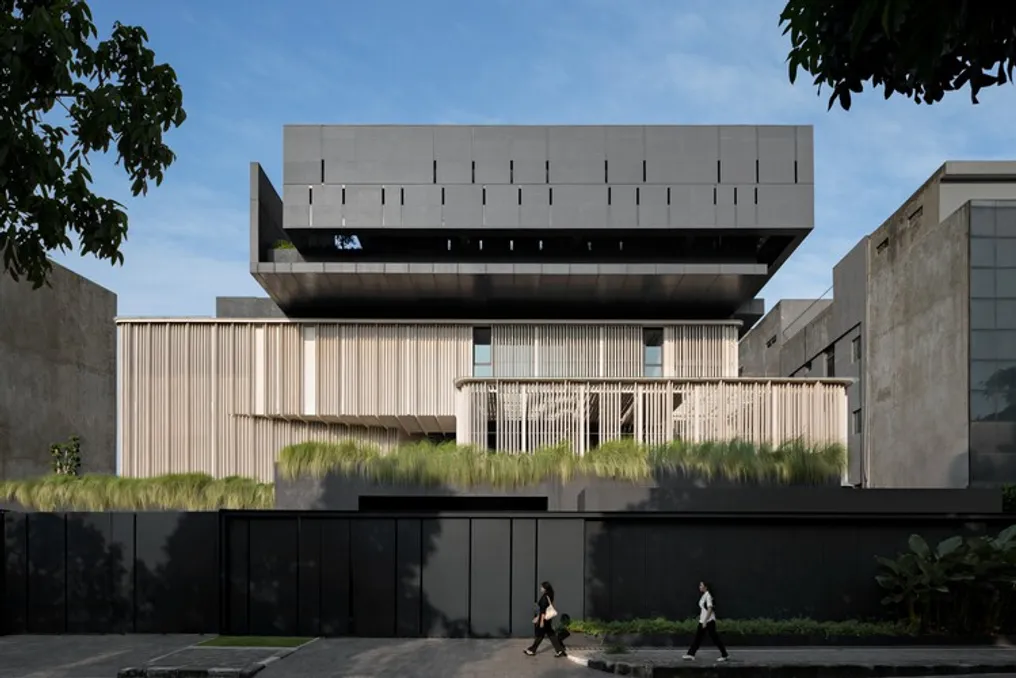
The design team presented the CMM (H)Office, a structure that consolidates three distinct architectural programs into a single, integrated location for CMM, a telecommunications and security company located in South Jakarta.
The design team presented the CMM (H)Office, a structure that consolidates three distinct architectural programs into a single, integrated location for CMM, a telecommunications and security company located in South Jakarta.
This building was conceived as a direct response to the evolution of the company's operational model, renewing the traditional office typology by blending workspaces, storage, and living functions in a hybrid and flexible setting.
Unlike the previous headquarters, the new facilities incorporate an on-site warehouse and private rooftop annexes, establishing a multifunctional space that values both efficiency and adaptability.
Contrary to conventional office buildings, which are often restricted by formal hierarchical structures, the CMM (H)Office promotes a dynamic environment where work, storage, and personal life activities meet fluidly.
The central element of the project lies in its resort atmosphere: a workspace meticulously planned to aid focus, collaboration, and rest. Nature is not merely a backdrop but an active component of the design, interacting directly with the workflow and spatial experience.
This mutual relationship between the building and the landscape supports both well-being and productivity, defining a new standard for offices that is complex in terms of programming and focused on the human being.
The system for protecting human rights has been strengthened by the National Center of the Republic of Uzbekistan. Information was provided about the work to be carried out under this system in the first half of 2026.
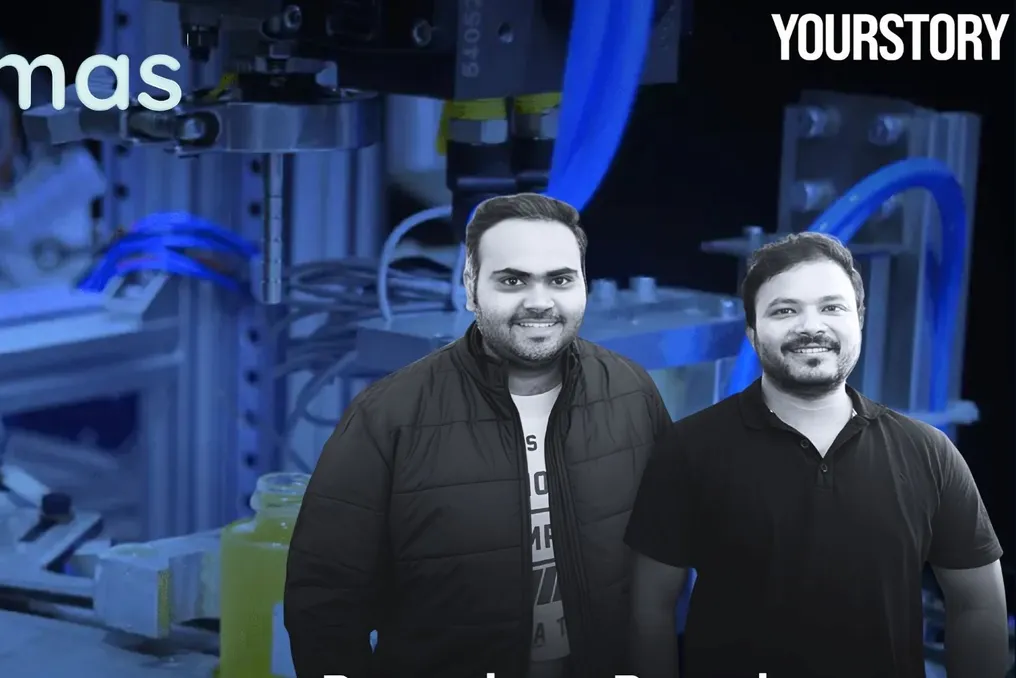
Leumas offers a solution for brands that do not wish to invest in building their own factory by providing them access to modular robotic production lines as manufacturing capacity. This allows companies to produce small batches as needed, while avoiding limitations associated with contract manufacturing, such as adherence to schedules and minimum batch sizes.
The company's founders are CEO Nitesh Kumar and CTO Subhadjit Biswas. The company is based in Bengaluru. Leumas calls its platform 'cyber-physical' because the production lines are reconfigured programmatically, not manually. These lines integrate robotics, camera-based quality control, and autonomous operation.
The design principle is based on modularity. Unlike traditional lines built for a specific product, Leumas' lines can be reconfigured between different batch sizes, product mixes, and formats. This enables a brand to release one hundred units of a new product without halting the entire factory.
This approach has two direct advantages. Firstly, traceability is ensured because the software-controlled line records all its actions, which is critical for pharmaceuticals where it is required by regulators. Secondly, the lines can operate continuously with minimal human involvement, which the company calls unmanned operation.
The offering is implemented in two formats: on-demand manufacturing, where the brand acquires capacity as needed, and dedicated production complexes configured for a single client. Both options give the brand access to the line without the need to own it.
Leumas' services target the food, cosmetics, and pharmaceutical sectors, which share common regulatory requirements and tend to launch many products in small batches. This is especially relevant for direct-to-consumer brands whose lines are retired faster than a traditional factory can reconfigure.
The company reports that over the past year, it has helped scale more than 120 products for wellness brands in the markets of India, the USA, and the Middle East and North Africa. Furthermore, agreements have been made with pharmaceutical and food industry research institutes to create specialized production capacity, which will provide access to both formula development expertise and production volume.
In June 2025, Leumas raised $2.2 million (approximately 19 crore rupees) in a seed round led by Capital 2B with participation from Capital-A and Anicut Capital. Previously, in 2023, the company raised 7 crore rupees in a pre-seed round from the same group of investors. These funds are intended for research and development, expansion of production infrastructure, and launching pilot plants for wellness and pharmaceutical brands.
Leumas is targeting the outsourced manufacturing market, which, according to the company and its investors, is projected to exceed $400 billion globally by 2030, although this forecast is not supported by independent sources. It should be noted that Leumas has not disclosed client names, financial figures, or the exact number of operating lines; the figure of 120 products reflects activity, not scale, and the pilot plants funded by the round are still in the planning stage.
The UAE Ministry of Finance has announced the adoption of a new decision that establishes a minimum excise price for liquids used in electronic smoking devices and tools. This step is part of efforts to strengthen compliance with the excise tax regime in the country.
According to this decision, the minimum excise price will be 1 dirham per milliliter for all liquids intended for e-cigarettes. This rule will take effect on September 1, 2026.
Meanwhile, existing minimum excise rates for cigarettes, shisha tobacco, ready-made tobacco products, and similar goods will remain unchanged. The Ministry explained that the goal of this decision is to align with market changes in the field of excise goods and ensure uniform application of standards across all categories of tobacco and electronic products.
Furthermore, it was noted that this measure contributes to increasing tax discipline and helps limit practices that could negatively affect the effective application of excise tax. Currently, the UAE levies an excise tax of 100 percent on all tobacco products subject to the excise regime, while the new decision exclusively concerns the minimum price threshold for calculating tax on electronic liquids.