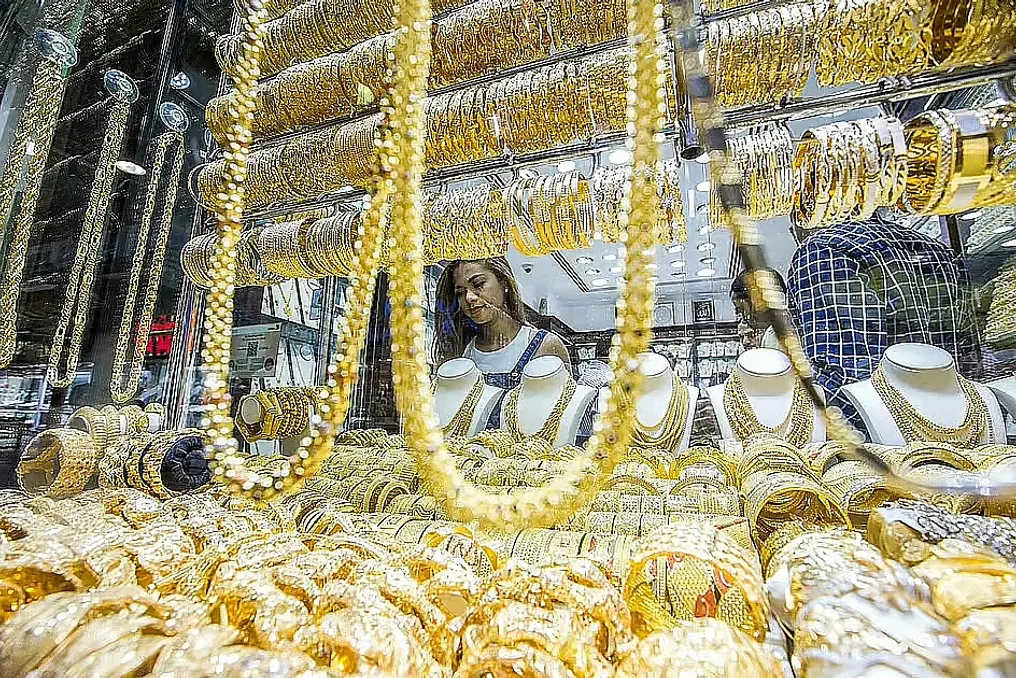
Gold prices in Dubai continued to rise on Wednesday morning, showing steady growth as the 24-karat sample approached the 500 dirham mark per gram.
Gold prices in Dubai continued to rise on Wednesday morning, showing steady growth as the 24-karat sample approached the 500 dirham mark per gram.
At the start of trading on Wednesday, the 24K sample traded at 496 dirhams per gram, which is higher than the 492.25 dirhams recorded at the close of trading on Tuesday. Other varieties of the yellow metal—22K, 21K, 18K, and 14K—also showed an increase, reaching prices of 459.25, 440.25, 377.50, and 294.25 dirhams, respectively.
The price of gold on the spot market was $4134 per ounce, up 0.96%. Silver traded at $60.73, showing a rise of 1.18%.
Analysts note that sentiment towards gold is improving after several weeks of reduced activity. However, according to Vijay Valechi from Century Financial, the lack of a growth impulse prevents prices from making a significant leap upwards.
Valechi explained that leading banks have not changed their long-term optimistic forecasts, predicting that gold will recover to the $4500–$5000 per ounce level within the next few quarters. He added that it is unlikely the market will see a strong gold rally solely based on official demand.
Although central bank purchases of gold remain high, they are significantly lower than the record purchases of 2024. In Valechi's opinion, the real gold boom will likely occur when the market starts factoring in a softer stance from the Federal Reserve.
In the short term, attention will be focused on US job vacancies, and any relative weakness in the labor market will be a favorable factor for gold prices. On the other hand, a resilient labor market may 'prevent the Fed from easing policy, keeping the dollar strong and putting pressure on gold prices.'
He also noted that gold is in a consolidating pattern: buyers are trying to push prices back above the $4150 level, but prices continue not to reach new highs. Buyers successfully defended support at $4000 for several consecutive sessions and managed to raise prices back to $4060. A breakthrough above the $4100 level will be required to move the market higher, but failure to hold above $4000 will open the next support level at $3960.
Gold prices in Dubai continued to trade below the 500 dirham mark for the second consecutive week. On Monday morning, the price of the precious metal fell by 3.25 percent. Meanwhile, gold dropped almost 25 percent compared to January highs.
At the opening of markets on Monday, August 3, 24-karat gold traded at 489.75 dirhams per gram, which is below the level of 495.50 dirhams recorded on Friday. Other options, such as 22K, 21K, 18K, and 14K, cost 453.50, 435.00, 372.75, and 290.75 dirhams, respectively.
On the global market, the spot price of gold was 4064.34 dollars per ounce, showing a decrease of 0.31 percent. Silver also fell by 0.39 percent, trading at $58.35 per ounce.
Analysts believe that downward pressure on the yellow metal is likely to continue, as rising energy prices increase the probability that interest rates will remain high for an extended period. Over the past month, the precious metal has mainly fluctuated in the range of $3945 to $4160, failing to overcome the immediate resistance level of $4110, noted Vijay Valecha, Investment Director at Century Financial.
Valecha added that the daily 14-period RSI index has not crossed the 50 level since April, indicating a lack of positive momentum. He suggested that a break of the recent support level of $4022 in the current session could trigger a test of lows at $3945, and subsequently $3900. Conversely, only a decisive breakthrough and close above $4160 would signal strengthening bullish momentum.
Regarding silver, it has also remained within a narrow price range between $55.60 and $63.25 over the last month. According to Valecha, a break of the recent support level at $57.14 could lead to testing the lower boundary of the range at $55.60. Otherwise, a breakout and close above $63.25 would signal the formation of bullish momentum in this metal.
He also emphasized that due to rising rates, further pressure is expected on non-yielding metals, which reduces their attractiveness. Valecha explained that according to CME Fedwatch, markets still assess the probability of a rate hike by the end of the year at 84 percent.
Gold prices in Dubai showed a decline on Thursday, following the UAE Central Bank's decision to keep its key interest rate unchanged. This decision came after a similar move by the US Federal Reserve, which opted to maintain rates at their previous level.
At the opening of trading on Thursday, 24-karat gold in Dubai traded at AED 487.50 per gram, lower than the AED 491.50 recorded at the close of markets on Wednesday. Other purity options—22K, 21K, 18K, and 14K—cost AED 441.50, AED 432.75, AED 371, and AED 289.25, respectively.
Globally, the price of gold futures rose slightly by 0.12 percent, reaching $4044.99 per ounce, while silver dropped by 1.07 percent to $57.19 per ounce.
The UAE Central Bank kept its base rate at 3.65 percent on Wednesday, which fully aligns with the US Federal Reserve's decision to keep the target range for federal funds within 3.5%–3.75%. The UAE typically follows US monetary policy because the dirham is pegged to the dollar.
Despite the Fed not changing interest rates, regulatory representatives maintained a cautious tone, noting that inflation risks remain despite the recent slowdown in growth.
Nick Spencer-Skin, Senior Executive Director at Lunaro Markets Limited, noted that June economic data confirmed the Federal Reserve's decision to leave rates unchanged. He explained that core inflation decreased to 2.6% year-on-year, and the number of hired workers was only 57,000 against a forecast of 114,000. However, he added that the possibility of rate hikes remains due to the June 'dot plot,' where half of the Committee still anticipated at least one hike this year, as well as due to the sharp rise in oil prices during the escalation of hostilities, which casts doubt on inflation improvement.
Vijay Valecha, Chief Investment Officer at Century Financial, agreed that the Fed's decision to maintain rates was consistent with the latest economic data. He emphasized that the June inflation figures were weaker than expected, and the labor market does not show signs of overheating, supporting the arguments for maintaining the current rate level. Valecha added that the current economic indicators are more favorable than those presented to the Fed in June, and it would be unusual for the Fed to react to such data by raising rates at the July meeting, especially since it refrained from doing so in June.