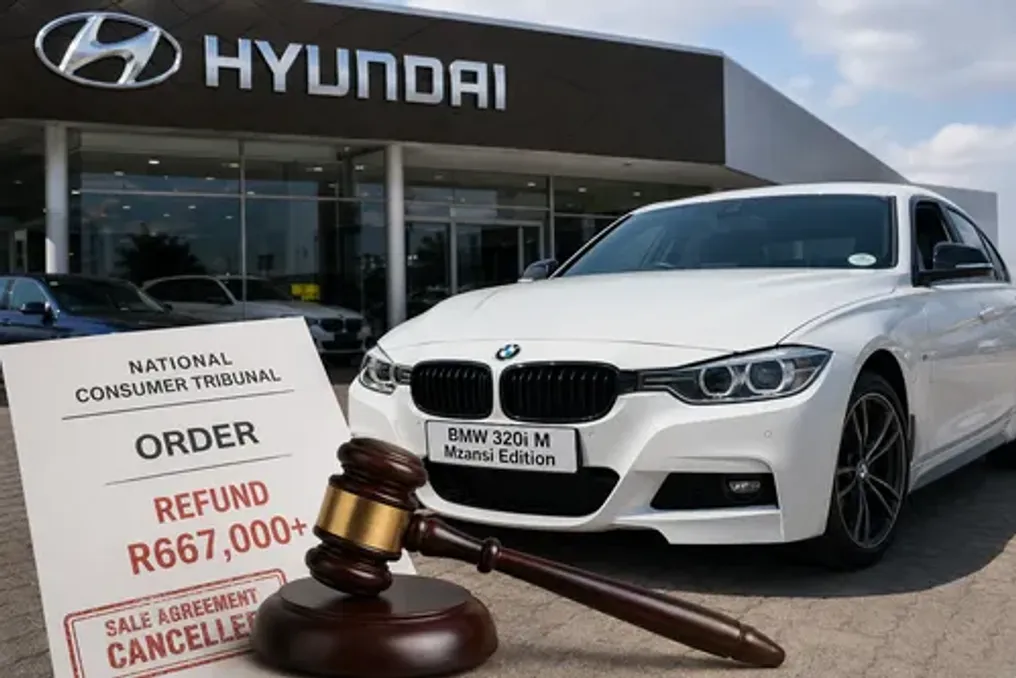
The Hyundai dealership in the Gauteng province failed in its attempt to overturn a court ruling that requires it to refund a client over 667,000 rand after selling a BMW vehicle that was falsely presented as an Mzansi Edition model.
The North Gauteng High Court in Pretoria ruled, with Acting Judge K. J. Mogale agreeing with Acting Judge F. Pauw, to dismiss the appeal by Hyundai N1 City. The court upheld the previous decision of the National Consumer Tribunal, finding that the dealer violated the Consumer Protection Act (CPA) by providing false information about the vehicle sold to Sylvester Henry Bartes.
The court also ordered the dealer to cover the appeal costs, leaving the tribunal's decision in force, which annulled the sales contract and required Hyundai N1 City to compensate Bartes with an amount exceeding 667,000 rand.
History of the Dispute
The conflict began in July 2022 when Bartes saw a BMW at the Hyundai N1 City dealership. After inspection and a test drive in August of the same year, he was told it was a BMW 320i M Mzansi Edition. Based on this information, the vehicle was financed and insured, and Bartes paid a deposit of 50,000 rand.
The problem emerged months later when Bartes showed the car to a body shop after minor damage. During the assessment, he learned that some components were not original BMW South Africa parts. He later found out from BMW South Africa that the vehicle was not actually an Mzansi Edition model.
After notifying the dealership of the discrepancy, Bartes demanded either a replacement with a genuine Mzansi Edition or a contribution towards its conversion using authentic BMW parts, valued at more than 352,000 rand. The dealer refused to acknowledge that the vehicle had been incorrectly described.
Dealership's Arguments
Throughout the legal proceedings, Hyundai N1 City maintained that the misrepresentation arose from an administrative error during inventory reorganization. According to the dealership, an incorrect stock code was mistakenly assigned to the vehicle, causing the standard BMW M Sport model to be registered as an Mzansi Edition. They insisted that neither they nor the client knew about the error, and there was no intention to mislead anyone.
The dealer also argued that the Tribunal misinterpreted sections 29 and 41 of the CPA, claiming that liability for false or misleading statements requires proof of intent to deceive consumers. Furthermore, they stated that if the sale was cancelled, the deduction for the use of the vehicle by Bartes should be allowed according to section 20 of the CPA and the purchase agreement.
Court's Decision
The court rejected these arguments. Judge Mogale ruled that the Consumer Protection Act uses an objective standard and does not require the consumer to prove that the supplier intentionally intended to mislead them. The court found that the seller's statements, along with quotations, financial documents, the sales contract, and insurance records, consistently presented the vehicle as an Mzansi Edition, creating a false impression regardless of whether it was intentional.
The court noted: 'The evidence in the case files is clear,' emphasizing that the misrepresentation persisted throughout the transaction and was never corrected, even after the dealer received an inspection report from BMW before the sale was finalized. The judges decided that the dealership's reference to common law principles requiring proof of fraudulent intent was irrelevant, as the CPA was enacted specifically to protect consumers without requiring proof of the supplier's state of mind.
The court also dismissed Hyundai N1 City's argument regarding the right to deduct compensation for Bartes' use of the vehicle before its return. It was established that section 20 of the CPA, which allows suppliers to charge consumers for the use of returned goods under certain circumstances, applies primarily when the consumer voluntarily returns the goods, not when the supplier violates the law through deception. The court stated that allowing the dealership to charge for use would effectively allow it to profit from its own illegal conduct.
Judge Mogale concluded that Bartes returned the vehicle solely due to the dealership's legal violations, not because he simply changed his mind. The court ruled: 'The appropriate remedy is the restoration of the parties to the position they would have been in had the deception not occurred.' In conclusion, the High Court found that Hyundai N1 City's actions constituted false, misleading, and deceptive marketing in violation of the Consumer Protection Act. The appeal was dismissed with costs awarded, and the tribunal's ruling from October 2024 was fully confirmed.