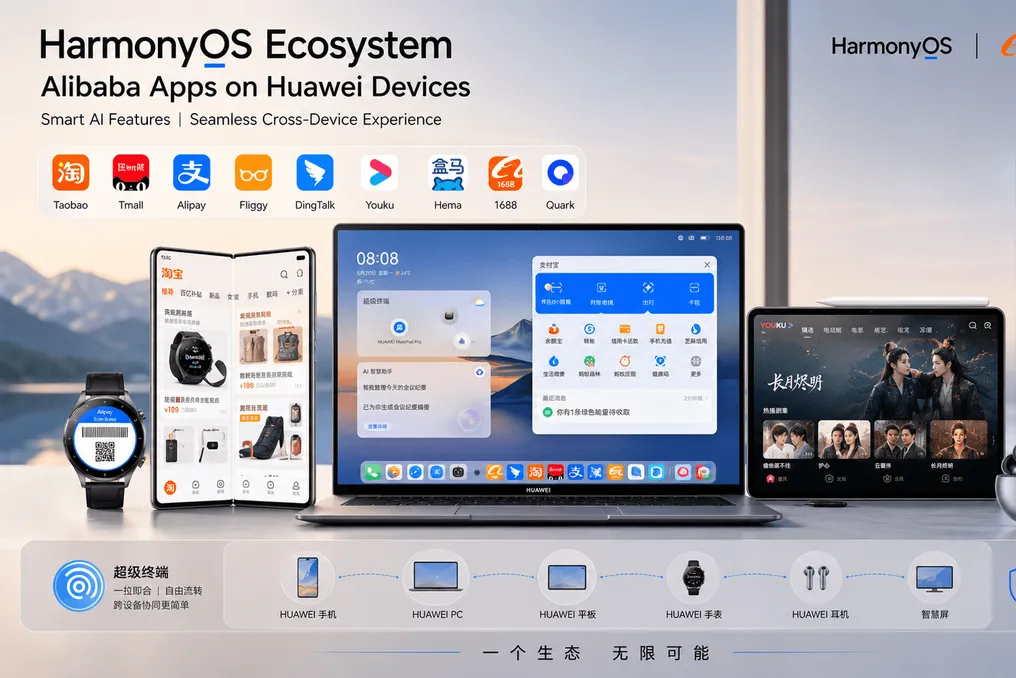
Alibaba has integrated over 50 innovative functions native to HarmonyOS into more than 20 applications in the first half of 2026. This move signifies a shift from simple application adaptation for compatibility to the active utilization of Huawei's system capabilities to enhance user experience.
Overview of Implemented Applications
The deployment covers a range of applications such as Amap, DingTalk, UC Browser, Taobao, Xianyu, Quark, Qianwen, Fliggy, Alibaba Cloud, Damai, 1688, Taobao Deals, Youku, Tmall Car Care, Fengniao Rider, and others. These applications belong to various sectors, including navigation, office tools, e-commerce, content, and local services.
Innovations in Transport and E-commerce
The Amap application leads in the transport category, offering HarmonyOS-specific live windows for walking and cycling navigation displayed on the lock screen and status bar. It also includes real-world AR navigation for foldable devices and proactive trip alerts via the trainable intelligent agent XIAOYI. The Fliggy Travel application allows users to search for destinations by voice using an intent framework, requiring minimal steps. In e-commerce, the Damai AI Maibao agent enables purchasing movie tickets with a single voice command through XIAOYI, while the 1688 agent processes corporate information requests. Xianyu achieves recommendation response times in milliseconds thanks to the intent framework. Taobao and Dian Tao adapt immersive browsing for tablets and foldable screens with adjustable display columns, while Taobao Deals ensures seamless content transfer between devices.
Deep Integration into Content and Office Tools
Content applications deeply leverage HarmonyOS capabilities. Quark and UC Browser utilize the smart card function to exchange content segments in card format, accessible to other users via QR code scanning. Qianwen uses a unified drag-and-drop function, allowing users to move images or text from any application interface directly into Qianwen for cross-application AI analysis, eliminating the need for traditional copy-pasting. The integration of the Qwen agent demonstrates the concept of AI as a system capability rather than just an isolated application feature.
Office productivity in DingTalk is achieved through deep system integration via the intent framework, service cards, wireless projection, and screen casting. Users can initiate DingTalk meetings with a single voice command through XIAOYI, while schedules and tasks are constantly displayed as service cards on the desktop, and meeting content is cast to large screens with one tap. Alibaba Cloud supports service cards, unified link navigation, and TaskPool for lightweight cloud resource management. This office integration shows how HarmonyOS AI system capabilities can transform enterprise workflows.
Specialized Features and Ecosystem Optimization
Specialized applications benefit from native HarmonyOS features. Tmall Car Care integrates Huawei's single sign-on and system calendar synchronization for maintenance scheduling. The video service Youku launches an AI agent for drama recommendations with a single command, selection, and actor information search. Fengniao Rider and Fengniao Courier, the most frequently used courier applications, simultaneously integrate six system capabilities: scanning, smart image selection, TaskPool, HarmonyOS vibration, security camera, and secure location, as well as AI reading. The deep embedding of features across Alibaba's diverse application portfolio indicates that HarmonyOS has moved from building an ecosystem to optimizing it, where existing applications are reimagined using native OS capabilities rather than simply being ported for compatibility.